OBEX, 2025.
Directed by Albert Birney.
Starring Albert Birney, Callie Hernandez, Paisley Isaacs, Frank Mosley, Tyler Davis, Paul Oh, Gloria Probably, Nate Krimmel, and Nicholas Gurewitch.
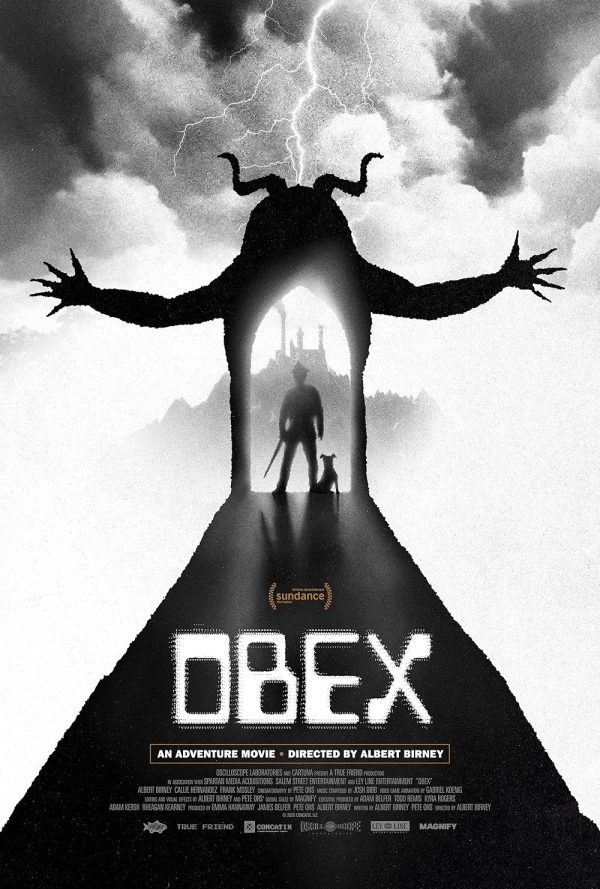
SYNOPSIS:
Conor Marsh’s secluded life is disrupted when he plays OBEX game. His dog Sandy disappears, blurring reality and game. Conor enters the OBEX world to rescue Sandy, navigating its strange realms.

In co-writer/director/star Albert Birney’s 1980s-set beautifully monochrome OBEX, loner computer guru and ASCII artist by trade Conor Marsh (Birney, unquestionably dorky but genuinely endearing since his personality type isn’t played for cheap laughs), speaking to his beloved dog Sandy (quite literally man’s best friend in this situation), theorizes that one day everyone will be obsessed with technology, living in their devices. This is also the kind of proselytizing that is downright eerie to listen to in the year 2026 (or 2025 where the film premiered at Sundance), with the film certainly showing concern that this man never leaves his home and essentially can’t function in the outside world (whether or not he has a diagnosis regarding anxiety or agoraphobia is unsurprisingly not made clear given the era and such stigmas around such conditions), relying on his neighbor Mary (Callie Hernandez) to deliver some weekly groceries kindly. However, it is equally interested in the positive effects screens can have, and uninterested in punching down on Conor’s lifestyle.
From a filmmaking standpoint, Albert Birney (writing alongside Pete Ohs) takes a similar approach to this low-budget yet visually remarkable monochrome story involving a radical computer game, the eponymous OBEX, that encourages users via newspaper advertisements to record themselves on tape answering a series of questions and doing several specific poses, preferably ones with dogs, to then mail in that VHS tape. They will then be sent a copy of the game with their likeness inserted into the virtual landscape.

Naturally, this technology is severely limited to one screen, where all Conor can do is move his avatar around the outside of the castle doors and interact with Sandy, also digitized, with preset poses and text boxes. Suffice it to say, it’s a letdown for a game selling itself as a fantasy epic where the hero must take down a demonic entity dubbed Ixaroth, which curiously sounds like the name of Final Fantasy VII villain Sephiroth.
Perhaps it is a mere coincidence, but the filmmakers do demonstrate knowledge and reverence for that timeless era of gaming, evoking the visual language of everything from Final Fantasy to The Legend of Zelda to old-school point-and-click adventures and more once Conor is sucked into the dangerous world for real (now with a disheveled look and large beard) and forced to confront his fears of the outside world to save Sandy from Ixaroth. As reality and fantasy further blend, it’s also evident that Conor is working towards potentially making peace with an unprocessed, tragic past, as we come to understand why screens and even specific TV programs provide a security blanket.

Admittedly, some of that is a bit sluggishly set up in a first-half that could stand to move slightly quicker and get Conor into the fantasy world, where the filmmaking also gets to truly flex inventive imagination (there is a cut to a turn based combat system during a pivotal battle that is, yes, nostalgically satisfying, but also genius regarding blending the two mediums serving a narrative purpose). Mary also appears on screen in the fantasy realm as the standard RPG inn/shopkeeper offering rest and healing potions, somewhat evoking one of those fairies from the Zelda franchise. However, the film is less successful at finding a meaningful dynamic here or one as emotionally investing as a man battling his anxieties and fears to save his dog.
That’s what OBEX mostly is: a fantastical adventure inside screens and across a fantasy realm that has more on its mind than adoration for that style, but rather the role screens can play to anyone and a man’s personal journey to conquer his limitations in the real world. There is no question that there are some frustrating pacing issues in that first half, but almost everything inside the fantasy world (including an amusing humanoid sidekick with a TV screen for a head played by Frank Mosley, speaking like a companion that would follow you around in a Fallout game) is wondrous and winsome, propelling the game and life quest forward with everything from humor to excitement and even moments of unexpectedly startling horror. Above all else, it’s bound to generate fascinating discussions about screens, technology, and their pros and cons in an ever-changing world.
Flickering Myth Rating – Film: ★ ★ ★ / Movie: ★ ★ ★ ★
Robert Kojder