Carousel, 2026.
Written and Directed by Rachel Lambert.
Starring Chris Pine, Jenny Slate, Abby Ryder Fortson, Sam Waterston, Katey Sagal, Heléne Yorke, Jessica Harper, Kulani Kai, Sarah Ann Mayer, Dalton Rimbert, and Jeffrey DeMunn.

SYNOPSIS:
Noah’s settled life caring for his anxious daughter and medical practice is disrupted when his high school ex Rebecca returns. Their old spark remains, making them question if love deserves another chance.
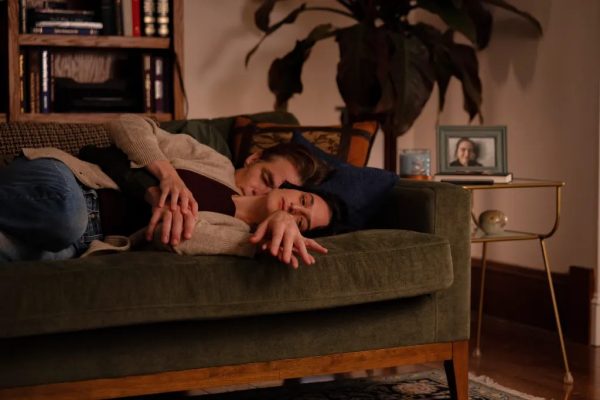
Roughly halfway into writer/director Rachel Lambert’s Carousel, there is an explosive verbal argument between former lovers who have rekindled their relationship, stemming from an unexpected incident and an emotional outburst involving a teenage daughter. Shot from afar in another room looking into the kitchen, it’s the type of heated sequence that is not only fly-on-the-wall engrossing, but boasts dialogue and cutting retorts that finally start piercing through into what this film is about and why these characters are the way they are, and how they should try changing for the better. It’s also a window into other strengths Chris Pine has as an actor, with Jenny Slate once again getting to flex her impressive dramatic chops.
Keep in mind that this comes almost halfway through the film, and much of what precedes it feels borderline aimless. There are also stylistic directing choices, such as janky editing that jumps back in time to run through a character’s solo perspective before returning to a connective story point. Apparently, the title Carousel has something to do with the small-town Cleveland surroundings, but in narrative terms, it resembles the discombobulating, clumsy back-and-forth of shifting focus between one character’s arc and another, sometimes going in reverse or pushing the plot forward.

There is also a third wheel to that in the previously mentioned teenage daughter (a terrific Abby Ryder Fortson as a bundle of anxiety that could detonate into rage the second something doesn’t go as planned, a product of family dysfunction and being the child of divorced parents), who arguably could have elevated the entire narrative by functioning as the lead, considering there are several other characters here (wasting recognizable and always welcome talent in the process) and she is usually within the vicinity of one of them. Her perspective comes across as vital, yet it’s shortchanged here.
Instead, Carousel is about Chris Pine’s Noah, a doctor who cares a little bit too much about everyone around him, including earthworms in his driveway that could be stepped on or driven over. It’s the classic and corny occupational metaphor for what this person is really about, how a divorce has emotionally hindered him, and to suggest that he needs to be less of a helicopter and let people, especially his daughter, on the verge of adulthood, live their own lives without overwhelming worry. There is also a subplot and other characters, involving the tiny medical clinic he works at potentially going under, but not much is compelling about that.

Jenny Slate’s Rebecca has returned to this town after an unfulfilling job in Washington, DC, and is now working as the debate team coach, which includes Noah’s daughter, Maya. Noah and Rebecca once dated before he got married and divorced. Sparks are still there, but the question then becomes, is Noah too emotionally stunted to give himself over to love again?
With far too many dreamlike montages of characters living their lives, some true messiness in the script (not in the characters, but in how these people sometimes relate to one another), and perspective problems, Carousel gets stuck. It only really gets going when Chris Pine and Jenny Slate are letting out their emotions, or when it occasionally lets Abby Ryder Fortson take center stage. These highs are almost enough to make the film work narratively, but it is also too structurally flawed and meandering at times.
Flickering Myth Rating – Film: ★ ★ ★ / Movie: ★ ★
Robert Kojder