Adam Page explores the controversy surrounding the notorious Cannibal Holocaust and the prosecution of its director Ruggero Deodato…
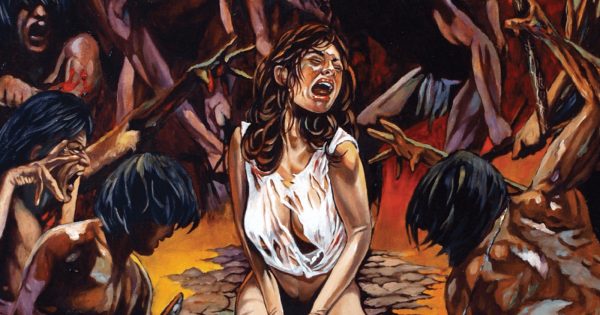
There is a certain species of moviemaker. One who confuses provocation with profundity, who mistakes the gag reflex of the audience for proof of their artistic achievement. And then we have Ruggero Deodato, who made a movie in 1980 that was so convincingly brutal, so utterly committed to its own fictive reality, that the Italian authorities hauled him into court on suspicion of murder.
Not simulated murder. Real, actual murder.
Let that sink in for a minute. Here we had a director so good at his craft that the state truly believed he had wiped out human lives on camera, then had the nerve to sell tickets to the spectacle. Admirable, in its way. In the same way a particularly virulent plague is admirable in its efficiency. Deodato wasn’t just pushing boundaries, he was napalming them, and filming the aftermath in clear-eyed detail.
Cannibal Holocaust rose from the fetid swamp of Italian exploitation cinema which gave us everything from stylish giallo murders, to zombie gut-munchers. There was something else on Deodato’s mind, however. He wanted to create a statement about media exploitation and the vicious hypocrisy of Western civilisation and who the real cannibals were. To be sure, these were noble intentions. And the road to cinematic infamy is paved with them.
The premise of the movie is deceptively simple; a documentary crew disappears in the Amazon while filming a tribe of cannibals. Several months later, an anthropologist goes in search of their fate and finds their documentary reels. What he finds, and what we eventually see, is footage which is so disturbing that it raises questions of exactly who are the monsters in this scenario? The “primitive” natives, or the “civilised” documentary makers who are willing to do anything for a shot?
And mind you, this was 1979. Still two decades before The Blair Witch Project made found footage a recognised term. Deodato was pioneering a new form that blurred the line between fiction and documentary so well that that audiences, and more importantly, the authorities, couldn’t tell one one ended and the other started.
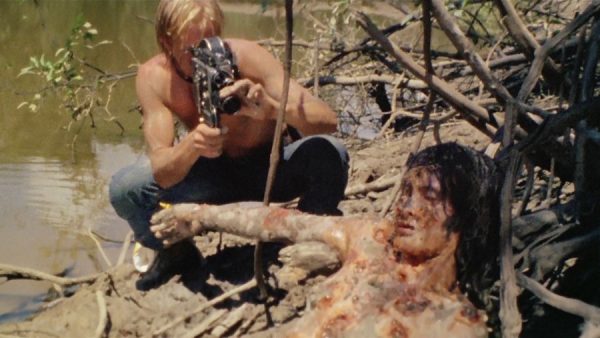
The anthropologists expedition opens the movie, shot in conventional style. But the second half, the famous reels found in the jungle, switches into raw 16mm territory. It was shaky cam before shaky cam had a name. No polish or score. Instead, its what appears to be real documentation of unspeakable acts. The effect is immediate and visceral. And for many viewers in 1980, seemed all too real.
We have to talk about what exactly is in this cinematic Pandora’s box. Because to understand just why prosecutors though they had found a real snuff movie, we need to understand just how far Deodato would go.
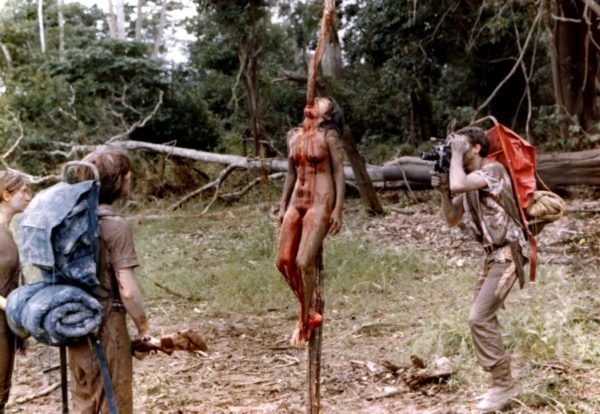
The movie has scenes of sexual violence that are hard to watch even four decades later. There’s the now infamous impalement scene, with a woman’s body on display on a wooden stake. A tableau so convincing that it became the prosecutors Exhibit A. There are dismemberments, executions and ritualistic violence that are rendered with uncomfortable realism. The special effects, created by Aldo Gasparri, were extraordinarily convincing for 1980.
But the really problematic part, the thing that no level of artistic justification can ever fully wash away is, Deodato really killed animals on screen. A pig, a squirrel monkey, a coatimundi, a turtle, all actually slaughtered for the camera in scenes of prolonged cruelty. There was no clever editing or movie magic. Just real death, served up as commentary or entertainment or whatever the hell Deodato thought justified it.
It wasn’t simulation. It was documented, actual killing, meaning when the Italian authorities saw the movie, the suspicion they had that the human killings may also be real wasn’t exactly paranoid fantasy. The director had just proved he was willing to kill living things for his art. So, why not humans?
Cannibal Holocaust premiered in Milan in February 1980. It took ten days before the Italian authorities seized it and Deodato was pulled in for questioning. He was charged with obscenity, which was expected, but also something a little more serious: suspicion of murder.
The theory the prosecutors had was something like this: that impalement scene looked too real. The performances were too convincing and it’s documentary style was too persuasive. This simply couldn’t just be all acting and special effects. Surely, somewhere in that Colombian jungle where Deodato had filmed, bodies were buried and relatives were grieving.
What didn’t help was the fact that Deodato had imposed a brilliant but diabolical contractual obligation on his actors. They were forbidden from appearing in any other type of media for one year after the movies release. This wasn’t artistic purity, it was marketing genius. With the cast kept underground, Deodato reinforced the idea that these people had died, and the audience really was watching actual footage from a doomed expedition.
It’s fair to say the Italian courts were not amused. Neither were the prosecutors in dozens of other countries were the movie had already been released, or was scheduled to be. The movie was banned in Italy, along with Finland, Norway, Australia, Singapore… West Germany seized it. Here in the UK, it was classed as a “video nasty”, one of the notorious 72 movies targeted under the 1984 Video Recordings Act, with accusations of corrupting the youth and degrading public morals. But Italy? They were special. They wanted blood.

Picture the scene: a courtroom somewhere in Milan, 1980. Ruggero Deodato is accused of killing his actors. The evidence is up there on screen, brutal, graphic and seemingly irrefutable. On hand, the prosecutors have expert witnesses ready to testify about how certain effects are impossible to fake. They have real animal killings as proof the director had no qualms about documenting actual death.
What Deodato has to do is prove a negative; that something which looks incredibly real is actually fake. It was the pre-internet era, so this was no small feat. He can’t just pull up laughing, behind-the-scenes footage on YouTube. What he needs is something more dramatic.
So the only thing he can do that makes sense, is bring the dead back to life.
Francesca Ciardi, Perry Pirkanen, Robert Kerman, Luca Barbareschi, the main cast of the documentary crew, are summoned to court. They stroll into the courtroom, all very alive and not impaled on wooden stakes or dismembered in the Amazon. It’s absurd and theatrical, the kind of moment that could only happen when cinema crashes into reality so violently that the legal system has no clue how to deal with it.
The actors describe the year-long media blackout and the special effects in detail. Kerman, who previously had starred in hardcore pornography (of course he had, this entire story works on multiple levels of exploitation) takes the court through the mechanics of the impalement. How it was done and just why it looked so convincing. The exact engineering that showed an actress skewered to a stake but in reality was sitting on a bicycle seat while the stake ran alongside her body.
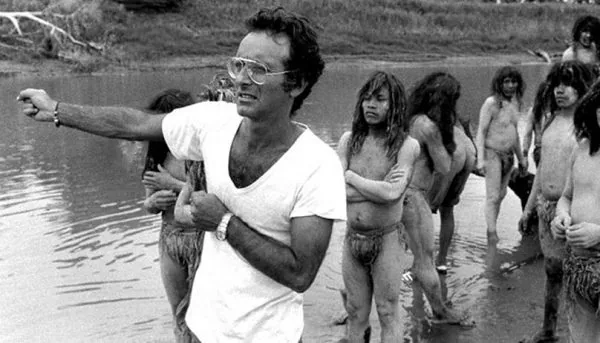
Deodato brought production stills, contracts, call sheets. He explains the conceit of found footage, and his deliberate attempt to blur reality and fiction. He isn’t apologetic, this is Ruggero Deodato after all, but he is very thorough. Eventually, the court accepts that no humans were harmed during the making of the movie.
But, the animal killings were real, and because of them Deodato was convicted of obscenity. The movie stayed banned in Italy for three years, and when it was finally released it was heavily edited. But by then, in 1984, it had achieved something that was very rare in exploitation cinema. Real notoriety that was backed by serious legal drama.
To understand just why Cannibal Holocaust became moral panic’s ground zero, we have to understand the video landscape of the early 1980s. Home video was brand new. Material that previously had been hidden behind the velvet ropes of grindhouse and art cinemas was now available to rent at your local video store. Moralists were apoplectic and parents were terrified. Politicians, of course, smelled opportunity.
In the UK, we got the Video Recordings Act, and this helped create the British Board of Film Classification’s rating system. But before that formal system, there was chaos. The Director of Public Prosecutions built a list of titles that were likely to be obscene. This was the creation of the “video nasty” list. Cannibal Holocaust, of course, made the list, along with I Spit on your Grave, Driller Killer and so many other titles that mixed violence, sex and transgression in ways that frightened the establishment.
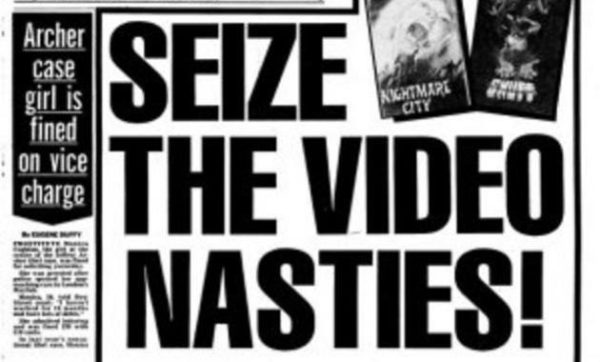
But the panic wasn’t totally irrational. Those movies were extreme, usually badly made and misogynistic. But they were, in most cases, clearly fictional. Cannibal Holocaust was different. The found-footage format, along with the commitment to realism and actual animal killings, this made it the perfect boogeyman. The moralists could now claim they had proof that home video was unleashing real depravity into the living rooms of the suburbs.
In Italy, the trial became a rallying point for both sides. Anti-censorship advocates used it as evidence of state overreach and authorities that were too stupid to tell fiction and reality apart. The pro-censorship crowd used it as proof moviemakers were going too far, and that strong controls were needed to hold the line between reality and simulation.
That’s what made the case so fascinating. Both sides had a point.
Deodato had always maintained that Cannibal Holocaust was a critique of media exploitation. A commentary about how Western journalists and documentarians corrupt indigenous spaces, manipulate reality, and give us savagery as entertainment. The film-within-a-film shows us the crew setting up scenes, starting violence and even committing atrocities themselves, all in the name of getting dramatic footage.
The movies final revelation, that the “civilised” film-makers are more monstrous that the “savage” cannibals, is about as subtle as a chainsaw to the sternum, but it is there. Deodato is arguing that we are the real cannibals. We, the audience, pay to watch that suffering. We, the media, manufacture it. The real, indigenous people are just reacting to provocation and invasion. We’re the monsters.
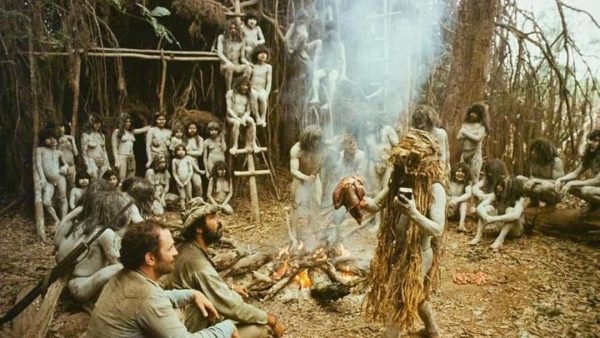
Fine. Like I said, noble intentions. There is a real idea buried in there about complicity, colonial gaze and exploitation cinema which exploits the very thing it says it’s critiquing. But the problem with that defence is you can’t condemn exploitation while actively exploiting. It’s hard to make a point about media cruelty when you’re the one being cruel. The animals Deodato killed weren’t metaphors, they were real, living creatures that he had butchered for effect and shock value. For a point that easily could have been made without their deaths.
This is where the fundamental contradiction of Cannibal Holocaust lies. It wants to be serious social commentary, and in a limited way, it is. But there’s no getting around the fact it’s also exactly the thing it claims to criticise. It’s sensationalistic and exploitative, happy to traffic in real suffering for entertainment.
Even Deodato seems to have come around on this point. In interviews later in life, he expressed regret about those killings, and acknowledged they weren’t necessary, that he would make a different choice today. It’s a rare moment of reflection from a man who has spent four decades defending every choice he made in that movie.
For better or for worse, Cannibal Holocaust changed cinema. It pioneered the found-footage genre that would explode decades later with Paranormal Activity and Blair Witch Project. It showed us just how effectively reality and fiction could be blurred, and how immersive horror could be created with formal innovation instead of just content.
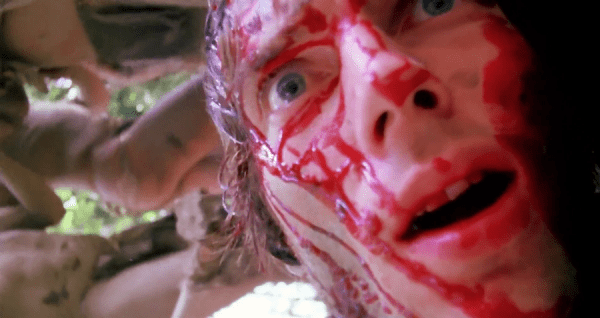
It also spawned a whole subgenre of cannibal flicks. Most of them far worse, less interesting and much more gratuitous. The Italian Cannibal craze of the late 70s and early 80s gave us Jungle Holocaust, Cannibal Ferox, Eaten Alive, and other examples of endurance tests disguised as cinema. Quite rightly, most of them have been forgotten. Cannibal Holocaust endured because it had more than just gore. There was structure and a concept, a controversy that elevated it above mere exploitation.
The trial guaranteed its place in cinema history. It became a cautionary tale, a legend almost. The director who had to resurrect his actors to prove he hadn’t killed them. A movie so convincing that reality and fiction were confused not just for the audience, but the legal system as well.
As twisted as it may be, that’s a hell of an achievement. Deodato made something that was so committed to its own logic, so successful at its simulated documentary that it smashed through the fourth wall and flowed into the real world. The violence in the movie wasn’t just affecting viewers emotions, it generated legal consequence and prosecutions, believe that people had been murdered.
So what do we make of this movie, 46 years after its release? Is it an artifact of exploitation that should stay buried, or a masterpiece of horror cinema? Is Deodato an exploitation guru who mistook shock for substance, or an artist?
It’s not satisfying, but the answer is yes, all of the above.
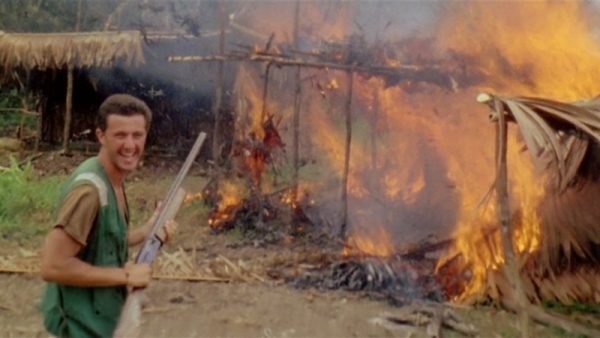
The movie is conceptually ambitious, technically accomplished and honestly ahead of its time in terms of innovation. But it’s also excessive, cruel and compromised morally by the choices that just can’t be artistically justified. You really can admire its craft while being repelled by the content. Its influence can be recognised while we question whether that influence was positive.
The trial revealed something very interesting about our relationship with moving images, and how we negotiate between fiction and reality. The movie was so viscerally convincing that it short-circuited our ability to maintain proper distance. It’s powerful cinema. It’s also really troubling cinema.
There is a brutal irony in the fact that in almost being convicted of murder for a fictional movie, Deodato proved his point about reality and media a lot more effectively than anything in the actual movie. The trials meta-narrative turned into the ultimate commentary on how we process violence on screen, how we determine what’s real and just how far we’re prepared to go in order for “truth” in cinema.
Cannibal Holocaust went beyond pushing boundaries; it found new ones we didn’t know existed. The line between documentary and simulation. The exact point artistic freedom becomes legal liability. Ruggero Deodato found those lines by crossing over them. And he paid for it with his obscenity convictions, multiple countries banning his work and a permanent reputation as either an exploitation merchant, or a boundary-pushing auteur, depending on who you’re talking to.
But his place in cinematic history is secured as the director who made prosecutors believe they’d found a snuff movie.
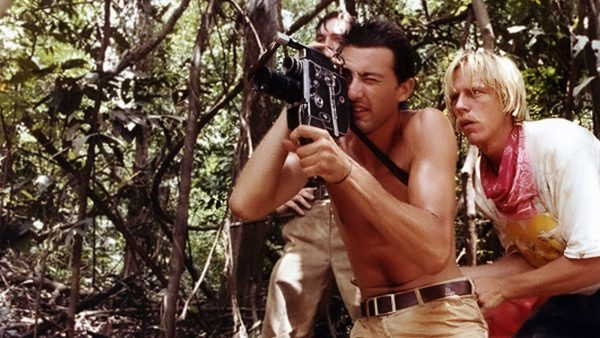
In the end, nobody was killed making Cannibal Holocaust. But the movie itself? I think it killed something; some measure of innocence about what cinema could portray. A boundary of taste that once you cross it, there’s no going back. I suppose it’s your own personal perspective on whether you think that’s a loss or liberation.
Me? I think we could have been better off not knowing just how real brutal death could be staged. Some boundaries are there for a reason. But then again, I’m just a guy sitting at a laptop and pontificating, not a prosecutor bringing murder charges against a director for doing his job a little too well.
That’s Cannibal Holocaust’s legacy; a movie that was too real, a trial that was too absurd and the director who proved he wasn’t a murderer by marching his still-living actors through an Italian courtroom like some demented curtain call.
Cinema has never been the same since.
Adam Page