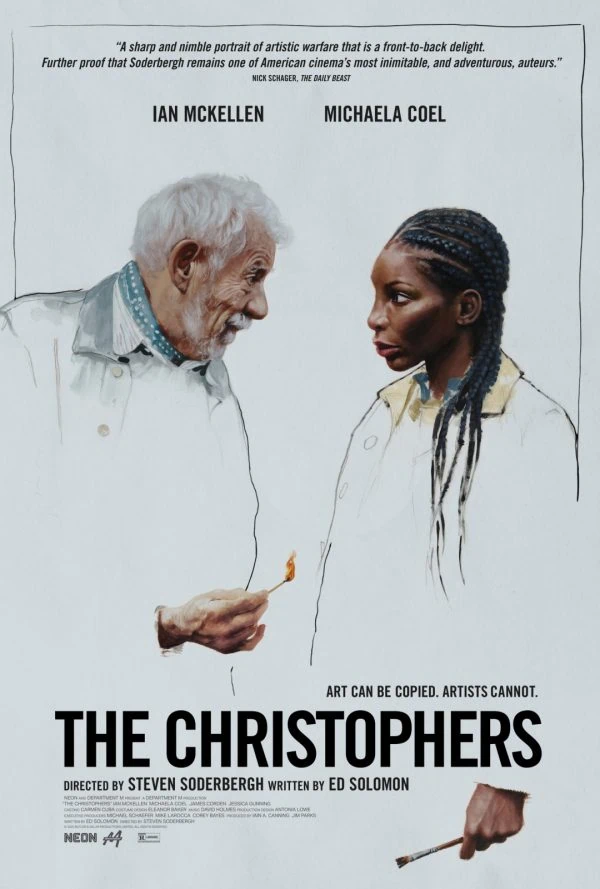
The Christophers, 2025.
Directed by Steven Soderbergh.
Starring Michaela Coel, Ian McKellen, Jessica Gunning, James Corden, and Ferdy Roberts.
SYNOPSIS:
The estranged children of a once-famous artist hire a forger to complete his unfinished works so they can be “discovered” and sold after his death.
There is a lot of narrative plate-spinning in the latest from Steven Soderbergh, The Christophers, which almost feels reverse-engineered to function as a stripped-down, much more low-key take on an Oceans heist through the lens of one home and its familial dysfunction. Written by Ed Solomon (a recent, frequent collaborator), it’s a story that matches the more minimalistic approach in the faux-retirement era of Steven Soderbergh, one also more screenplay-centric and practically bursting with themes to ponder, this time involving what constitutes auterism, the personal baggage behind such art, and how the role and purpose a critic and/or admirer plays into that.
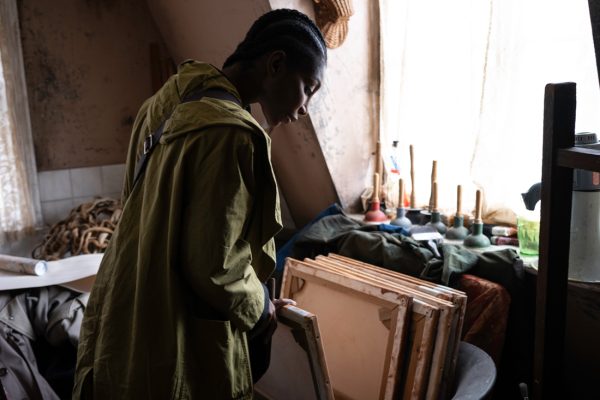
With the sudden, jarring presence of James Corden as Barnaby alongside his sister Sally (Jessica Gunning), the siblings employ a struggling former aspiring artist in Michaela Coel’s Lori to take on the role of their dying father’s assistant, a washed up but once famous oil painting artist named Julian Sklar (Ian McKellen), to invade his creative space and forge/finish a series called The Christophers, which would be discovered and sold for a high price upon his death and split three ways between the trio. Julian seemingly plans on leaving the children with nothing, and deservedly so, which is not something I say because one of them is played by James Corden (he is admittedly quite amusing as a bumbling fool here), but more that they are rotten, less concerned with the legacy of their father, and more about exploiting that for personal gain.
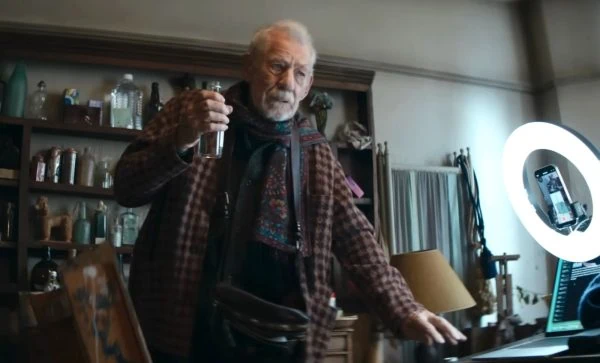
Granted, there is some father/son baggage that the film occasionally gets into, not to mention some personal demons and failings of Julian himself. Coming out as bisexual when it “came at a cost”, he is an outspoken and chipper man, even in his mid-80s, who knows he is dying and has no real interest in finishing the paintings. Ian McKellen gives an endearing performance as an elderly, rambling, unfiltered character, which isn’t necessarily anything groundbreaking in terms of on-screen old age. However, he delivers each line with an acidic edge.
McKellen somehow has the physical energy to move briskly through the house to match his stream-of-consciousness dialogue (one could easily see this film adapted into a stage play), which sometimes feels as if it will never end. It’s also amusingly contradictory at times, such as when he sets the record straight by saying he doesn’t mind questions, only to add that he doesn’t like giving answers.
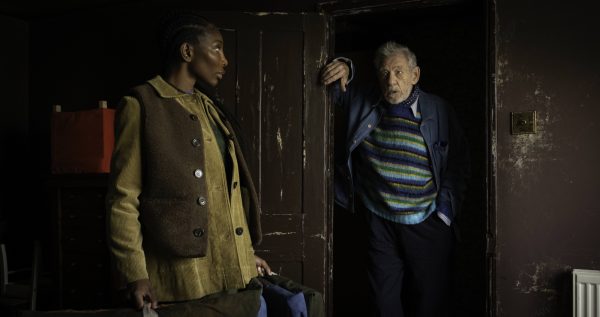
The brilliance of the filmmaking here is that the filmmakers don’t always bother having Lori trade words with Julian. Instead, she remains unfazed, stone-like but not ticked off or petrified in fear. Calm, Lori carefully chooses her moments to pick apart Julian, not only about his past art and whether or not she is capable of forging his work in the first place (it’s not long before the jig is up and she catches on to why she is here), but also his torched reputation which includes being a snarky ass of a condescending critic on a TV show called Art Fight, which is essentially a reality competition to find the next great artist.
As mentioned, this is a film that’s constantly teasing the different directions it could go, whilst also shifting the character dynamics as if everyone is on a chessboard. Even at roughly 95 minutes without credits, this becomes slightly tiring, yet it is more than kept afloat by the chemistry between the leads. Ian McKellen is a cranky delight here (there is one insult towards a random artist that unexpectedly catches one so off guard, it results in a big laugh that one feels bad about immediately afterward), but Michaela Coel is the real revelation here, standing tall with the legendary actor in a performance calibrated on a specific reactionary wavelength.
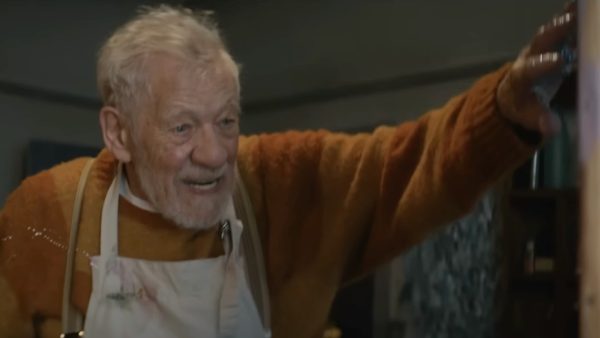
Beyond that, The Christophers also uses its art-scene setting, with an emphasis on criticism, to say something about the nature of critique itself and how the most powerful within an industry have a responsibility for how they wield it, especially when doling out a pan. Even here at this site, I never take glee in writing a negative review, which is also not to say that my judgment carries the same weight as this fictional character in his world (it doesn’t, not by a long shot), but that there is material in here that should have some rethinking how they go about criticism whether they are a professional or not.
As for the rest, the story keeps moving, sometimes with exciting monkey-wrenches and other times settling into a sense of exhaustion from going in no direction by teasing every direction. The performances, alongside what the film has to say and what it wants to leave viewers thinking about, make that circular storytelling and this minor Steven Soderbergh effort worthwhile.
Flickering Myth Rating – Film: ★ ★ ★ / Movie: ★ ★ ★
Robert Kojder