Exclusive interview with Hamnet costume designer Malgosia Turzanska…
Ahead of awards season and fresh off festival season, we spoke with Hamnet’s costume designer, Malgosia Turzanska, about the response to the film, the involvement of director Chloé Zhao and crafting a unique take on a Shakespearean film.
What was your starting point and how involved was Chloé Zhao?
When I first started talking to Chloé about the film, it was very obvious that our goal was to focus on the story of Agnes and Will, their powerful love story, and their attempt to find themselves and each other in the face of this incredible tragedy. It was always Will and Agnes rather than William Shakespeare and Anne Hathaway. It was a living, breathing exploration of grief and artistic identity rather than an attempt at a historic reconstruction. I think that’s why the story is resonating with audiences so much — Chloé infused it with life rather than trying to find it in the past.
Hamnet is more rugged than usual Shakespearean films. How did you approach that?
In order to take the historical characters off the pedestal, it was important to me that the costumes were not precious in any way. I looked at a lot of paintings of lower classes for ideas of how the period clothing was worn in a non-stilted way. That is where we got Will’s open shirt, his rolled-up sleeves. We wanted to make sure everything felt real and lived in. His fingers are covered in ink stains; he always wears a penner on his belt instead of a dagger (a container for a portable inkwell and a quill).
Agnes, as a creature of the forest, is always covered in some mud or plant stains. There’s sweat, there’s dirt, there’s the evidence of the environment on her clothing. I worked very closely with our amazing production designer, Fiona Crombie, and I wanted to make sure that we feel the world she’s built for our characters, that they feel like they belong to it.

Were there any particular inspirations for Agnes and William’s costumes? Can you talk us through the evolution of Agnes and William’s costumes throughout the film, as the nature of their relationship evolves?
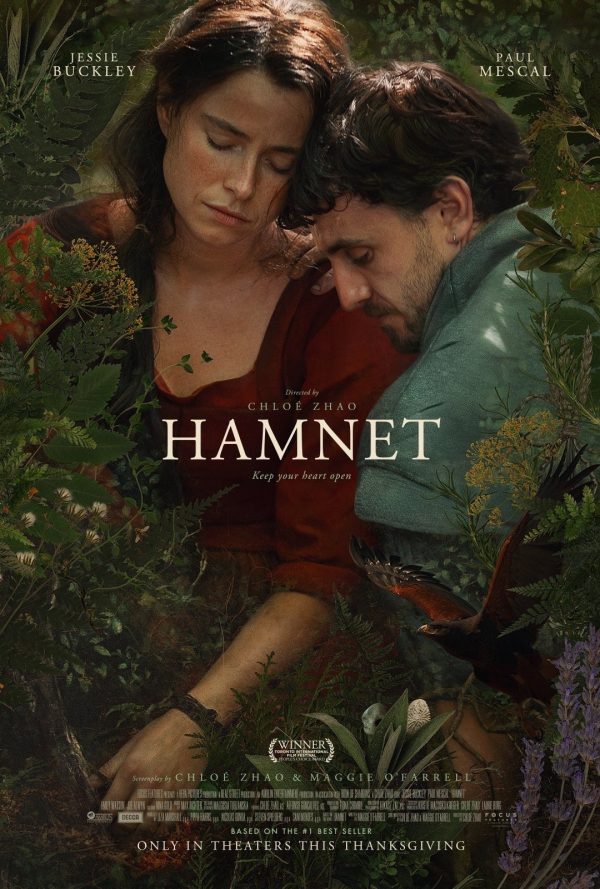
My starting point for Agnes’s character was an image of a giant heart pumping fresh, vibrant blood, pulsing full of life. She is a product of the forest as well — when we see her in the first shot nestled in the roots of the tree, she looks like she has organically grown out of it. She is like a berry – one that could heal you, but one that could poison you as well, if you don’t know how to handle her. It was important to me to emphasise her connection to nature through the feel and textures of her clothing. The first bodice she wears is actually made of barkcloth, the fibrous textile found between the bark and the trunk of a tree. It’s not an Elizabethan textile at all; it was sourced from Uganda, but its woodsy look and feel made it perfect for Agnes.
Her other garments are primarily made of linen, so a plant fibre as well, and the bodices are subtly embroidered to resemble bark, or veins with flowing blood. As she is going through the arc of the story, her vibrant reds turn more rusty, a bit like drying blood, then as she grieves Hamnet, the colours lose all their hue completely, and turn into a scab-like greys, browns and prunes. Her bodice resembles a dried-up piece of bark that would turn to dust if you touched it. When we see her travel to London at the end, her blood flow gradually returns, and she regains some of the initial colour.
For Will, there were a couple of threads in play. One was the grayscale, which we got from diluting the iron oak gall ink, the actual ink that Shakespeare used. We added some greens and blues into his initial looks, emphasising his connection to the river — we see him processing his feelings through his contact with water. The greyscale was also a characteristic of the costumes of his family home. Since they live with an abusive father, I was wondering what the mother, played brilliantly by Emily Watson, would do to protect her children from his outbursts. She does not physically stand up to him, but I thought she would equip the kids with some sort of a shield. Their costumes are all on a greyscale, so they can blend in with the walls of the house a bit and not provoke him, not to stand out too much. But also, I was looking at vintage sportswear for padding (in addition to the already pronounced Elizabethan shapes), so the clothing is either quilted or has some cushioning in the fabric, so it can soften a potential blow.

Will is wearing an irregularly quilted doublet when we first meet him. He is also wearing a layer made of laser-scratched leather that looks almost like the underside of a mushroom. I imagined it metaphorically comes from his father’s constant jabs at him. The father wears a necklace with a toothpick on it — which was customary in the period. It is claw-like and violent-looking, and I thought he uses it to poke at his son constantly, trying to break his skin and spirit. We start with those scratches, and then, as we go through the story, and as Will is getting more and more frustrated with himself, he switches to a thick leather doublet, that looks almost like cracked elephant leather, and it is covered in slashes.
This is a traditional Elizabethan technique called pinking, but for us, rather than using it in a fashionable way, it signifies the character’s emotional journey. After Hamnet dies, we see Will in London in a doublet where the smaller slashes have now become giant gashes, screaming silently. Then, finally, when we see him as the ghost, he is covered in a layer of cracked clay that breaks further with every move, until he gets to wash it all off and finally starts crying.
You must be delighted that both Train Dreams and Hamnet are being so well received by audiences and award bodies.
It’s been so incredible to see audiences responding with such emotion to both! I made these two films back-to-back, so as I was driving through the snows of Spokane, I would listen to podcasts about Elizabethan London, about Shakespeare, or to books like How To Be a Tudor, just to start getting into the right mindset before travelling to the UK. But both films resonate with me so deeply. As filmmakers, we are away from home so much in order to follow our work dreams, but of course, that means leaving behind loved ones for long stretches of time and trying to navigate those relationships and balance life and work. Both films, of course, deal with learning to cope with loss and grief. Both are so special to me, and I am so proud of them!

Were there any particular challenges for Hamnet’s costumes?
The biggest challenge was navigating the period and the characters, making sure that we stay respectful to the historical details without suffocating the characters or losing their identity.
But I think my favourite challenge was the whole of the Globe, both the players in Hamlet, and the audience. As to the Globe audience, we had 350 background actors. Because we shot them at the very end of the schedule, we held BG fittings for the whole duration of the shoot. We had time to build pieces that we were missing — some headwear, partlets, belts, bags — just to make sure that everyone was from a cohesive world, but mainly, that each person looked like a real, layered and textured full character. The BG actors are right there around Jessie and Joe in the last moment of the film, surrounding them, laughing and crying, responding to the play. They were just incredible!
As for the players, I decided to take a bit of poetic license to make it work. In Shakespeare’s time, the players would have worn clothing that was very much like what the audience was wearing. This helped them connect to the play and see themselves in the story. That doesn’t work for us as a modern cinema audience, so I decided to veer away from historical accuracy. We kept the beautiful Elizabethan shapes, but built the costumes out of raw linen, and then painted the fabric with a layer of modern latex paint, with visible brush strokes and leaving some of the linen showing.
It served a couple of purposes. I was imagining that if you saw costumes like this today in a theatre in Brooklyn, they would still work and they would not seem antiquated. So, they exist somewhere between now and then, hopefully connecting us to them in a meaningful way. And the other thing was seeing the brushstrokes was to emphasise that this is just the beginning of the life of this incredible play. It is not calcified in any way yet; it has not been performed a million times. This is just its beginning, and you see the process of it being made, thought up. It’s simple and unadorned, and I was imagining that for Hamlet’s costume, Will would try to remember his son, and represent him in this simplified way, painting the costume in Hamnet’s colours, including the painted gold hair, like his sons.
Many thanks to Malgosia Turzanska for taking the time for this interview.
Chris Connor