Chris Connor chats with Hamnet’s production designer Fiona Crombie…
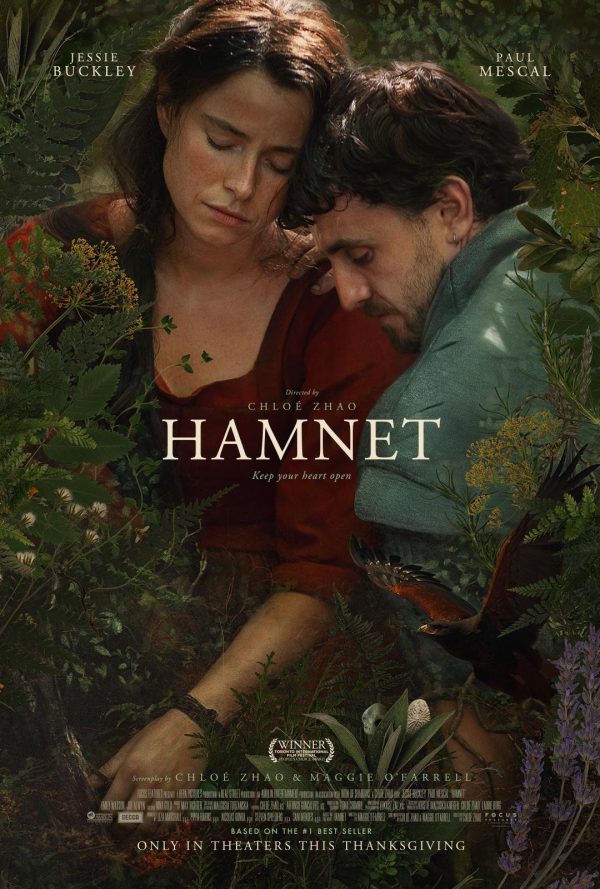
Based on Maggie O’Farrell’s best-selling 2020 novel, Hamnet has emerged as one of the major players for this awards season, earning serious acclaim on the festival circuit. It tells the lesser-known story of William Shakespeare and his wife Anne (Anges in the book/film) and their son, the titular Hamnet. One of the challenges for any film like this, emulating a period from British history that has been frequently depicted on screen before, is the production design and sets. We sat down with production designer Fiona Crombie to discuss the unique challenges presented by the film, re-creating the Globe Theatre and the contrast between sequences set in Stratford and London. Fiona also discussed some of the main differences between this film and Yorgos Lanthimos’ The Favourite.
What was your starting point for Hamnet?
I was sent the script in early 2024, and I immediately had a very strong emotional response to the material. I was really struck by the intimacy of the story and how tangible it felt. It felt alive on the page. I gathered images ahead of my meeting with Chloé to help express my thoughts, and when I look back at those images now, I see that they absolutely informed the film. I looked at Tudor architecture with its heavy, linear beams and wild forests with open skies. I gathered photographs and paintings of children playing in gardens, laundry drying, ink spots on parchment… I looked around my house and thought about my family, finding countless intimate details that became the foundation for creating the immersive design.
Can you talk us through the contrast between Stratford and the London sequences?
One of the most evocative decisions we made was in the representation of London. Stratford is open fields, rambling nature, and low buildings. There is plenty of sky. London could have been a big, wide establishing shot of a vast city, but we did the opposite. We thought about what would be most foreign and uncomfortable for Agnes – a lack of nature and space. London had to be a place she did not understand. We chose a location that had a long, narrow road with high brick walls and an enclosed courtyard with a single tree. There is no wide view of London because the characters are amongst the city rather than looking at it from afar.

How did you find making the iconic Globe Theatre?
I was initially intimidated! It is an iconic building. I knew early on in preproduction that our Globe could not be a replica of the building that exists today. It had to be an interpretation that was born of our story. The existing Globe theatre is a replica of the second Globe that was built after the first burned down. The first Globe is not that well recorded, but there was an account that said the wood used to build it was stolen or “reclaimed.” I jumped on this anecdote. Chloé had said to me she wanted the theatre to feel like the inside of a tree. Our Globe had to be an extension of the forest. So, the minimal historical records, the direction from Chloé and the freedom to use aged oak beams gave me the license to create the theatre that was right for our film.
How does Hamnet differ from other projects you have worked on like The Favourite?
A film like The Favourite was, in many ways, designed to be admired! The opulence was integral to the story. All the period films I have made have had castles and royal courts. Hamnet is a period film about an ordinary family. I felt very strongly that part of my job was to make these characters relatable and tangible through the design. I wanted the environments to feel textured and real, even though they were sets built on a backlot. We worked very hard at adding depth and story through the level of detail in the design. My impulse was very much that the design should bring the audience closer to the characters and the story. It was about being up close rather than admiring from arm’s length.
How involved was Chloé Zhao?
There were no absolute directives from Chloé. The images I showed when we first met indicated that my impulses were aligned with hers, so the process was very much about discovery throughout pre-production. We kept adding depth and detail to the story and the design. Chloé is hugely intuitive. We were in constant conversation throughout the process. She was very involved in the textures and palette. Chloé is masterful at distilling imagery to the clearest articulation. There is nothing superfluous or indulgent. She was a great touchstone for me with the design.
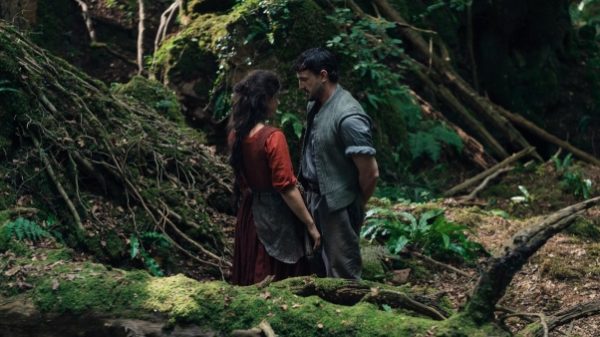
Hamnet is a unique take on this era with the more dreamlike nature of it and more rugged settings. Was that a challenge?
The primary challenge for me was geographical. We chose an untouched forest and locations that were remote. We were working on the border of Wales and England while building large sets in London. There was one week where I realised I had spent 20 hours driving between the locations and the studio. But the locations added so much texture to the film. The town of Weobley had so much character. We built a large part of the streetscape scape but by having one or two real buildings, the set became grounded. Working on these types of locations brings complications too – protected buildings, protected forests. We did dress plants and roots in the forest to make it more verdant and wilder, but each plant had to be local to the area. We always had people looking over our shoulders making sure that we were taking care of the environment.
Did you visit Stratford for inspiration?
Yes! That is the first thing I did after I started the job. I walked the Henley Street house, Hewlands farm, and I visited the gardens of the New House. I went there to see what they felt like more than what they looked like. I did take inspiration from the fireplaces, the glove workshop, and the patterned walls in Henley Street. We visited countless other Tudor houses, and each of them gave me details that I built into the backlot set.
Did you refer to the original novel for inspiration?
I had read the novel years ago, but when I started the film, I re-read it and focused on underlining the descriptions. The tone and emotion of the book absolutely inspired the design. Maggie’s research is extraordinary. The book was an incredible resource, and Maggie was available to us for any questions.

Is there anything else you would like to cover about Hamnet?
I think what was wonderful was the depth of collaboration. I spent hours working on the design with Lukasz, discussing the camera and how the sets would work for the style of cinematography. Malgosia and I sat on the floor talking through colours and textures. I feel like we were all making the same film, we had the same intentions from day one and that was led by Chloé.
Many thanks to Fiona Crombie for taking the time for this interview.
Chris Connor