Are we at a crossroads with AI, or already way down the road leading to the death of the creative?
You can’t halt progress, and when money is being fired at an industry with the velocity of the Death Star’s planet-destroying laser, then it inevitably feels like said industry is unstoppable. Despite everything the Terminator franchise (other sci-fi dystopian depictions of AI are available) told us, it would seem that the movie industry is destined to end up being heavily reliant on AI, and investment in it is rocketing.
It isn’t just an underground movement of unheralded, low-budget studios seeking cost-cutting measures. This includes acclaimed, high-profile filmmakers and some of the largest studios, both actively pushing AI or laying the foundations for a future move to using it. The short version always comes down to the same things, whether you’re making movies for $100k or $100m. The biggest rationale behind using AI is to save time and money. Being at the expense of the individual artist and their qualities is an afterthought.
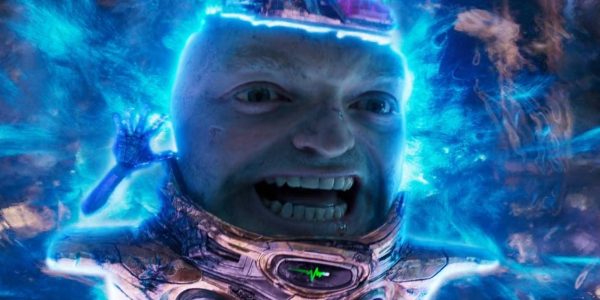
You can use AI to create visual effects, so you don’t need a VFX artist, least of all the kind of large teams often required for tentpole studio films. Evidently, there’s been a drop in CGI quality for years, either overextending a small pool of effects studios or outsourcing to cheaper artists from across the world. It’s the Fiverr approach to post-production.
So, if the CGI is now mediocre and AI can reproduce mediocre CGI in minutes, is it an issue? The same goes for a script. Writers are now having to bend to the executive-led focus group ideals of what a script in the doom scroll generation needs to be. It doesn’t need to be a decent script as long as it hits key structural moments that benefit audience retention, whilst regurgitating the plot several times over with exposition dumps for an audience who don’t want to give their full attention. Again, why hire a writer if AI can produce a formulaic script with far more ease, and AI doesn’t need to be paid?
However, there’s a problem: Audiences are quite capable of paying attention if they’re given due respect. Even the youngsters most addicted to their phones are the leading Letterboxd demographic, a platform that’s seen a new boon in cinephilia. Just make better films, but to do that requires a creative first approach and, very much, a human approach. That means human writers, editors, graders, musicians and CGI artists. In terms of CGI, it’s about switching back to a more demi-practical approach (at least) where CGI just embellishes sequences laid upon practical filmmaking, and doesn’t become the entire sequence. Why not make a huge film with 100 VFX shots rather than needing to make 1000?
The continued popularity of A24, which generally champions individual expression, shows that audiences don’t just crave churned, production-line cinema. Sadly, though, auteurs have been finding it increasingly difficult to get movies made. Investment in film has declined, partly because it’s just a money pit these days and very difficult to make money back for studios, let alone the investors. Roger Avery has bemoaned an inability to find money to make movies in the conventional ways, which has become his excuse for pushing three AI-driven films into production.
For many creatives (myself included), it’s depressing that a guy who has a creative hand in Pulp Fiction, as well as his own successes like Killing Zoe and The Rules of Attraction, would get in bed with the devil, but the money was thrown at him with relative ease compared to getting a conventional film off the ground. Just go to any film market right now, and you’ll see the looming face of AI popping up and a surging interest in investing in studios, films, and programs which utilise artificial intelligence. It’s where a lot of money is going. Creative-focused work platforms like Upwork and Fiverr are now overrun with low-paid jobs requiring people adept at using AI (and the pay is lower because AII is, in theory, going to take more of the heavy lifting).
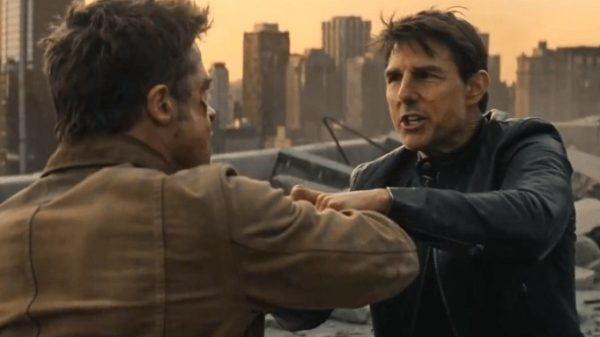
AI in film is seeing marked investment all over, from analytical platforms to “creative” systems to the grim prospect of AI performers. Disney have recently threatened copyright action toward a host of AI companies, not least sending a cease and desist to Bytedance’s Seedance 2.0, who put out a now viral (fully AI-produced) clip of Tom Cruise fighting Brad Pitt. The issue of copyright is huge, too, because AI right now effectively draws upon copyrighted material to create. Mind you, you could say the same about Quentin Tarantino (badum tish!). Ironically, Disney has its own preoccupation with AI, having reached an agreement with OpenAI to be the first licensing partner with Sora.

The use of AI in films has already been contentious, even with minimal use. Just a couple of years back, the filmmakers behind Late Night With the Devil used AI to create some artwork featured in the film briefly, and caught some backlash. It was a very minimal use. Imagine what kind of backlash you’d receive for making an entirely AI-produced show or movie. Well, that’s already happening with Darren Aronofsky, a man you wouldn’t expect to be the driving force behind a full AI production (given his distinct and idiosyncratic auteur resume). On This Day: 1776 dropped a trailer recently, as the first production from Aronofsky’s AI studio, Primordial Soup (I prefer Pea and Ham myself). It’s more than a little depressing that the likes of Aronofsky and Avary have, in effect, sold their souls. Though the overriding response to 1776 has been critics calling it AI slop (it genuinely looks horrendous).
Cinema has had very distinct shifts in its culture, production and presentation over the years. Each shift was greeted with derision in some corners. Silent era artists didn’t universally greet soundies with adoration, nor the shift from black and white to predominantly colour cinema, or celluloid to digital and more. However, never in these shifts has there been a more direct threat to the creative artists in almost every form than we see from AI. Aronofsky can claim his (frankly horrible-looking) 1776 used SAG voice actors, but the production itself did not need a few hundred cast and crew members who might have been employed in an equivalent real show. Of course, the counter there is, would it have been financed that way? Right now? Probably not, but frankly, I’d rather see Aronofsky make another ‘real’ film even if he had to shake down his sofa for spare change to fund it.

We’ve already seen CGI used to bring actors back from the dead. It’s always looked a bit grim and disturbing, but the ease with which AI can recreate an artist, and honestly, more convincingly than a CGI artist, makes it inevitable. Even in the past week, word has spread about the prospect – with his estate’s blessing – of Val Kilmer returning to film from beyond, in Canyon of the Dead (as we exclusively revealed recently). It’s not coming entirely from a cynical place, with Kilmer having been hugely keen prior to his death to be on board the production. Still, it feels inevitable that we’ll see it used repeatedly if and when the backlash on doing so is less virulent.
Are we now at a crossroads, or have we already gone too far down the road? Filmmaking is particularly difficult for aspiring indie filmmakers who find it challenging to get even a small amount of money together to make films. At Flickering Myth, we’ve experienced the difficulties and woes of developing, producing and releasing films. We’ve avoided AI at every turn, whilst other filmmakers in the same lanes as us have started to utilise it for simple things like AI backgrounds, or indeed for (quite obviously) AI artwork. This soon becomes more complex uses like CGI, music, and grading. That they’re often so blase about effectively accelerating their own obsolescence is the most surprising part.

On our own film, The Baby in the Basket, we may even have benefited from just giving way to AI for visual effects issues that never quite got solved, or picture issues that took hours of post expertise to be solved (and associated costs). Getting chuckles from all sides for a CGI devil baby that – from its original practical effect, to the CGI to cover the ineffectual practical effect, to the final result – just never worked (aside from some who appreciate a crappy practical). A click or two on AI might have just solved it in seconds, but personally, I’d rather fail by human hands than the uncanny valley of AI. In fairness, some AI creations are genuine nightmare fuel, but only in part thanks to the inherent flaws of the technology at its current stage of evolution.
Increasingly, though, distributors are starting to utilise AI on the sly. Particularly in the low-budget levels, where artwork is quite obviously being left to AI to save costs on using even cheap Fiverr artists. I’ve been hired many a time to write low-budget features from an array of studios and producers, and there will inevitably come a point where I’ll probably be replaced. It’s probably already come to the point that I’m working from concepts dumped out by AI that I have to hone and refine before creating a screenplay from. Films released across Amazon, Tubi et. al. are already scored with stock music. Soon, that’ll probably be AI-produced music. How many composers these days are tasked with producing a Hans Zimmer-esque score? There are loads. So much in film, at every level, is beholding to trends and formulas, things AI could replicate in seconds at no cost. Inevitably, even Mr Zimmer himself might find himself replaced (in the worst-case scenario) for an AI-constructed “Zimmer-style” epic score.

There is still hope, however, with a recent upswing in interesting indie cinema and a wider availability of world cinema that has seen so many incredible films built on human artistry, vision and the unique viewpoint of individuals. Audiences want to be swept away by compelling stories and characters, with real heart. If the rudimentary entertainment films aren’t quite hitting because they’ve been produced with an air of cynicism, it feels like AI might capably produce films just as good/bad. Maybe we just need to be making better films at appropriate scales, given the limited investment that is out there.
In the age of quick and easy, let’s not give away cinema to the convenience and cost of artificial intelligence. Let the AI take care of the boring, perfunctory shit. What’s clear, though, is that artists with genuine fear over the future of their respective specialisms are quite happy to let AI do the job of another discipline to save them money. If you create in any capacity professionally, just be mindful that the next time you outsource something to AI, that a year or two back, you might have given to a human, the favour might just be returned to you. Be mindful that every time you ‘play’ with an AI program, you’re helping to refine and improve it.
What are your thoughts about AI in film? Let us know on our social channels @FlickeringMyth….
Tom Jolliffe