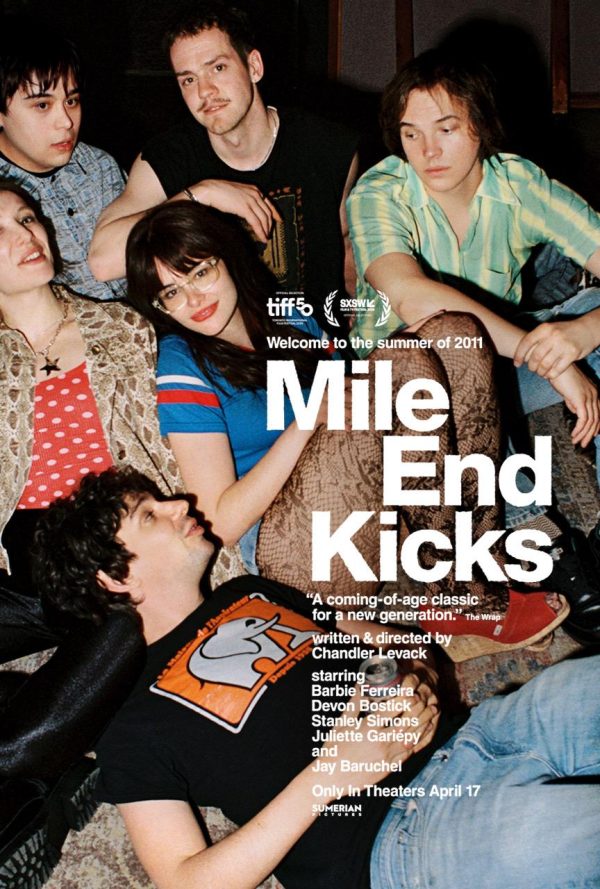
Mile End Kicks, 2025.
Written and Directed by Chandler Levack.
Starring Barbie Ferreira, Devon Bostick, Stanley Simons, Juliette Gariépy, and Jay Baruchel.
SYNOPSIS:
A young female music critic moves to Montreal to write a novel about Alanis Morissette, but complications ensue when she becomes romantically involved with two members of the band she is covering.

A director’s second feature usually tells you whether the first was a fluke or a foundation. Watching Mile End Kicks, my judgment falls towards the former. Chandler Levack follows up I Like Movies by swapping cinephile nostalgia for music nostalgia, but keeps many of the same weaknesses—only now they feel intentional rather than accidental.
The film follows Grace Pine, a young music critic following the 2011 Montreal indie music scene who moves to the famous French-Canadian city for inspiration to write a book about Alanis Morissette despite not knowing a lick of French. She’s aimless, self-involved, and, like Quentin Tarantino during his Video Archives days, convinced that being near art is the same as participating in it. That worked better in Levack’s previous film, where the character behaviour was grounded in genuine social anxiety brought up by past trauma. Here, Grace doesn’t have that excuse. She’s difficult without being especially revealing, and Barbie Ferreira, a former model, is miscast as an awkward outsider.

Ferreira still does solid work, trying to bridge the gap. She channels the vulnerability she portrayed so successfully in Bob Trevino Likes It, and it mixes well with Levack’s sensitive direction and tone so that when her character does something selfish, like blow off work or friends, you see the internal conflict; it’s just that Levack’s own script doesn’t support it. Early on, the film hints at a few interesting topics: biting off more than you can chew as an author, or a critic getting too close to her subjects, and potentially losing or discovering her voice in the process. Then it drops the idea almost entirely. By the midpoint, Grace’s career is background noise, and the story beats seem to drift by on vibes.
The influence of Almost Famous is obvious by the poster in Grace’s room and the comparison does it no favours. The stakes are lower, the humour thinner, and the characters less engaging. But some exceptions and characters work.
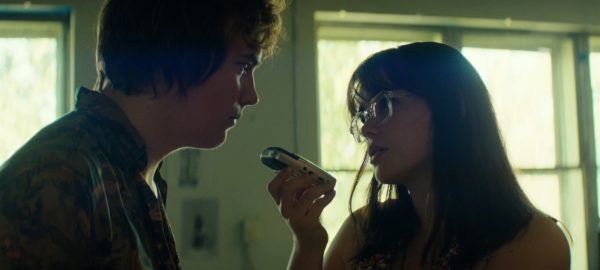
Isaiah Lehtinen, who was the lead of I Like Movies, is the thankless guitarist of the band Grace is covering, ‘Bone Patrol’ and all his scenes are genuinely funny. His offbeat energy and obliviously chill vibes recall Paul Walter Hauser and is one of the biggest sources of laughter from the audience. And Jay Baruchel as Grace’s exploitative boss, hints at a sharper, darker and more greasy version of this story. But those moments stay on the margins.
What replaces those threads is a love triangle involving a band that never becomes more than a collection of archetypes. Stanley Simons brings some presence as the frontman, but was able to show more dimension, giving the best performance in The Iron Claw— here his character is all outline and no interior. Devon Bostick has the opposite issue as the bassist: the film over-explains his character until there’s nothing left to discover. It’s unbalanced throughout—either too vague or too obvious. All three leads do the work to make these characters feel real and interesting, even if the script does not give them much interesting to say or do.

At 112 minutes, the film feels long for what it is. The central turning point arrives so late it barely registers, and Grace’s downward spiral resolves almost as soon as it begins. The issue isn’t just pacing—it’s momentum. The story never really builds.
What does work is the atmosphere. Montreal looks good, even when it’s stripped of specificity, and there’s an early party scene that feels electric—dim lighting, roaming camera with a spotlight following the protagonist, the kind of stylized music video energy that recalls the popular party art of that era with I Love College and Project X. Cinematographer Jeremy Cox who moved mountains visually with Osgood Perkins in Keeper last year deserves praise as this little Canadian film wouldn’t look out of step with Hollywood, in fact it might even look a bit better than what has released lately.

If only the film didn’t keep undercutting itself. Grace moves through the film with very little consequence—supportive parents, forgiving friends, a career that never quite demands anything of her. The climax leans on a predictable romantic decision, complicated by a late reveal that isn’t given enough time to matter.
Even the title feels like an afterthought, tied to a single scene that goes nowhere. Like much of the film, it shows up briefly, then disappears.
Levack still has an eye for performances and texture, and the cast does what it can. But Mile End Kicks never settles on what it wants to be. It gestures at a character study, a romance, and a cultural snapshot and time piece without fully committing to any of them. There’s a bit of everything here, but it just never quite comes together.
Flickering Myth Rating – Film: ★ ★ / Movie: ★ ★ ★
Will Hume