Slanted, 2026.
Written and Directed by Amy Wang.
Starring Shirley Chen, Mckenna Grace, Amelie Zilber, Vivian Wu, Maitreyi Ramakrishnan, Fang Du, Elaine Hendrix, R. Keith Harris, Megan Hayes, Kristen Cui, Charlotte Ann Tucker, Britton Webb, and Callie McClincy.
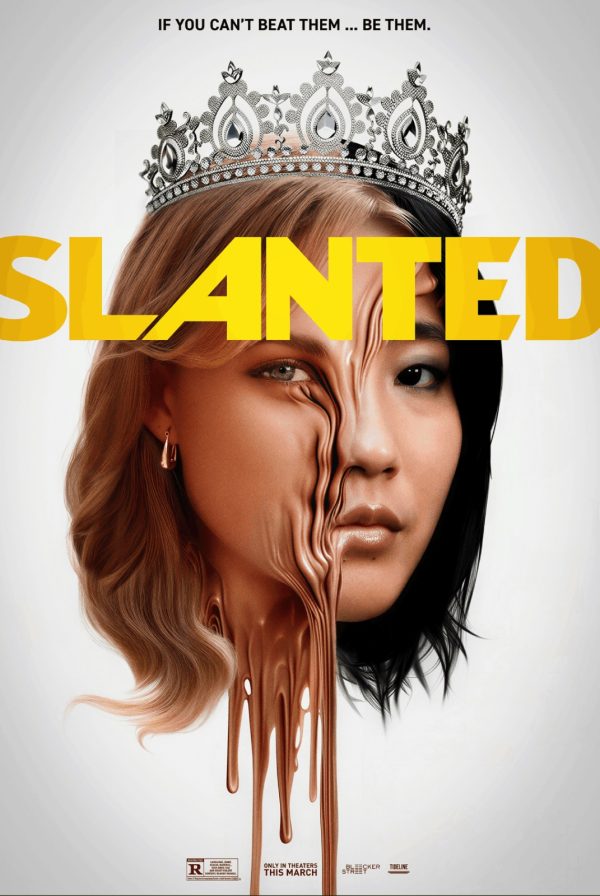
SYNOPSIS:
An insecure Chinese-American teenager undergoes experimental surgery to appear white, hoping to secure the prom queen title and peer acceptance.
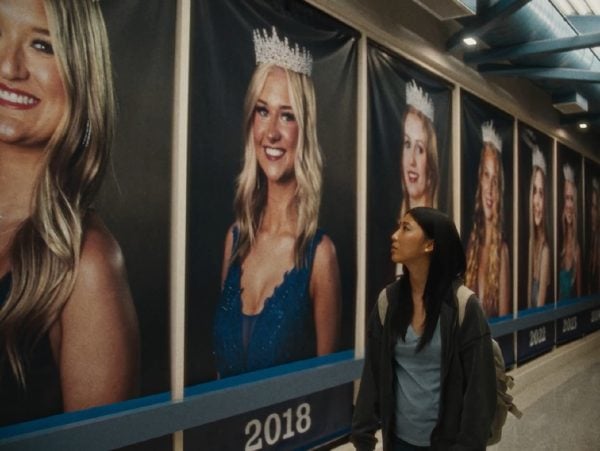
Immigrating to America can be confusing for a child. In writer/director Amy Wang’s Slanted, Joan (played by Shirley Chen in high school and Kristen Cui in this prologue at a young age) is ostracized for her Chinese heritage and culture (peers at the lunch table exclaim “gross” at her food) and she also notices that the standard for conventional beauty in America seems to have been accepted as white, blonde, and a slim figure as seen all over various advertisements. Her father, Roger (Fang Du), finds work as a school janitor, which fills Joan with some wonder before she goes up and realizes that this is “immigrant work” and “something to be ashamed of”.
In high school, Joan is essentially embarrassed by her identity and the fact that her only friend, Brindha (Maitreyi Ramakrishnan), is another person of color. There is also a split within the family as Joan gravitates more toward her father, who is understanding of her desire to westernize herself, whereas mom Sofia (Vivian Wu) remains a traditionalist, hoping to reinforce and ensure her daughter maintains a sense of pride in their identity.
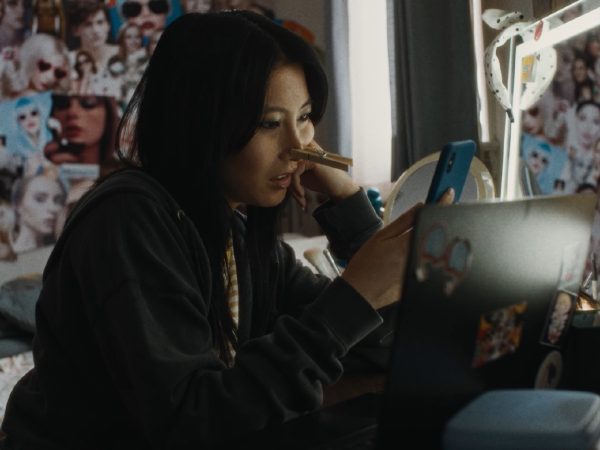
With all of this grounded and emotionally honest framework, it then becomes baffling that what Slanted is more about is a half-baked obsession with becoming prom queen (an honor seemingly only reserved for the same type of white girls mentioned above) that, admittedly involves some pointed and amusing commentary on the obliviousness and racism of such girls, slowly but steadily paving its way into a Substance-like body modification story (I cannot in good conscience use the term horror, because this film isn’t committed to going that far) about obliterating the identity of oneself for acceptance, a more socially fawned-over style of beauty, a prize, and an easier, less-judged life.
Before the film introduces this sci-fi element roughly halfway in, the film still certainly doesn’t have a handle on a firm tone, but nonetheless provides a protagonist who is deeply internally conflicted about her life, the way she is received (or perhaps more appropriately, not received but rather ignored) by others, and the possibilities of an unfulfilling future working a low-level cleaning job like the father she also has complicated feelings toward. Some humor at the expense of ignorant white women and a prom campaign is, in theory, fine, but it also begins to paint Joan as someone shallow, only concerned with coming across as beautiful in the eyes of her peers and society. The very real issues of racism in America, especially in schools of all places, in all likelihood (I can’t imagine it has gotten too much better since my day), start to feel washed away in favor of a blunt, clichéd, far less interesting story about vanity.
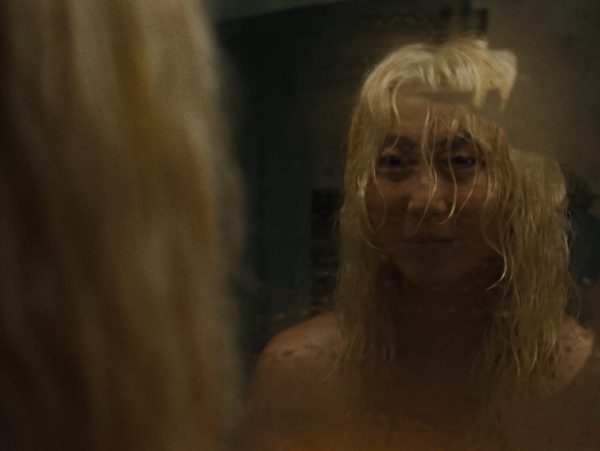
With an ethnicity-based app teased of inviting Joan to participate in something greater than simple filters that edit her selfies into a white image of herself, there is both concern that the film is really going to go off the rails yet also some slight hope that this gimmick could be the connective tissue to tie everything together into a profound statement on race relations and women’s bodies and maintaining a sense of self and culture while ingratiating oneself into America. This involves Joan, who is apparently a part of a tiny, minuscule portion of people using this app (the statistical data makes it sound like she might be the only one), taking up an offer to visit their offices where she discovers some shadiness but also a doctor well experienced in this work offering her to take part so long as she receives consent from a legal guardian (mom is easily deceived into signing the paperwork).
It turns out this is more than just facial reconstruction, and that, after going through with the procedure, Joan’s skin pigmentation has been entirely altered to the point that she is now portrayed by Mckenna Grace. Solid in what must be a challenging performance, taking over the role from another character while also trying to step into the mindset of a person of color (the Mandarin when spoken to her parents, is most likely ADR, although that would make the performance more impressive if it’s her), there are understandably numerous questions to have here not only regarding whitewashing the role, but the attempt at body horror which ultimately feels sanitized and simply doesn’t pan out, since it’s only sticking to the face and nothing too grotesque.
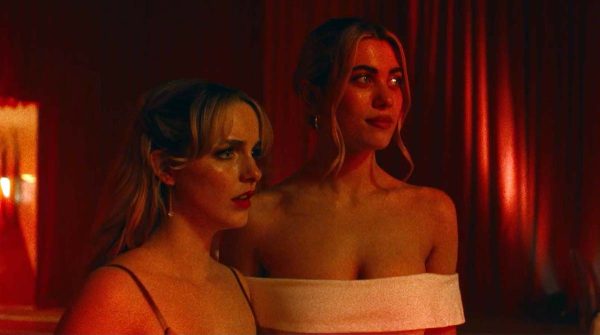
If that’s where the ambition begins and ends, why reconstruct the entire body rather than just leave it as a simple facial reconstruction? This film feels confused about what it wants to say, what genre it wants to be, and who its target demographic is (it is aimed at teenagers but is rated R, with harsh language being the deciding factor for keeping it PG-13). There are also reservations about taking the role away from Shirley Chen in the second half, who had already been holding the movie together and eliciting the necessary emotion despite the film’s faults.
To play devil’s advocate, maybe that’s for the best, given how unpleasant and unlikable Joan becomes, namely toward her parents, which comes across as emotionally false. Giving credit where it’s due, Slanted doesn’t pull a fairytale ending out of its ass, but it does introduce so much more about this company and app through certain reveals that only make the film more complicated, detracting from Joan’s character arc. It’s as if it were decided that there had to be some shocks for no real reason. It’s a film that wants to be about racism, culture, and beauty, but it is consistently undercut by being more about tropey teenage selfishness and vanity.
Flickering Myth Rating – Film: ★ ★ / Movie: ★ ★ ★
Robert Kojder