The Dutchman, 2025.
Directed by Andre Gaines.
Starring André Holland, Kate Mara, Zazie Beetz, Stephen McKinley Henderson, Aldis Hodge, Lauren E. Banks, Tracy Wilder, Shonica Gooden, Lazarus Simmons, Sally Stewart, and Megan Miller.

SYNOPSIS:
A successful black businessman, haunted by his crumbling marriage and identity crisis, is drawn into a sexualized game of cat and mouse with a mysterious white woman on a subway that leads to a violent conclusion.

In what seems to be an attempt to demonstrate how relevant The Dutchman (Amiri Baraka’s stage play) still is today, director Andre Gaines (taking a turn from sports documentaries on legendary pioneering Black athletes for a narrative feature on racial identity, co-writing alongside Qasim Basir) is telling a version of that story here with the hook that this Clay (André Holland) is another in a long line of Black men undergoing an individualism crisis between staying true to their roots and white assimilation, so much so that it may as well be a tale as old as time.
During a therapy session with his wife Kaya (Zazie Beetz), conversing about some ongoing drama that saw her regretfully cheat on him with another Black man (perhaps one much more in touch with his Blackness), Dr. Amiri (Stephen McKinley Henderson) grasps what is happening here and urges him to read The Dutchman, stressing that sometimes we see ourselves in art. That is a worthwhile message, but it’s delivered with a high-concept premise that isn’t necessarily capitalized on, merely existing as if to say, “Hey, isn’t this still timely?”
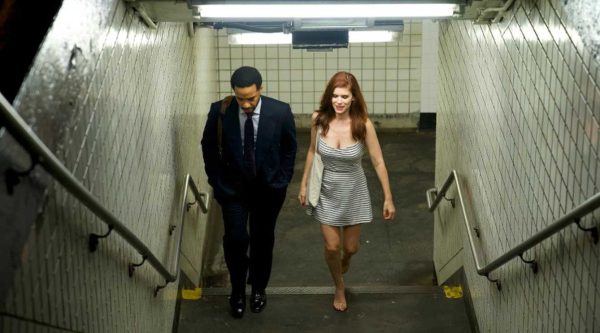
From there, Clay boards the subway home to prepare to attend his politician friend Warren’s (Aldis Hodge) fundraiser, where he will give a speech. It is on that ride where he encounters the racially insensitive but seductive Lula (Kate Mara), who somehow seems to know everything about him. She also plays mind games, telling Clay that everything she says is a lie. It’s also worth noting that she does all of this while offering him apples, in what has to be a case of biblical allegory so on-the-nose that one can’t help but cringe while watching it (this also serves as a reminder that not everything translates well to cinematic form). Opposite her, there is also a strange encounter with a mysterious woman (Sally Stewart) pleading with Clay not to go down this path and to stay true to himself, but it is a nearly non-existent, thankless role that only adds to the underdeveloped feeling behind everything here.
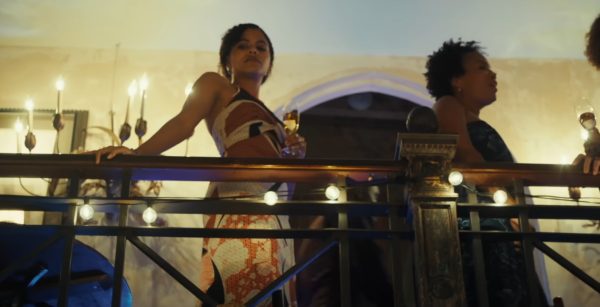
Lula’s goal naturally turns out to be a nasty one, tempting Clay into sexual intercourse at his home, only to then blackmail him into joining the party as his guest, which his wife will also be attending. The film also hints at something supernatural or demonic happening to Lula, which mostly turns out to be another element that Andre Gaines doesn’t quite know what to do with. Nevertheless, Clay and Lula arrive at the party, with him not having anything close to a prepared speech and her inserting herself into numerous conversations solely between Black people, making an ignorant fool of herself.
As a two-hander, The Dutchman occasionally works on the strength of André Holland’s performance, which ranges from conflict to confusion to vulnerability, whereas Kate Mara gets to chew the scenery and gradually become more unhinged in her thinly veiled (that is, all but thinly veiled by the finale) racism. Even then, this is a mostly repetitive story (especially once the characters arrive at the fundraiser party) that has so many ideas it doesn’t know what to do with them. It’s a film about identity that suffers an identity crisis of its own. This is undoubtedly a more admirable swing than straight-up adapting The Dutchman, but it also never figures out what it actually wants to do with that swing.
Flickering Myth Rating – Film: ★ ★ / Movie: ★ ★
Robert Kojder