Casey Chong presents an essential selection of 90s road movies…
The 1990s road movie tropes define its genre by focusing on the characters’ journey of self-discovery with thought-provoking themes from the search for freedom to identity, rebellion, adventure, and friendship. Depending on the movies, some of them lead to a positive end, while others culminate in a tragic conclusion, complete with the genre’s versatility in mixing and matching different elements, blending the likes of comedy and drama. Let’s take a step back down memory lane as we journey across ten of the best road movies of the 1990s…
Wild at Heart (1990)
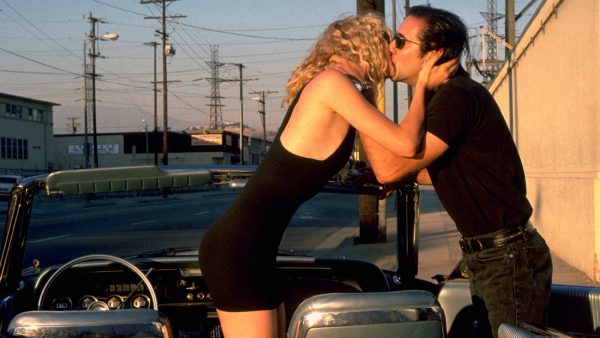
Once a lesser-known effort from David Lynch, whose Wild at Heart received polarizing responses and even got booed after winning Palme d’Or at Cannes, his otherwise divisive black comedy has been reassessed ever since. Using the familiar road-movie elements as one of the fundamental jumping-off points to navigate his adapted screenplay from Barry Gifford’s 1989 novel of the same name, the story is best described as an acid-infused journey combining the teenage rebellion vibe of Nicolas Cage’s Elvis-worshipping Sailor and Laura Dern’s feisty Lula’s star-crossed lovers-on-the-run tropes with Lynch’s signature surrealistic and dreamlike filmmaking.
Lynch also emphasizes heavily on visual and thematic references from The Wizard of Oz, evidently in Lula’s recurring hallucination of her dominant mother (Diane Ladd) as a Wicked Witch flying on a broomstick, mirroring the coercive control and obsession between their mother-daughter’s dysfunctional relationship. Wild at Heart is notable for featuring Willem Dafoe, who appears in the second half as Bobby Peru at his unhinged best.
Thelma & Louise (1991)
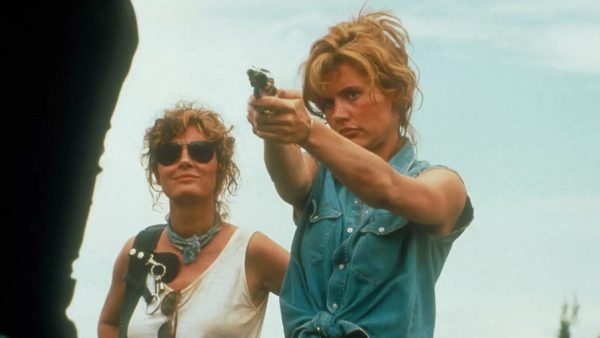
Feminist-driven movies were like an off-road niche during the 1990s era, but Ridley Scott’s absorbing take on the subject resulted in one of his best movies ever made. And of course, among the best ‘90s road movies, which follows two best friends – housewife Thelma Dickinson (Geena Davis) and waitress Louise Sawyer (Susan Sarandon) – on a weekend road trip to the fishing cabin. However, things go sideways when a man from a roadhouse bat trying to assault Thelma, before it ends with an angry Louise shooting him to death. The two soon find themselves on the wrong side of the law after they become fugitives.
Thelma & Louise benefits greatly from the solid buddy-movie dynamic of Davis and Sarandon’s engrossing performances. What elevates this movie further is how their respective arc gradually subverts as the story progresses, like how the otherwise meek-looking Thelma turns from a naïve to an unexpectedly rebellious character after everything that happens to her. The movie also famously culminates in an iconic ending – a fade-to-white conclusion as Thelma and Louise decide to drive their 1966 Ford Thunderbird convertible off the canyon, symbolizing their never-ending pursuit of freedom and the will to rebel and take control of their lives.
My Own Private Idaho (1991)

The 1991 cult classic My Own Private Idaho remains one of the key films from Gus Van Sant, marking only his third directorial feature at the time following Mala Noche and Drugstore Cowboy. The road-movie tropes are the one-half of this acclaimed indie drama, as Van Sant’s screenplay navigates Mike Waters (River Phoenix, in one of his best performances in his otherwise short-lived career) and Scott Favor (Keanu Reeves, proving his versatility as a dramatic actor beyond his Bill & Ted fame) on a cross-country journey from Portland to Idaho, before flying off to Rome to search Mike’s missing mother.
Phoenix and Reeves’ on-screen pairing highlights their rebellious, youthful energy as street hustlers in their soul-searching discovery. The movie also addresses the queer theme seen from Mike’s perspective, whose unrequited love for Scott underlines a deeply resonant drama that reflects the former’s desperate search for his mother. Van Sant even utilizes Mike’s narcolepsy disorder, not only for depicting his character’s recurring condition but also serving as a metaphor for mirroring his fragmented reality and emotional vulnerability.
True Romance (1993)
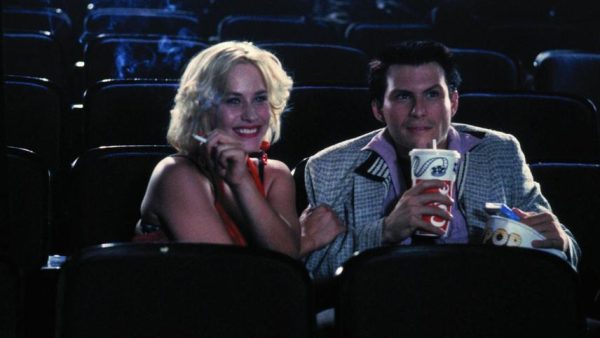
In an ideal world, it would be nice to see Quentin Tarantino himself direct True Romance if not for his decision to sell his screenplay so he could finance his own Reservoir Dogs. But life can be stranger than fiction as Tony Scott surprisingly did a good job translating Tarantino’s razor-sharp screenplay into a perfect marriage of the director’s kinetic visual filmmaking and the latter’s witty, genre-bending narrative. The story goes like this: Elvis-loving Clarence (Christian Slater) and call girl Alabama (Patricia Arquette) are in deep trouble after they steal a suitcase full of cocaine from the latter’s pimp, Drexl (an intimidating Gary Oldman). They end up fleeing from Detroit to Los Angeles, hoping to sell the coke through Clarence’s friend (Michael Rapaport), acting as the middleman. Of course, things do not go as smoothly as planned, resulting in a series of unfortunate and complicated events from both sides of the law.
The fairytale-like romance between the lovestruck Clarence and Alabama contrasts well with the violent, anything-can-happen scenario, where True Romance deftly blends visceral crime drama with road movie and action thriller tropes. The movie features great supporting characters from James Gandolfini’s volatile mob enforcer Virgil to Dennis Hopper’s Clifford, whose verbal face-off with Christopher Walken’s consigliere during the iconic Sicilian scene is a peak cinema. Further credits also go to Scott and Tarantino for packing the movie with cool pop-culture references, from Clarence’s love for Sonny Chiba’s movies to the Elvis obsession with Val Kilmer showing up as an imaginary version, and gritty Hong Kong action-movie influence.
The Adventures of Priscilla, Queen of the Desert (1994)
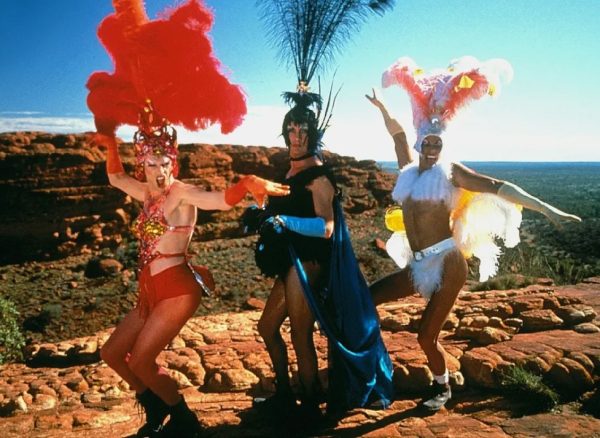
Hailing from Down Under, writer-director Stephan Elliott’s sophomore feature marked his international breakthrough as he successfully blends the road-movie tropes with a humanizing portrayal of queer characters in a positive light. Backed by a trio of career-defining performances, including Terence Stamp, Hugo Weaving, and Guy Pearce, their characters – one’s a trans woman, and the other two are drag queens – are subtly depicted as flawed and vulnerable individuals without reducing them to superficial stereotypes.
Elliott uses the characters’ cross-country journey on a tour bus across the Australian outback from Sydney to the remote Alice Springs as a reflection of friendship, self-discovery, and overcoming prejudice. The Adventures of Priscilla, Queen of the Desert equally excels as a feel-good entertainment, mixing sardonic and irreverent humor with an energetic soundtrack from Peaches & Herb’s “Shake Your Groove Thing” to CeCe Peniston’s “Finally”.
The movie won an Oscar for Best Costume Design, and thirty years after the first film, a sequel is currently in development, which would reunite the original trio, including a posthumous role from Terence Stamp, who has already shot all of his scenes during his final months before his death in August 2025.
Dumb and Dumber (1994)

Jim Carrey was on a roll in the 1990s, appearing in hit after hit, with Dumb and Dumber being one of his biggest box-office winners. He plays Lloyd Christmas, sporting a distinctive bowl cut, who’s a limo driver falling in love with the beautiful Mary Swanson (Lauren Holly). The adventure begins after she leaves a briefcase in the airport, prompting Lloyd to try to return her belongings by journeying from Rhode Island to Colorado in a van. Not just any van, but rather his best friend Harry’s (Jeff Daniels) dog-shaped van, where he used to work as a dog groomer before he got fired.
Given the dim-witted nature of Lloyd and Harry’s characters, the Farrelly brothers escalate their movie with an unhinged mix of low-brow comedy and absurd humor, subverting the typically self-reflecting road-movie tropes into a journey of accident-prone mistakes and bad decisions. It also helps that Carrey and Daniels play off each other well while delivering excellent comic timing.
Boys on the Side (1995)

Herbert Ross, whose illustrious film career as a director stretched over 25 years since Goodbye, Mr. Chips, bowed out on a high note in Boys on the Side, a quintessential ‘90s road movie that effectively mixes comedy and drama. At the heart of this movie is a trio of different women with contrasting personalities, including the cynical lesbian musician Jane (Whoopi Goldberg), an uptight real estate agent Robin (Mary-Louise Parker), and a free-spirited Holly (Drew Barrymore).
The three are brought together on a road trip as the story evolves with the love-hate dynamic between their friendship and sisterhood. Working from Don Roos’ screenplay, Ross doesn’t sugarcoat these characters’ bumpy journey beyond the movie’s humorous moments with thought-provoking themes of HIV/AIDS, same-sex relationships, and domestic abuse. Boys on the Side is equally notable for featuring Matthew McConaughey in one of his earlier film roles as Holly’s police officer boyfriend, Abe Lincoln.
Fear and Loathing in Las Vegas (1998)
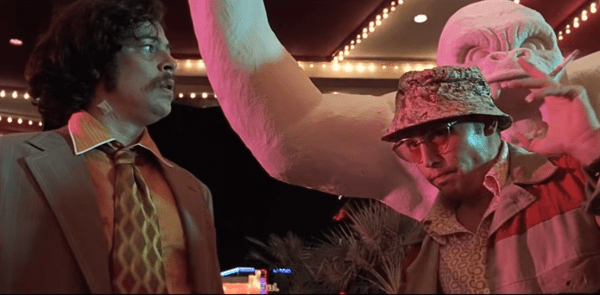
Once a polarizing movie at the time of its release, this long-in-the-making Fear and Loathing in Las Vegas has been struggling to get off the ground since the late 70s era. Notable directors like Martin Scorsese and Oliver Stone tried and failed, until Terry Gilliam signed on to direct. No doubt the right man for the job, he successfully captures the intoxicating perspective of Raoul Duke (Johnny Depp), a fictionalized version of Hunter S. Thompson, whose journey across Las Vegas is like chaos imploding from within.
Depp mumbles his way with a mix of voiceover narration and devil-may-care acting performance, while his co-star Benicio del Toro matches Duke’s eccentricity with his Dr. Gonzo’s unhinged persona. Their wild, buddy movie-style dynamic drives the movie’s otherwise episodic nature of the story. Gilliam’s gonzo style of filmmaking is on full display – disorienting camera angles, warped perspectives, and extreme close-ups that border on all things invasive to reflect the characters’ mounting paranoia and drug-fueled simulated thoughts.
Central Station (1998)

Walter Salles’ Central Station is a deeply poignant story of an unexpected friendship between a stubbornly cynical middle-aged woman (Fernanda Montenegro’s Dora) and an orphaned young boy (Vinicius de Oliveira’s Josué). The latter lost his mother following a tragic bus accident, leaving him homeless with no adult guardian to look after him. His only hope is to search for his long-lost father, where he and his mother used to pay Dora, a retired schoolteacher, making a living by writing letters for illiterate customers in the titular central station in Rio de Janeiro.
Salles takes his time developing the story before the two eventually go on a long road journey across Brazil to locate the boy’s father, highlighting the gradual character growth as Dora and Josué’s bond strengthens and their mutual understanding of human connection and self-discovery. Central Station was a big hit in Brazil, earning two Oscar nominations for Best Actress and Best Foreign Language Film.
The Straight Story (1999)

The Straight Story was the time when David Lynch went uncharacteristically off from his usual dark and surrealistic cinema in favor of a slow-moving, yet poignant drama for a change. And who could have thought a David Lynch film was granted a G-rating? As odd as it may sound, there’s an underlying sense of off-kilter weirdness behind the movie’s deceptively wholesome façade. From the suggestively ominous opening scene where the camera slowly pans towards a house to the quirky introductions of side characters (the bickering mechanic twins and an overwhelming woman who got frustrated over hitting a deer with her car), Lynch doesn’t entirely abandon his filmmaking trademark.
But what truly elevates The Straight Story is his earnest exploration of a fiercely determined protagonist – a 73-year-old Alvin Straight (Richard Fansworth, whose sympathetic performance earned him an Oscar nomination) insists on travelling hundreds of miles from his small-town home of Laurens, Iowa to Mount Zion, Wisconsin on a lawnmower hooked to a rig. His purpose is to visit his recently stroke-stricken brother, Lyle (Harry Dean Stanton), whom they barely kept in touch with for the last ten years. Along the way, Lynch incorporates grounded themes of mortality, memory, and genuine human connections through the kindness of strangers, resulting in not only one of his best films but also among the top road movies of the ‘90s era.
What are your favourite 1990s road movies? Let us know on our social channels @FlickeringMyth…
Casey Chong