Tom Jolliffe looks back at Peter Greenaway’s most iconic film, an unrestrained arthouse masterpiece…
If anyone has ever watched the film work of Peter Greenaway, then they’ll know that his films are difficult to ingest. Greenaway is an artist turned film director. He’s never been particularly cinematically minded. His canvas through the lens of his camera allows him to translate his very particular visions without compromise, but following the cinematic rules laid out by the establishment, has never been in Greenaway’s thinking. Like many other iconic directors coming from another artistic background, he looked to convey the moving image in his own distinct way, whether he adhered to any kind of rigid parameters or not. Andrei Tarkovsky, a photographer turned director, with a penchant for the intense feel of cinema over narrative logic, was similarly singular of vision.

In 1989, Greenaway would make probably his most accessible work. Firstly, as far as narrative goes, it’s deceptively simple and almost ‘genre’ on the surface. A tale of love, murder and revenge. In a nutshell that sounds like something many might find appealing. It stars Michael Gambon and Helen Mirren as husband and wife. The husband, Albert, is brutish and obnoxious. He’s a microcosm of Thatcher political semantics, as well as 80’s excess and boorish class jumping, and the eras prodigal excess. Mirren stars as his long suffering wife. Having forcibly taken over a high class French restaurant, Albert has ideas above his intellectual and class station, as he feigns a knowledge and understanding of culinary art. He imposes his will to impress on his fellow diners (of his table who are his underlings). He has no real appreciation of what he’s eating beyond the fact it’s expensive or sounds fancy.
Georgina (Mirren) is disinterested in the whole culinary affair and finds herself drawn to a lone diner who reads while he dines. The lover (Alan Howard) is the intellectual. A quiet entity in the corner of the room interested only in his literature and learning, whilst the others (Albert particularly) are more concerned with excessive expense and pretension. You might say Tory bluster still consumes genuine intellectual rationality, but Greenaway certainly takes particular aim at the eras pomposity and a perceived immorality (it’s Ken Loach through artistic metaphor and allegory). As Albert, Gambon delivers an iconic performance, and perhaps one of the most unrelentingly reprehensible characters ever committed to film. There’s such relish in Gambon’s stomping scenery chewing and he becomes oddly likeable at times. His ability too, to switch between moments of unkempt rage and childish moments of solemn sulking akin to a toddler who can’t watch Cbeebies, is absolutely masterful.
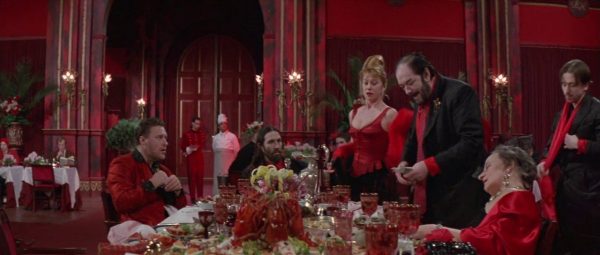
An illicit affair begins and soon the put upon head chef (Richard Bohringer) becomes an ally for Georgina and Michael. Increasingly, aside from a couple of unshakably loyal and intellectually challenged henchmen, every one is against Albert, fed up of his overwhelming, all consuming behaviour. Greenaway’s techniques here very much feel like a strange mixture of painting with the lens, and with an almost intentionally withdrawn camera that gives the feeling of looking at a theatrical stage (we largely see the sets from one place, as if our place in the audience never alters). The only times we feel that element of cinema are on long and distinctly paced tracking shots that take us from one set to another. The film predominantly taking place in the connecting areas of the restaurant itself. The outside, the kitchen, the dining area and the lavatories (we also have some more confined interiors like a larder, truck and then Michael’s library).
Greenaway had an interest in Renaissance and baroque paintings. This is something that comes across through many of his works as far as the way he frames a shot, but likewise particular in this film with such strong use of colours too. Very intense colours that feel almost painted, like the film was crafted with technicolor. Those long tracking shots take us through settings with a distinct colour code, from blue, to green, to red, amber, more earthy brown and then the near all white of the bathroom. More interestingly, some of the characters see a change in costume colours (the costumes in the film designed by Jean-Paul Gaultier no less) as they shift from one set to another, most notably Georgina, whose entire colouring changes, whilst Albert’s accessories change.
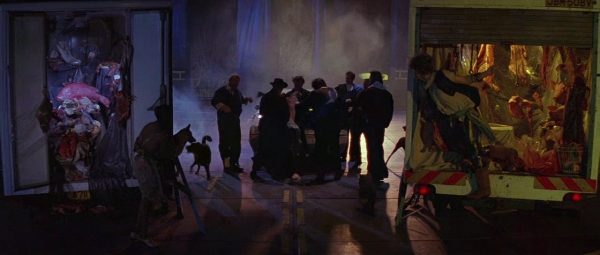
Greenaway also has a predilection for repugnance. Ordinarily, cinema looks to invite an audience and hold them into a story, even when parts of that story might become difficult to watch. Greenaway has no such care. He shows a vulgarity in violence, sexual deviance and grotesque visions of rotting meat, beaten victims of Albert covered in shit, and of the results of death by literature. All building up to a particularly macabre final moment that takes the culinary theme of excess and indulgence one step further. The film likewise, is fairly graphic with nudity. Not explicit in the way you might have seen from a Tinto Brass picture, but certainly for Mirren and Howard, everything is out on display in sequences that have a bluntness about them which never titillates (particularly when the illicit lovers have to hide in a truck or rotting meat whilst naked). Greenaway challenges us to repel, to stay beyond arms length, but all the while he shows us gruesomeness, he has layered his film in these enrapturing and beautiful images. From the framing, to the lighting, to the set decor, costumes and mise-en-scene, it’s resplendent. So despite those moments that repel, we’re ultimately enraptured, and that push pull is the mark of a master (likewise aided by Michael Nyman’s exceptional music). His anti-cinematic-establishment approach, is ultimately what makes his films inherently unique and so engrossing. None more so than The Cook, The Thief, His Wife and Her Lover.
Tom Jolliffe is an award winning screenwriter and passionate cinephile. He has a number of films out on DVD/VOD around the world and several releases due in 2020/21, including The Witches Of Amityville (starring Emmy winner, Kira Reed Lorsch), War of The Worlds: The Attack and the star studded action films, Renegades (Lee Majors, Billy Murray) and Crackdown. Find more info at the best personal site you’ll ever see here.
Originally published September 1, 2020. Updated November 29, 2022.