Josephine, 2026.
Written and Directed by Beth de Araújo.
Starring Mason Reeves, Channing Tatum, Gemma Chan, Philip Ettinger, Syra McCarthy, Eleanore Pienta, Dana Millican, Michael Angelo Covino, Stefanie Estes, and Michael X. Sommers.

SYNOPSIS:
After 8-year-old Josephine accidentally witnesses a crime in Golden Gate Park, she acts out in search of a way to regain control of her safety, while adults are helpless to console her.
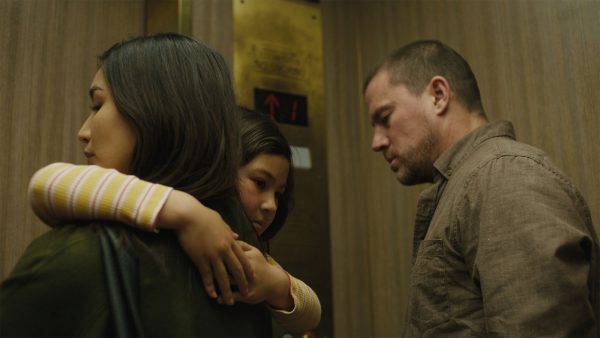
In the wrong hands, Josephine could have been a deeply irresponsible movie, given that it centers on an eight-year-old witnessing and processing a traumatic event. Even describing what writer/director Beth de Araújo’s film is about requires considerable delicacy and the use of trigger warnings.
One can’t help but notice that even if the film isn’t labeled as an adaptation, the end credits state that it is a dramatized interpretation of a real event. Whether or not this film is personal, though, it is exceptionally crafted in a way that visualizes the pain and confusion and behavioral shift stemming from the traumatic event; the perpetrator routinely appears as a silent, ghost-like figure as if to symbolize that his actions will forever loom over this young girl’s damaged psyche, first-person perspectives that seamlessly blend into third person when the time is right, one sequence sees the camera spinning in a dizzying frenzy when the conversation between parents, child care workers, and lawyers becomes too much for a child to take in. This man, resembling a ghost, also comes across as gentle sometimes, a far cry away from his behavior in the opening, playing into the confusion that has entered into the mind of the young girl, about when this particular action is acceptable and what it isn’t, and whether or not this is the case of good people sometimes doing bad things.
Full confession: this critic is getting choked up just from reflecting on the film (roughly 2 hours removed from watching it). Josephine is a shattering film in almost a million different ways, but one that sidesteps exploitation at every turn to consistently function as an engrossing, powerful look at both what trauma does to a child and how that ensuing behavior shift can throw the entire family dynamic off course. Final trigger warning: the film involves a minor, albeit not physically harmed, emotionally and mentally scarred from observing something horrifying from atop the hill overlooking a public park bathroom.
The eponymous Josephine (an astonishing Mason Reeves, who, even with stand-ins and no doubt being protected from the full dark scope of this story, delivers a pitch perfect performance whether it’s observing trauma or lashing out in response to it; it’s the best performance from a child actor since Brooklynn Prince in The Florida Project, and arguably even better than that one) gets far ahead of her father Damien (a career-best Channing Tatum, going through his own transformation following the incident, one tapping into masculine fears of not being able to protect the ones they love) while going for their morning run, training her leg strength for soccer. On the previously mentioned hill, she looks on as a woman (Syra McCarthy) is dragged from the bathroom, knocked to the grassy ground, beaten, choked, and sexually abused by a blue-shirted, curly-haired man (Philip Ettinger), all while having no understanding of what is happening.
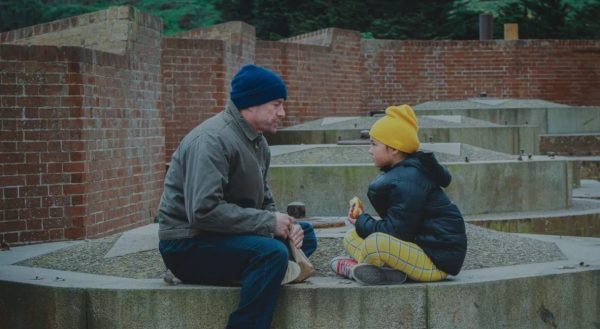
Damien arrives soon after, chases the perpetrator, and calls the police, who make an arrest quickly. That is only the beginning of the hardships that follow, as Josephine turns to the Internet to research what she saw. Meanwhile, Damien initially seems to believe there will be no residual psychological scars leftover from his daughter, casually telling his wife Claire (an outstanding Gemma Chan as the more levelheaded parent concerned with moving forward in a slightly more productive manner rather than reducing lecture with the Josephine or family conversation to the incident) that he would kill anyone if they tried to sexually assault her or their daughter. At school, Josephine isn’t merely practicing hard at soccer; she is putting all of her physicality into it, exclaiming to another boy afterward, “You will never rape me!”
Not only does Josephine take an interest in self-defense (uncharacteristically going straight to the toy-gun aisle at a store), but Damien also begins to question whether he can truly protect anyone, prompting her to take self-defense karate classes. In some of the more heated exchanges, he insists that no one can fix anyone but themselves (a devastating thing to hear from someone telling an eight-year-old girl, yet not inaccurate). The family tries to take Josephine into therapy, which the young girl rejects as a sign of weakness. Naturally, Claire grows increasingly concerned about Damien’s personality shift as well, insisting that they should pack it up and move to another home to get away from this pain, especially since Josephine also grows violent at school.
The film also functions as an indictment of the justice system, as the abuser isn’t in prison yet. That will require a testimony from young Josephine. Whether or not she can pull herself together mentally and have the maturity to do such a thing in a manner that the court will accept is another matter entirely. However, Beth de Araújo never forgets that this is the story about a traumatized young girl and a shaken, proud father picking up the pieces together and each other. Josephine is a soul-shaking, heart-racing, and unflinchingly poignant work depicting how the pain and processing of trauma spreads outward and upends an entire family.
Flickering Myth Rating – Film: ★ ★ ★ ★ / Movie: ★ ★ ★ ★ ★
Robert Kojder