Union County, 2026.
Written and Directed by Adam Meeks.
Starring Will Poulter, Noah Centineo, Emily Meade, Elise Kibler, Danny Wolohan, Sylvie Mix, AJ Hunt, Brandon Terrell, Gemma Nelms, Kevin P. Braig, and Annette Deao.

SYNOPSIS:
Assigned to a county-mandated drug court program, Cody Parsons embarks on the tenuous journey toward recovery amidst the opioid epidemic in rural Ohio.
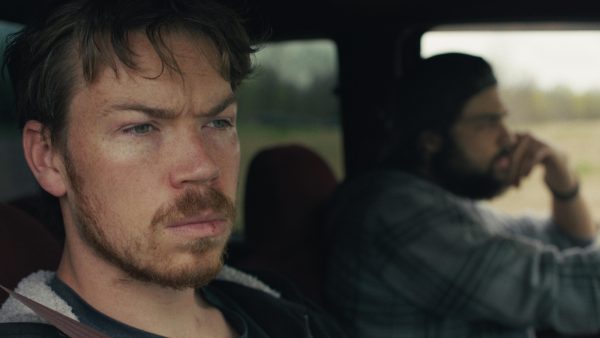
Adapting his short film into a narrative-docu-lite hybrid feature, writer/director Adam Meeks’ Union County is a sturdy story about the hardships of overcoming opioid addiction and staying sober, even if it probably should have stuck to one format or the other. It isn’t that Will Poulter is giving a bad performance here as Cody, but rather that even if his work is grounded and believable, there is no shaking that it is the Hollywood counterpart, given that he is often in the same scenes as jittery, fidgety, real-life addicts who have had their physical appearance and dental hygiene visibly affected. Typically, films are applauded for casting real people in background roles like these; here, it is a mild distraction whenever that reality is forced to coexist with the more standard dramatic machinations of Cody’s journey. Yet in the end, the whole is still emotionally effective.
Cody is a homeless addict living in his car, ordered by the court to show up to a group recovery program that his foster brother, Jack (Noah Centineo), is already mandated to take part in. The hope is that bringing the brothers together will have a positive effect on both of their recovery journeys. Jack shows Cody the ropes for a workshop gig that involves cutting wood, and they attend nightly campfires where the former is much more sociable and flirts with women.
During the day, each member of this program takes their turn standing in front of the classroom, so to speak, sharing words about their journey, whether it’s milestones to be proud of or setbacks. Naturally, there are mandatory drug tests as well. However, some of the film’s most compelling moments come from listening to these clearly real addicts (or at the very least, addicts’ versions of themselves) openly talk about their progress, good or bad. It’s enough to make one also want a feature-length documentary on the same subject (the film itself is dedicated to this real program). A clever casting choice that fits this film is that Cody’s handler, someone seemingly always available on call if he is fighting a relapse, is also played by a real individual involved with this program.
Again, that’s also not to say the fictionalized narrative aspects here are a failure. After a while, it turns out that putting the brothers together does not have the desired effect, as there is a relapse. This forces Jack to be moved to a more strict, severe treatment facility, whereas a room is freed up in this group home for Cody. It also brings on another attempt at recovery, this time reckoning with the fact that he is the one responsible for getting Jack hooked on opioids in the first place, struggling for forgiveness from his sister-in-law, and to be given a chance to be a solid role model uncle to his nephew. Cody also finds a potential love interest in a woman who lives nearby, who has gone through this treatment process but stays to encourage newcomers through the door or anyone in need of help. Thankfully, this isn’t a full-blown romance, but the mere possibility is still somewhat corny and convenient, given how attractive these two are compared to everyone else in the movie.
When Union County is in a quiet observing register, whether it be watching Cody wet a toothbrush while standing outside his car, coming to terms with the fact that the road to forgiveness is much tougher than the already difficult recovery road, or the stories of other addicts rehabbing, it is a moving watch. It may be fleeting, but there are moments where the ambitious approach comes together.
Flickering Myth Rating – Film: ★ ★ ★ / Movie: ★ ★ ★
Robert Kojder