Dracula, 2025.
Written and Directed by Luc Besson.
Starring Caleb Landry Jones, Zoë Bleu, Christoph Waltz, Matilda De Angelis, Ewens Abid, Guillaume de Tonquédec, David Shields, Bertrand-Xavier Corbi, Raphael Luce, Liviu Bora, Anne Kessler, Romain Levi, Jassem Mougari, Thalia Besson, Haymon Maria Buttinger, Ivan Franěk, Karim Rakrouki, Arben Bajraktaraj, Nicola Puleo, Aaron Guillemette, and Alex Andréa.

SYNOPSIS:
When a 15th-century prince denounces God after the devastating loss of his wife, he inherits an eternal curse: he becomes Dracula. Condemned to wander the centuries, he defies fate and death itself, guided by a single hope — to be reunited with his lost love.
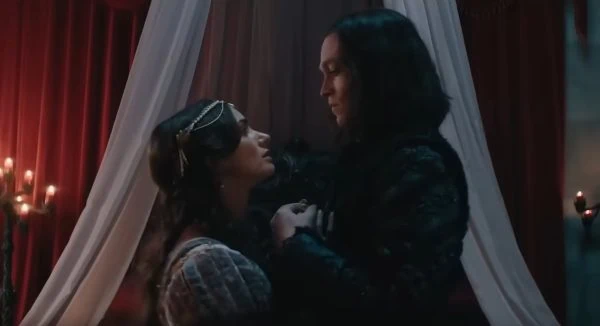
Somewhere within faithful adaptation, hilariously unfortunate fashion choices, and pointless video game-reminiscent add-ons like gargoyle minions (PS1 games were sometimes rendered with more detail) in writer/director Luc Besson’s Dracula (no, he should not be allowed to make movies for any country due to his controversial history behind and in front of the camera, but alas, here we are with another French production that relocates some of the source material to Paris) is an intermittently compelling take on the material centering a crisis of faith, religious betrayal, and a more romantic version of yearning than typically depicted.
At times, Dracula is in lockstep with Guillermo del Toro’s unabashed sympathy for monsters and the supernatural. There are also flashes of an attempt to capture the look and energy of Francis Ford Coppola’s Bram Stoker’s Dracula, but this interpretation ultimately comes up short as Luc Besson doesn’t have much personality or even wanton violence (for a Dracula movie with several swordfights, the blood here is minimal aside from one cartoonish decapitation that comes out of nowhere) to dish out, not to mention tosses in out-of-place cartoony elements like the previously mentioned gargoyles that don’t add anything.
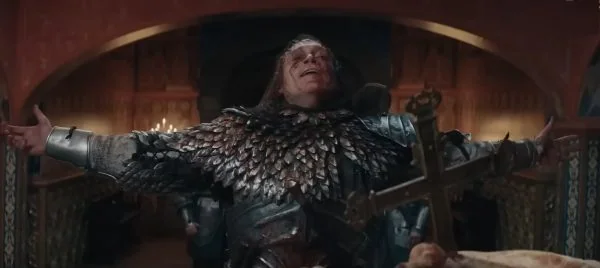
The film generally only sparks when it is operating in hopeless romantic mode, with serviceable performances (Caleb Landry Jones, who is now apparently the filmmaker’s muse – which begs the question what he is doing with his acting career – has a hokey accent leaning too far into Dracula caricature although he admitted the nails the seductive, deceptive, and romantic traits) and a religious emphasis elevated by the reliably quirky Christoph Waltz as a vampire hunting priest.
Opening at some point in the 15th century, Vlad the Impaler (Caleb Landry Jones) is madly in love with his wife, Elizabeta (Zoë Bleu). The only thing he asks of God is to ensure her safety when he is off slaughtering armies in his name. During a decently sized battle (especially given what budget constraints had to be in place) and a castle siege, Vlad’s beloved is placed in harm’s way, where she meets her demise at the exact moment he comes to her rescue. From that day forward, he doesn’t merely renounce his faith but murders the priest who blessed her safely, in turn making a wooden Jesus Christ cry.
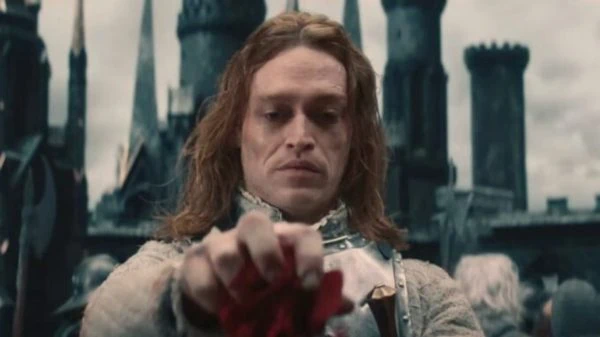
Flash forward 400 years, and Vlad is still alive, apparently cursed by God with eternal life for sacrilege and turning his back on his faith, doomed to never see Elizabeta in the afterlife. As everyone knows, he is also now a vampire, drinking blood to reverse his aging. This is where the film also enters some of the more traditional storytelling beats, such as the arrival of John Harker (Ewens Abid) to discuss selling the property, who has a wife named Mina (also played by Zoë Bleu) who resembles his long-deceased beloved.
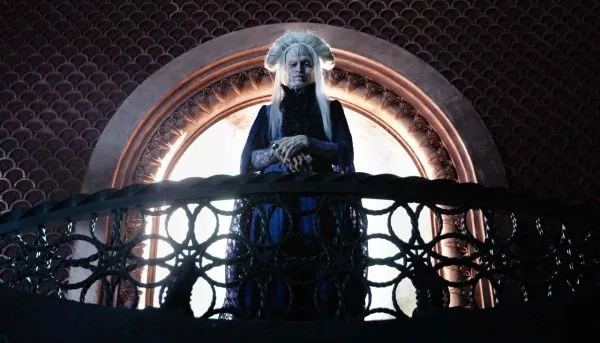
As they converse, flashbacks offer glimpses into Vlad’s journey across centuries as he searches for his dead wife’s reincarnation. At one point, he bites the neck of one woman after another in a preposterous scene where every woman surrounding them either doesn’t acknowledge what’s happening or looks on in horror, waiting their turn, resembling broken or straight-up bad video game AI. However, what truly sinks this section is that, in the present day of the timeline, the makeup effects, wardrobe, and prosthetics applied to Dracula are impressive yet give him an unintentionally funny appearance of an old woman. Other instances of costuming and production design are all around solid, meaning the quality is inconsistent and unpredictable from scene to scene.
Nevertheless, the mere sight of Mina in John’s locket reinvigorates his quest for love: violent toward everyone in his way, yet steadfast in his gentlemanly demeanor when he finally meets her, he uses telepathic powers to show her his former life and how much he loved Elizabeta. This third act is by far the strongest aspect of Luc Besson’s Dracula, as it wholeheartedly embraces doomed romanticism and expressions of centuries-long yearning. There is even a satisfyingly staged and choreographed sword fight throughout Dracula’s Carpathian Alps castle alongside a genuinely moving ending. It’s a shame that the film doesn’t have much life until then.
Flickering Myth Rating – Film: ★ ★ ★ / Movie: ★ ★
Robert Kojder