Hasitha Fernando dives into the story behind Crocodile Dundee at the film celebrates its 40th anniversary…
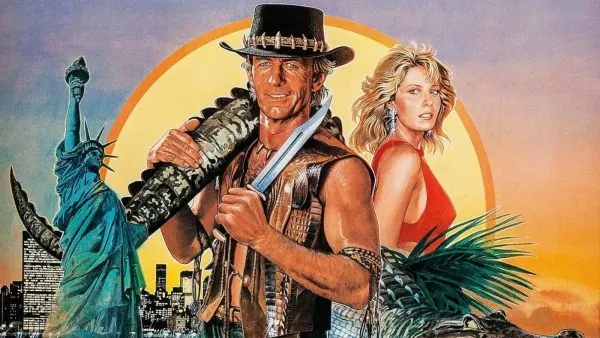
When Crocodile Dundee debuted four decades ago it became an instant pop-culture phenomenon, launching actor Paul Hogan into the proverbial stratosphere and making the comedian a household name. The character of Mick “Crocodile” Dundee too became immensely popular with audiences, who found the Aussie bushman’s laidback charm simply irresistible. The unique spin the story put on the age old “fish-out-of-water” premise was also refreshing to people who went to see the movie. As the film celebrates its 40th anniversary we look back at what went on behind-the-scenes and how a modest Australian production went on to become a global sensation…
The idea for the film came to Paul Hogan when he visited New York
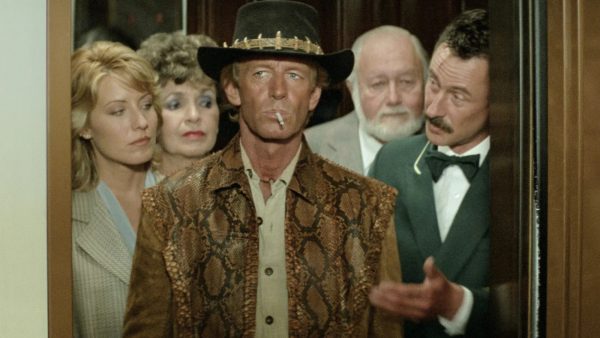
Paul Hogan started his career in Australian television in 1971 with the Nine Network’s amateur talent program titled New Faces. Hogan proved his mettle as a natural comedian during this show and its success led to his own comedy sketch TV program The Paul Hogan Show by 1973. The show ran for twelve seasons until 1984 even after the increasing popularity of Hogan with the release of Crocodile Dundee. After stints in advertising for Winfield cigarettes and Foster’s Lager, Hogan got his big break with Crocodile Dundee, an idea which came to him when he was once visiting New York, where he felt like a proverbial “fish-out-water” in the highly modernized urban setting. Hogan wondered what it would be like if a Northern Territory bushman arrived in a radically urbanized place like New York and how he’d react to the environment and its occupants. During an interview Hogan revealed that there’s an established image of outback Australians in the minds of Americans, and he just wanted to give more of that.
Was there a real-life inspiration for the Crocodile Dundee character?
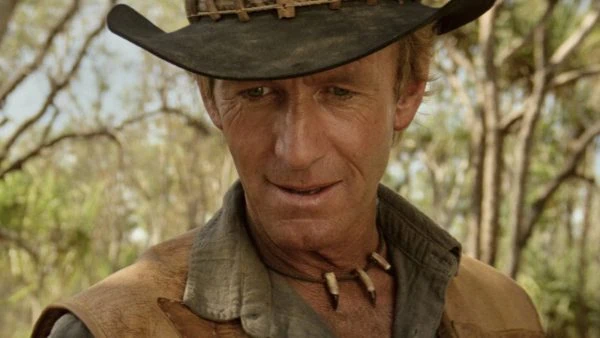
In spite of Paul Hogan’s insistence that Crocodile Dundee was, indeed, his own creation, it was later revealed that there was an Australian bushman by the name of Rod Ansell who may have served as the real-life inspiration for the iconic character. Ansell received popularity in 1977 when he was stranded in the outback wilderness for two months, after his boat capsized while he was in a solo hunting expedition. He survived by consuming cow blood, sleeping in the snake infested bush and on occasion fighting and decapitating the odd crocodile. During an interview BBC Ansell revealed that the little detail where he slept in his sleeping bag on the floor when he was accommodated at a famous five-star hotel was what inspired Crocodile Dundee’s story. After the success of the film Ansell even took Hogan to court, albeit with unsuccessful consequences. We will never know if Ansell’s ordeal really happened or whether it was all a publicity stunt by the bushman, but for what its worth, it’s certainly a very interesting story.
Linda Kozlowski was the only American on set during the shoot Down Under
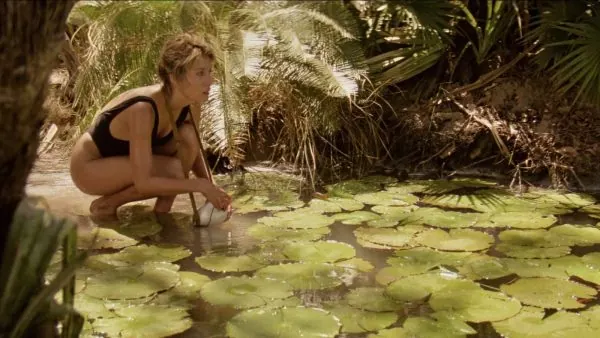
Linda Kozlowski played Sue Charlton, the love interest of the rough and tumble Outbacker Crocodile Dundee, in the movie. In the film her genuine onscreen chemistry between Hogan added some much needed emotional depth, in an otherwise comedy-centric effort. The actress was the only American on-set the during the entirety of the Australian shoot, which was done in the Northern Territory. Crocodile Dundee was the feature film debut of Kozlowski, and she also reprised her role for the two sequels that followed. Kozlowski was imported by the producers to play the American reporter and initially Actors Equity Australia were against this decision. Later, however, the trade union retracted those sentiments and allowed Kozlowski to join the cast of Crocodile Dundee.
The film’s budget was achieved through government tax concessions
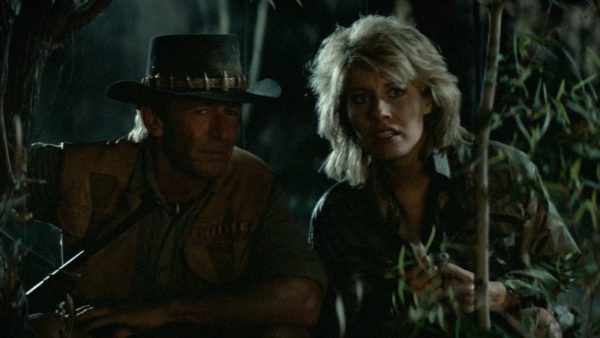
Paul Hogan brought in his collaborators from television to help bankroll and produce Crocodile Dundee. This included Hogan’s manager John Cornell, The Paul Hogan Show co-writer Ken Shadie and the show’s director Peter Faiman. Shadie co-wrote the screenplay for Crocodile Dundee with Hogan and Cornell while Faiman helmed the effort. The movie’s production budget was Australian $8.8 million which was equivalent to around $2 million at the time and this modest budget was raised through generous tax concessions given by the Australian government.
Michael Hutchence and the band members of INXS invested in the film
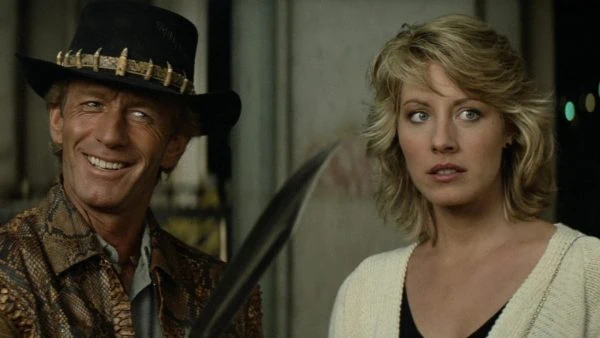
INXS is a band that requires no introduction. Originally called the Farriss Brothers, the group, fronted by lead singer and lyricist Michael Hutchence achieved international recognition and great success with hit singles like “Original Sin”, “What You Need” and “Need You Tonight”. Apart from providing the song “A Different World” for the soundtrack of Crocodile Dundee, INXS and Michael Hutchence also invested in the film itself, to help decrease paying more tax in Australia. These investments certainly turned out to be quite the rewarding venture for INXS as the movie’s unexpected success ended up making them a fortune.
Insurance didn’t allow real crocs to be used for closeup shots
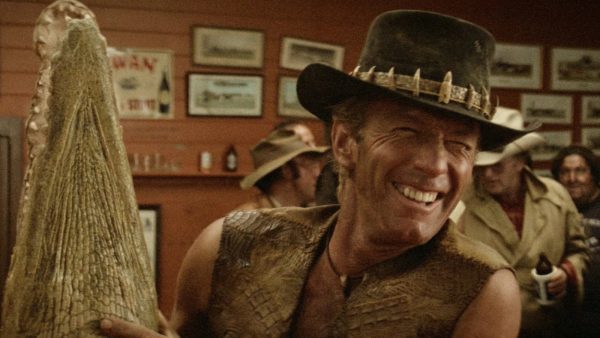
Kakadu National Park is a World Heritage Site and a protected area of wilderness located in the Northern Territory of Australia southwest of Darwin. The production of Crocodile Dundee shifted to Kakadu National Park at the end of its dry reason since crocodiles were less active during this time period and therefore wouldn’t pose much of a problem for the cast and crew. Since the insurance companies wouldn’t allow real crocodiles for the movie, the ones seen during closeups were actually a life-size rubber model on an underwater rail. The crocodile attack sequence was shot at Girraween Lagoon, located just out of Darwin. Other locations featured in Crocodile Dundee are Gunlom Falls and the rural town of Cloncurry.
Certain scenes in the film were changed prior to its release in the USA
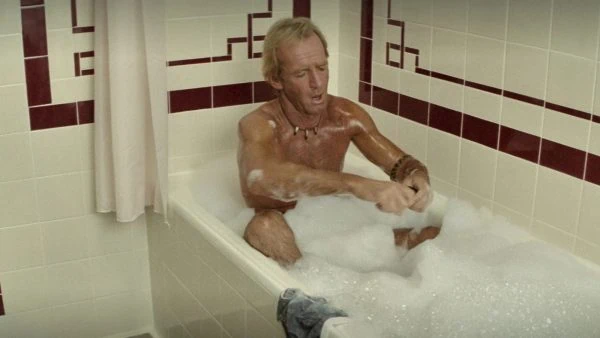
In order to appeal to a broader audience Crocodile Dundee underwent a few changes and edits that resulted in a version of the movie that was six-minutes shorter than the original Australian cut of the film. Certain Aussie slang words, such as “stickybeak”, which were unfamiliar to international audiences were substituted with more familiar sounding words. In addition, dialogue-heavy scenes which allowed character development were also removed, in order to make Crocodile Dundee more of a comedy-centric affair. The American title even had quotation marks around the word “Crocodile” so that no one would mistake the movie to be centered around a crocodile.
Box-office success, rave reviews, award wins & the launch of a franchise
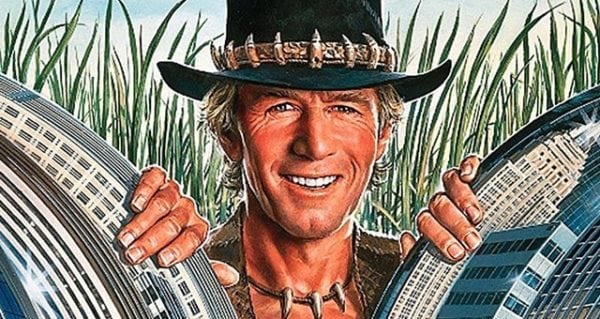
Made on a production budget of approximately $2 million Crocodile Dundee went on to make a whopping $328 million at the worldwide box-office, surpassing the critically acclaimed Mad Max 2 to become the highest-grossing Aussie film at the worldwide box-office. The effort was also the highest-grossing film of all time in both its native country of Australia and its neighboring country of New Zealand. Chicago Time film critic Dave Kehr gave the effort 3 stars out of 4 writing, “Handsomely directed by Peter Faiman, the film punches most of the right buttons at most of the right times and emerges as an effective crowd-pleaser”. During awards season the charismatic Paul Hogan even won a Golden Globe Award for Best Actor and received nominations BAFTAs as well. The screenplay crafted by Hogan, Ken Shadie and John Cornell even received an Oscar nomination for Best Original Screenplay at the 59th Academy Awards ceremony, which Hogan co-hosted with Goldie Hawn and Chevy Chase, such was the meteoric rise in popularity of the down-to-earth Aussie actor and the iconic character that he’d created.
Being a love letter of sorts to Australia, which showcased its unique landscape, wildlife and cultural nuances, Crocodile Dundee had a tremendous impact in boosting tourism for Australia back in the 1980s. Kakadu National Park still runs a Crocodile Dundee tour where tourists can visit the very locations seen in the film. The producers of the film, wanting to capitalize on the success of the IP, churned out two sequels titled Crocodile Dundee II and Crocodile Dundee in Los Angeles which were released in 1988 and 2001 respectively. Neither sequel were met with good reviews and with the dismal box-office performance of the third outing the franchise came to a close. But in spite of this, four decades later Crocodile Dundee still remains a beloved classic and continues to resonate with audiences with its unique blend of humor, action and proves, without a shadow of doubt, that great storytelling knows no borders.
What are your thoughts on Crocodile Dundee? Let us know on our socials @FlickeringMyth…
Hasitha Fernando is a part-time medical practitioner and full-time cinephile. Follow him on Twitter via @DoctorCinephile for regular updates on the world of entertainment.