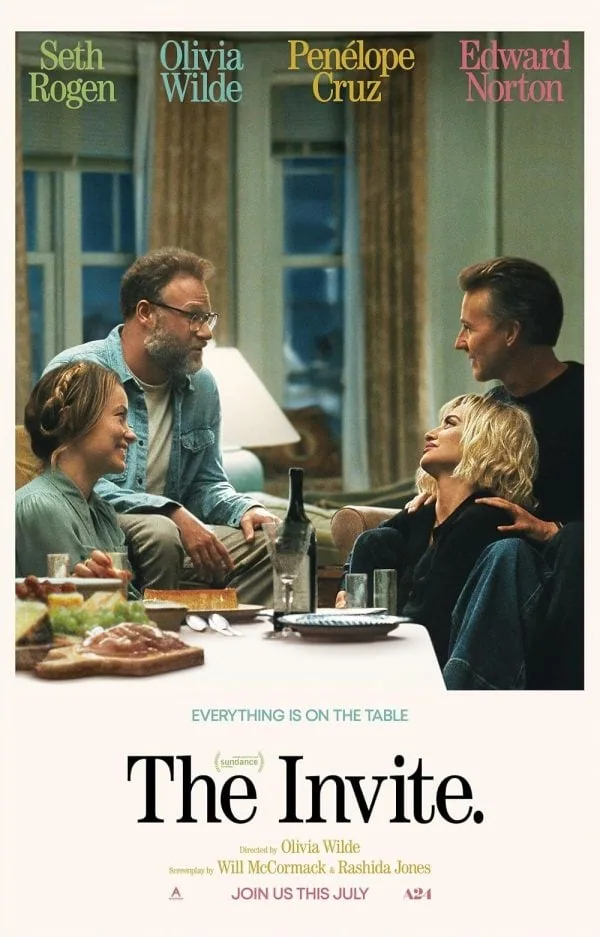
The Invite, 2026.
Directed by Olivia Wilde.
Starring Olivia Wilde, Seth Rogen, Penélope Cruz, and Edward Norton.
SYNOPSIS:
Joe and Angela’s marriage is on thin ice. When they invite their enigmatic upstairs neighbors for a dinner party, the night spirals into unexpected places.
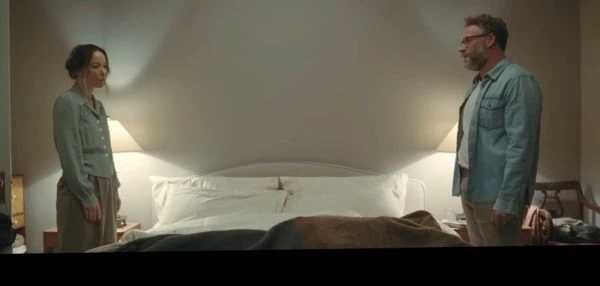
Before Seth Rogen’s Joe and Olivia Wilde’s explicitly state the last time their married couple has had sex in The Invite (the latter pulling double duty as the director), the private dysfunction in that dynamic seen for roughly ten minutes before apartment neighbors, Edward Norton’s Hawk and Penelope Cruz’s Pina, arrive for a get-together dinner, there is no question that it has been a long time.
Nevertheless, Angela wants to apologize to the much more sexually active couple about the frequent noise coming from their home during a lengthy period of renovations, whereas Joe, who is already having a lousy day as a music teacher at a small conservatory and dealing with intrusive back pain, is livid that that she has not only invited them over without running it by him (she tells him that she actually did multiple times, and that he doesn’t listen, much like he shows no romantic or sexual interest in in her anymore), but that they will be the ones apologizing for such noise when Hawk and Pina regularly keep him awake at night with intense orgasms (amusingly explaining to their unseen young daughter – at a sleepover during the events of the movie – that that they are moving furniture around).
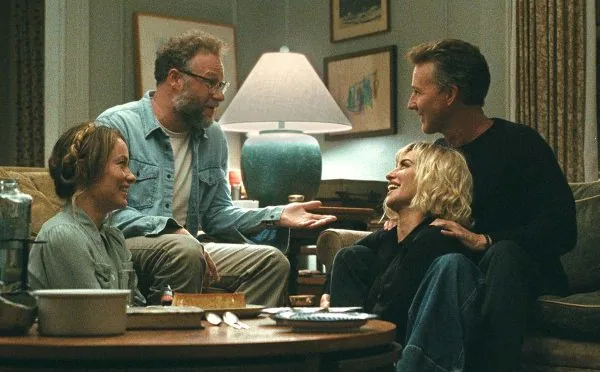
As such, the no-BS, blunt Joe *Seth Rogen laugh* pun intended threatens to blow up the entire evening by confronting and shaming Hawk and Pina for the erotic noises, therefore also embarrassing Angela in the process. Naturally, much of the humor comes from this chaotic uncertainty, which, unlike most modern comedies (especially those sent out to die on streaming services, repeating the plot over and over), contains almost no dead air. Even with a sharp script from Rashida Jones and Will McCormack (based on Cesc Gay’s film Sentimental), one can also feel each actor imbuing a sense of themselves into their characters, most notably Seth Rogen who appears to be improvising at a hilarious hit-ratio that might be still be prevalent on TV shows like The Studio, but not necessarily from movies lately as he had been taking more dramatic roles.
Then there is Olivia Wilde’s direction, which refuses to let these stagey actors settle into a generic shot-reverse-shot formula, consistently making use of mirrors reflecting a character into the frame, or voyeuristic shots from a room or two removed, knowing full well that we are peering in on a combustible situation. This is a film that could have comfortably settled for relying on those performances; instead, Olivia Wilde has directed the hell out of it (similarly funny is the pounding, anxiety-filled score by Devonté Hynes that feels like it belongs in a war movie, every time the dinner somehow makes Joe more uncomfortable). It is also not just impressive that she and company keep the proceedings so undeniably funny at such a rapid pace, but also consistently drip-feed new revelations and information about these characters during zingers and laughs.
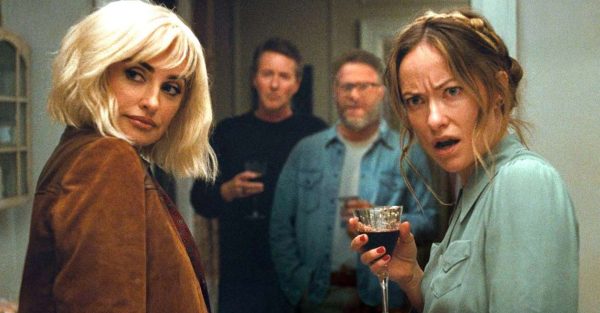
Without giving too much away, all that will be said is that the dynamics between these four characters frequently shift, with even Joe flustered and trying to lie his way through a couple of conversations that paint them in a negative light. There is also the truth regarding why Hawk and Pina were really invited, which flirts with transitioning the proceedings into a raunchy sex comedy while also threading the needle, sometimes clunkily, into something weighty and meaningful, tackling what happiness in a relationship means, why Joe and Angela are miserable together, the dreams and ambitions that the former has ran away from, and assessing whether or not sex is constructive or deconstructive, depending on where the parties are and what emotions they are harboring. Also rising to the surface is the emotional honesty of what Angela needs to be happy sexually, bringing up kinky feelings of being desired that Joe never knew were there. The film also works on a more simplistic level, where neighbors can see through when you are trying to BS them or trying too hard to impress.
Yes, that’s one way of saying that, amid the rampant laughter, the otherwise crowd-pleasing and uproariously funny The Invite ends up, touchingly, fully being about something, even if it is telegraphed from the opening quote by Oscar Wilde. There is also an argument to be made that this is a more mainstream film that runs away from some of its more kink-charged ideas quickly after being brought up. In short, it also struggles and falters as it strives for something deeper, even if it does close on a moving note. Regardless, accept the invitation; this one is a laugh-riot with its outstanding quartet, effortlessly matching one another.
Flickering Myth Rating – Film: ★ ★ ★ / Movie: ★ ★ ★ ★
Robert Kojder