Every Heavy Thing, 2025.
Written and Directed by Mickey Reece.
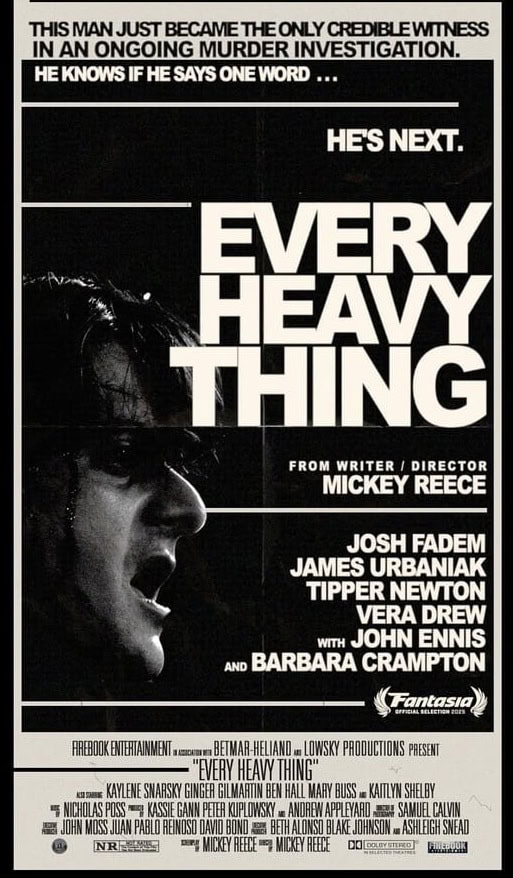
Starring Josh Fadem, James Urbaniak, Tipper Newton, Vera Drew, John Ennis and Barbara Crampton.
SYNOPSIS:
Set against a string of women’s disappearances in Hightown City. Joe, an ad-seller for the last alt-weekly in the state, unwillingly becomes entangled in conspiracy after witnessing a murder.

Having had some exposure to his work, it feels like Mickey Reece has always operated on a slightly skewed wavelength. With Every Heavy Thing his instincts seem particularly focused, as if all his obsessions with paranoia, technology, identity and decay have met synergetically.
Set against a dark backdrop with women vanishing from the margins of a mid-sized American city, the film follows Joe, played with twitchy adroitness by Josh Fadem. Joe sells advertising space for the last alt-weekly newspaper still limping along in Hightown City. He’s a man who knows everyone but understands very little about himself. One night, after a jazz club performance by torch singer Whitney Bluewill, he witnesses a murder – an event which becomes more of a slow infection than a turning point, and what Joe internalises, then begins to hollow him out.

Reece looks to have little interest in treating this as a conventional crime thriller. The plot is deliberately porous, drifting in and out of focus as Joe’s mental state deteriorates. The film is less concerned with who did what than with what it feels like to live under constant surveillance, and to suspect that every image you see is watching you back. The conspiracy elements, involving a tech magnate with plans for the town’s future, function more as atmosphere than explanation with the real story being Joe’s slow unravelling, his grasp on normality slipping as work, love and conscience collide.
From the opening scenes, Every Heavy Thing is soaked in analogue dread. Reece bathes us in eroded neon, vintage lens soft focus and textured grain, conjuring the ghost of Eighties thrillers. There are nods to De Palma and Lynch, but filtered through Reece’s own off-kilter humour and taste for awkward pauses. Lucille Gable’s editing frequently feels unstable, as if the film itself might glitch out at any moment, while Nicholas Poss’s synth-heavy score hums and pulses like a malfunctioning hard drive. This is an aesthetic that many filmmakers reach for; Reece and his crew nail it.

The performances are uniformly strong. Fadem leads with a beautifully modulated turn, his everyman anxiety gradually mutating into something darker and damaged. Tipper Newton brings warmth and bite to Lux, whose relationship with Joe becomes another pressure point rather than a refuge. James Urbaniak is icily effective as William Shaffer, a man embodying corporate menace. And Barbara Crampton, used sparingly but memorably, leaves a lingering impression that speaks volumes about Reece’s instinct for casting against expectation.
Every Heavy Thing refuses to over-explain. Reece trusts mood over mechanics and implication over answers. The film drifts, doubles back on itself, then lurches forward with sudden clarity, mirroring Joe’s own fractured perception. It won’t be to everyone’s taste, and that’s part of its strength. This is cinema that unsettles by suggestion rather than theatricality.

Every Heavy Thing feels less like a mystery solved than an experience survived. Strange, abrasive, often funny and quietly devastating, it stands as Reece’s most confident work to date. It’s a reminder that impactful cinematic unease rarely comes neatly packaged.
Flickering Myth Rating – Film: ★ ★ ★ ★ / Movie: ★ ★ ★ ★
Tom Atkinson
Originally published January 17, 2026. Updated January 18, 2026.