Adam Page on when horror got smart…
I’m not going to sit here and pretend that, before the 1990s, horror was in some kind of intellectual wasteland. That would be bullshit. George A. Romero gave us pointed social commentary nicely wrapped in entrails. David Cronenberg gave us body horror as technological anxiety, and David Lynch was doing… just what David Lynch does. But in the early 90s, something fundamental shifted. The genre stopped apologising for itself.
Somewhere in between Reagan-era slasher fatigue and post Cold War-malaise, a few moviemakers decided that scaring the crap out of people and making them think weren’t mutually exclusive ideas. I know, revolutionary. They brought in the baroque mythology of Clive Barker, the paranoid philosophy of John Carpenter, and the psychological dissolution of Adrian Lyne. They made movies that understood the most effective horror doesn’t just show us the monster. It makes us complicit in the monsters very existence.

Candyman, directed by Bernard Rose, hit the screens in 1992 like a straight razor hidden in an academic paper. Based on Clive Barker’s short story The Forbidden, it had a simple hook, pardon the pun. Say his name five times in a mirror and he appears. Rose transformed Baker’s story into a meditation on urban decay, racism and the stories we tell ourselves to make sense of systemic violence.
Our protagonist, Helen Lyle, is a graduate student studying urban legends in Chicago. She is white, privileged and totally oblivious to her position in the power structures she’s examining. She treats Cabrini-Green, the housing project, like an anthropological site, somewhere to extract stories, work on her thesis and advance her career. The real horror of Candyman isn’t the supernatural killer with a hook where his hand should be. It’s the slow realisation that Helen has stumbled into a narrative she can’t control, digging into a mythology born from real historical trauma that she has no claim to.
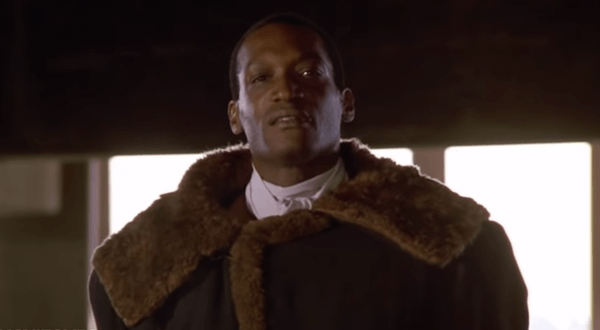
Daniel Robitaille, the Candyman himself, is the son of a slave, an artist, a lover, a victim of a lynch mob and exists right at the intersection of ghost story and historical memory. He is an embodiment of the violence that white America would prefer to forget, and summoned by the simple act of speaking his name. Barker and Rose understood something crucial: folklore isn’t just entertaining. It’s how communities deal with trauma, how they warn each other. How they remember what the official history wants to erase.
The movies score, by Phillip Glass, does something remarkable. The minimalist and repetitive structure is hypnotic and ritualistic. It becomes the horror. The ascending and descending patterns are a mirror to the movies own logic, Helen drawn deeper into the mythology until she becomes a part of it. Until she is it.
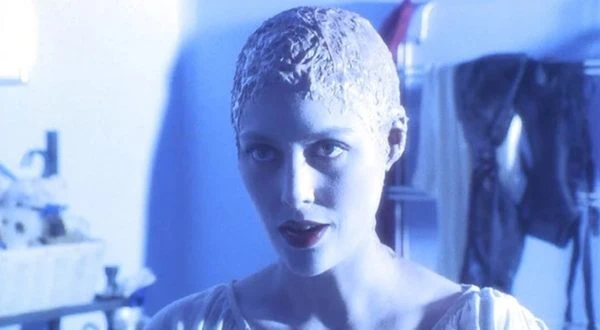
The depiction of the Cabrini-Green projects were problematic on the movies release and are still debated now. But Rose doesn’t shy away from the complexity. The projects aren’t just some backdrop used for scares. They are the result of of segregation, policy decisions and disinvestment. The real horror is that those residents need Candyman. They need that mythology to explain the fear and violence, and how their neighbourhood has been abandoned by the surrounding city. Candyman’s legend is a type of control in a place where all control has been torn away.
Rose then does something really gutsy. He makes Helen the new Candyman. She changes into the legend, the cautionary tale. A story that mothers tell their children. It’s transubstantiation, a dark baptism. The white academic who came to study urban legends is transformed into one. Her body absorbed into the mythology she treated as mere research material. There’s a brutal irony there, and Rose never blinks.
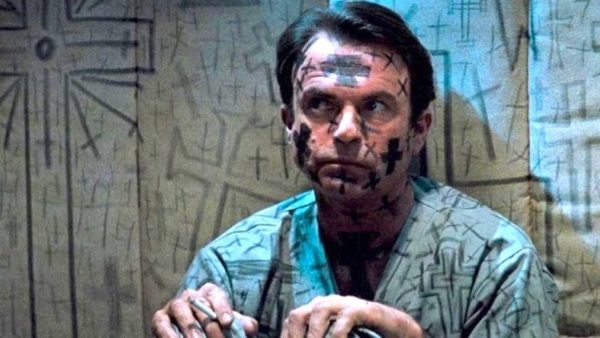
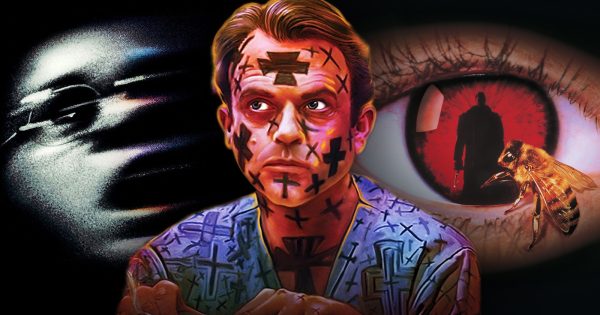
In The Mouth of Madness, by John Carpenter, landed in 1994 and it may be the most overlooked major horror movie of the decade. And that’s a real shame because Carpenter was working out ideas about fiction, reality and the collapse of meaning that feel more relevant today more than ever.
In it, we follow John Trent, an insurance investigator played by Sam Neill with the ratty intensity of a man existing on too much coffee and too little sleep. He’s hired to track down Sutter Cane, a horror author who disappeared with the manuscript of his final work. We’re told Cane’s novels have been causing psychological breaks in his readers. Violence. Mass hysteria. The types of things that makes insurance companies nervous.
Carpenter builds his movie like a Möbius strip. Trent discovers the fictional town Cane writes about. It shouldn’t exist, yet it does. He discovers Cane himself, who isn’t missing exactly, more like transitioning into something…else. Slowly and methodically, the movie pulls the rug out from not just Trent, but the audience as well. What’s fiction? What’s real? And most importantly, does that fine distinction even matter if enough people believe the fiction is real?
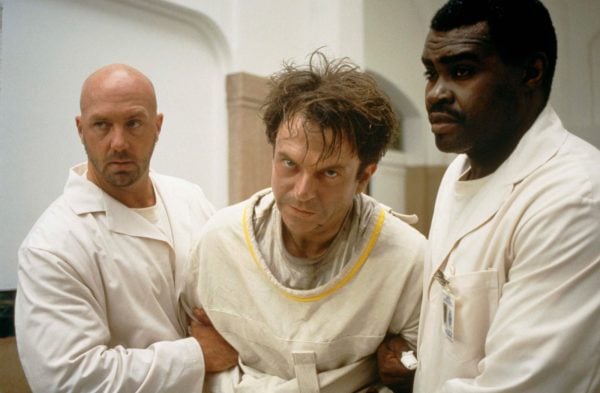
It’s cosmic horror in the classic Lovecraftian tradition, but Carpenter updates it for the postmodern era. It’s not about incomprehensible beings from beyond space and time. Well, okay it is, but it’s also about the power of the narrative itself. Cane has written reality, in the literal sense. His fiction has become fact because so many people have read and believed it, been changed by it. The Elder Gods aren’t breaking through from another dimension. They are being thought into existence.
The title of the movie comes from a line in the fictional Cane novel, but it’s a pretty accurate description of watching the movie. The audience is in the mouth of madness, that place where certainty dissolves, cause and effect become mixed together and the frame story and story in the frame bleed together until we can no longer tell which is which.
The movie hangs on Neill’s performance. He starts as a cynic, a rational man who prides himself on seeing through the bullshit. And Carpenter deliberately dismantles that certainty. By the end of the movie, when we’re watching Trent watching himself on a movie screen, showing his own story as a horror movie, we are witnessing a complete existential breakdown. He’s a character in a story. He knows it. And he can’t do a damn thing about it.
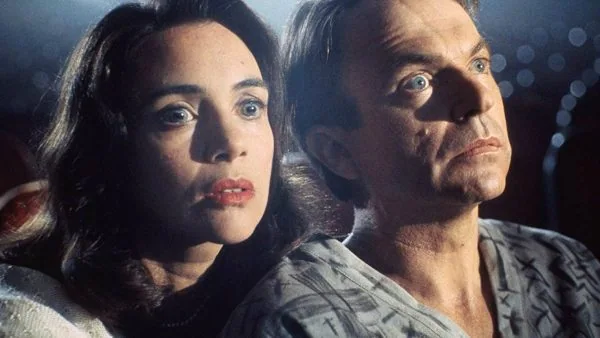
Courtesy of Greg Nicotero and crew, the movies special effects are brilliantly practical and grotesquely visceral. Bodies aren’t just transformed, they’re inverted, manifestations of interior chaos made flesh. But, the real horror is conceptual. It’s the idea that our reality is thinner than we want to believe. And that delusion, fiction and belief may be more powerful than fact.
After this, Carpenter had a string of commercial disappointments, and there seems to be a certain misanthropic glee in it. His work has always had a suspicion of mob mentality and groupthink, but here he takes it the logical extreme. It isn’t monsters from space that destroy humanity. We think ourselves out of existence willingly, even happily, because the story is much more compelling than the reality.
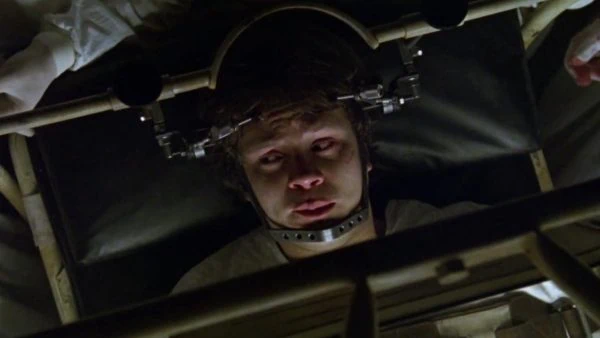
Jacob’s Ladder, directed by Adrian Lyne and released in 1990 at the doorstep of the decade may be the Rosetta Stone for all that followed. It’s a movie that showed definitively that you could make a horror movie that also worked as a meditation on grief, trauma, death and the nature of consciousness itself.
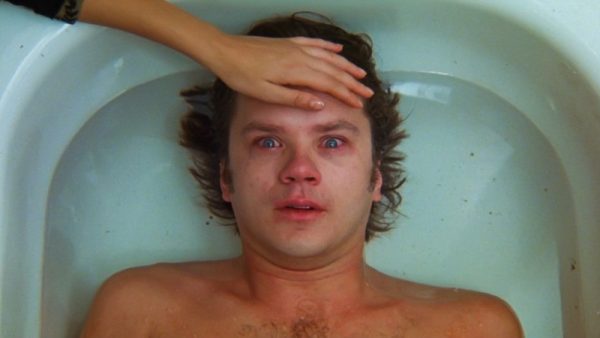
Tim Robbins stars as Jacob Singer, a Vietnam vet experiencing more and more disturbing hallucinations in 1970s New York. But are they really hallucinations? The movie keeps yanking the ontological ground out from under us. Long-tailed demons in the New York underground. His dead son constantly appearing and disappearing. Reality flickers like a faulty projector. Nothing is stable, and nothing is certain.
Writer Bruce Joel Rubin’s script is built around Tibetan Buddhist philosophy, and more specifically the Tibetan Book of the Dead, the Bardo Thodol. The whole movie is Jacob’s death process. His consciousness is fragmenting and rebuilding as it tries to process just what is happening. Every character in every scene, every moment is part of his death dream. Even scenes that seem like flashbacks could be false memories, comforting lies his slowly dying mind is telling itself.
Lyne’s brilliant direction lies in just how tactile he makes the surreal. The rightly famous head-shaking effect, created by filming at different frame rates, gives the demons a shuddering, inhuman quality more disturbing than any prosthetic could be. Even the film stock itself seems sick and jaundiced, as though the medium has been infected by Jacob’s collapsing consciousness. Jeffrey L. Kimball, the cinematographer, films New York as though it’s one of the circles of Hell, full of steam and shadow and industrial decay.
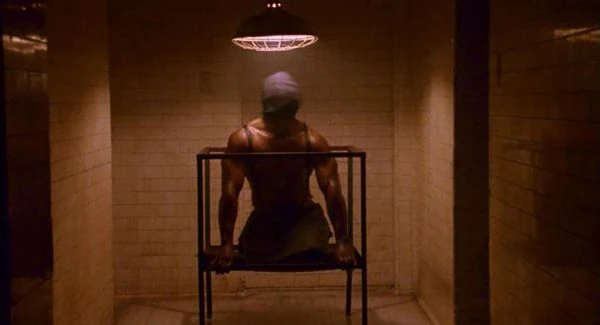
But where it gets interesting is seeing how the movie works on different levels simultaneously. A horror movie about demonic possession. A thriller about chemical weapons experiments and government conspiracy. A study of a man coming apart at the seams. And a spiritual allegory about letting go and accepting your death. These readings are all valid, and they are all happening at once.
The character of Louis, a chiropractor played by Danny Aiello, might be an angel. Or a hallucination. Possibly both. His speech to Jacob on how the only thing that turns life into Hell is trying to hold on to it is pure Buddhist philosophy, and is the emotional, thematic centre of the movie. The demons aren’t torturing Jacob, he’s torturing himself by his refusal to accept what’s happening.
The movie’s ending, when Jacob finally climbs the stairs to the light with Gabe, his dead son, could be cloying and sentimental. In less confident hands, it would be. But Rubin and Lyne earned it. They pushed us through the wringer, forced us to question everything then offered a moment of grace. Jacob isn’t fighting any more. He accepts. And because he does, the horror dissipates.
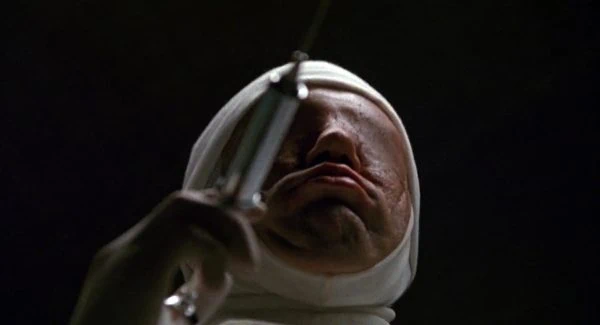
Jacob’s Ladder influenced so many that came after it: The Sixth Sense, Silent Hill, The Others, to name a few. It created the template for the psychological horror movie where our protagonists subjective experience is unreliable. Where reality itself is questioned. But even more than that, it proved that genre movies could engage with serious philosophical questions without losing their ability to frighten and disturb.
These three movies, different in style, substance and approach, all share something fundamental. The audiences are treated as adults. They all assume we can handle complexity and intellectual challenges alongside visceral horror. Everything isn’t explained, and every loose end isn’t tied up. We are trusted to do some of the work. This wasn’t an entirely new concept, but it highlighted a shift in mainstream genre moviemaking. In the late 80s, horror movies had been dominated by slasher flicks running on fumes, rubber-suited monsters and more baroque kill scenes that substituted style for substance. The horror movies breaking through in the 90s were different. They had something to say besides: “Look how creatively we can make this person die.”
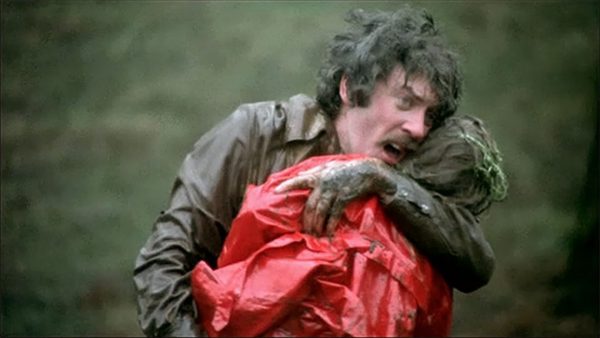
Part of it was generational. The moviemakers coming up in this era grew up in the horror renaissance of the 1970s, watching movies like The Exorcist, The Wicker Man and Don’t Look Now. These were movies that understood horror could be used as a means of serious artistic expression. They had been through film school, reading their Derrida and Lacan. They got that genre was a vehicle, not a limitation.
But of course, part of it was cultural. The decade of the 90s was an odd interregnum, a brief window between the Cold War and 9/11. The old certainties had collapsed, but the new world order hadn’t shown us its full horror yet. There was room for ambiguity and questioning, and movies that mirrored that uncertainty. The enemy wasn’t some far off ideology any more. It was internal, it was us. It was the stories we told ourselves.
Candyman studied the racial history of America and urban policy through a folklore lens. In The Mouth of Madness explored the power of the narrative and how fragile consensus reality was. And Jacob’s Ladder used horror to study consciousness, death and how to let go. These weren’t just scary movies. They were philosophical deep dives that also happened to be scary.
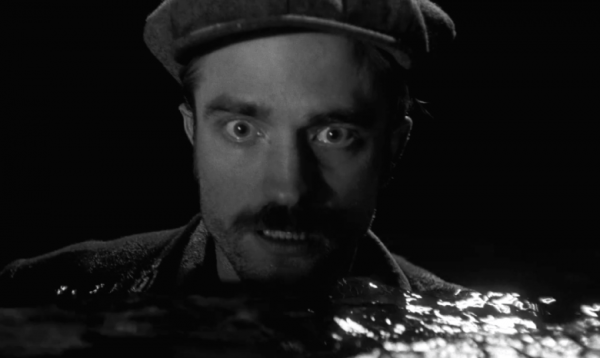
You can draw a direct line from these movies to the so-called “elevated horror” of the 2010s and 20s. Hereditary, Get Out, The Lighthouse, these are the twisted grandkids of what started in the early 90s. The idea that horror can be artistic, tackle big themes and make you think while at the same time making you squirm.
But the thing is: the term “elevated horror” is condescending bullshit. It’s an implication that horror needs to be elevated. That in its natural state, it’s low and base. The moviemakers working in the 90s knew better. They weren’t trying to elevate anything. They were examining what the genre could do when it was taken seriously, when you used its tools of dread, fear, the uncanny, to explore ideas that mattered.
Candyman is about racism and urban decay. It’s also about a man with a hook for a hand who kills people. Both these things are true. And both things are essential. You can’t separate the visceral horror from the intellectual content. They are feeding off each other. The movie works because it won’t choose between being scary and being smart.
It’s the same with In The Mouth of Madness. Yeah, it’s grappling with questions about fiction, reality, and the nature of belief. It also has people ripping through dimensional barriers and characters changing into Lovecraftian monstrosities. The philosophy in it doesn’t diminish the horror. Instead, the horror embodies the philosophy.
Jacob’s Ladder doesn’t want us to ignore the gore and the demons to appreciate its Buddhist themes. The demons are the themes, made manifest. Jacob’s reality dissolving is the vehicle Lyne uses for exploring death and consciousness. The content and form are inseparable.
At the beginning, I said I wouldn’t pretend horror was in an intellectual wasteland before the 90s, and I meant it. Horror has always been capable of this kind of depth. But there was something about this particular moment, and these specific movies, that felt like a coming-of-age for horror cinema.
Maybe it was the timing. Maybe just a critical mass of very talented moviemakers who had something to say and found in horror a genre flexible enough to say it. Maybe it was the audiences. Getting tired of the same old formulas and positively responding to movies that challenged them.Whatever it was, it mattered. These movies were proof that you could make smart horror that was a success, found an audience and became part of the cultural conversation. They opened doors. They told us what horror can do when it isn’t limited.
I suppose, in the end, horror has always been the place where we work out our fears, anxieties and cultural traumas. The 90s understood that on a very fundamental level. The movies stopped being about monsters out there and became about the monsters in here. In our systems, our histories. Our minds.
That’s what happens when horror gets smart. It doesn’t stop being horror. It becomes more essentially itself, more true. And occasionally, when it’s late at night and you’re thinking about these movies, you realise the scariest thing of all. That the line between reality and fiction, between ourselves and the monsters, was never as solid as we pretended or hoped it was. That’s the real horror, and it’s what these movies understood.
So, say his name five times. Question just what’s real. Let go of what’s killing you. Because, the rest is just details.
Adam Page