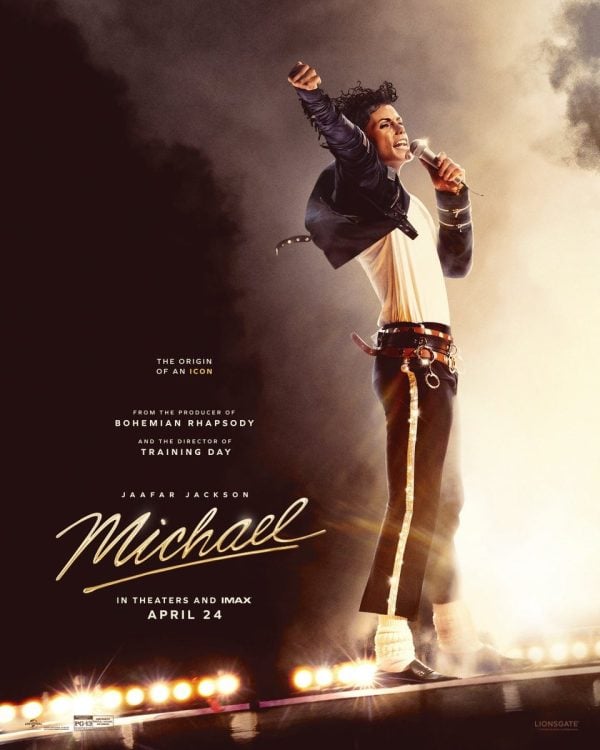
Michael, 2026.
Directed by Antoine Fuqua.
Starring Jaafar Jackson, Colman Domingo, Nia Long, Kendrick Sampson, Miles Teller, Juliano Valdi, Joseph David-Jones, Jamal Henderson, Rhyan Hill, Trey Horton, Jessica Sula, KeiLyn Durrel Jones, Kat Graham, Larenz Tate, Laura Harrier, Nathaniel Logan McIntyre, Judah Edwards, Jayden Harville, Jaylen Hunter, Mike Myers, Liv Symone, Kevin Shinick, Effie Spence, and Daniel Korenfeld.
SYNOPSIS:
The story of the famous musician Michael Jackson, known as the King of Pop.
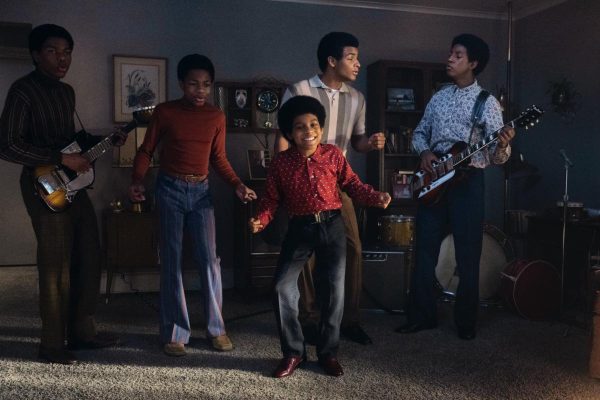
At no point did Michael Jackson ever live a normal life. As such, there were some eccentricities to arguably the biggest pop star the world has ever seen, whether it be turning his home into a zoo of unorthodox pet choices (rest assured, Bubbles the chimpanzee is here) or coming home from another sold-out performance with hit songs from one of the hottest records around to watch Fred Astaire musicals and other movies (some of which would go on to influence his music videos) with his loving mom Katherine (played with grace and understanding by Nia Long) or paying extra attention to the pain children are going through in various hospital wards he visits. For director Antoine Fuqua’s hollow, dull, and sanitized Michael, that last part sounds like it would lead into, just call it, the most controversial part of his life.
After all, Michael (played here by his nephew Jaafar Jackson in a debut that could open the door to more acting opportunities) grew up with an abusive father, Joseph Jackson (Colman Domingo mostly excelling as a self-absorbed manipulator convinced his plans and actions are what’s best for everyone), with terror that followed into his adult life. The minute the boy (played at a young age by Juliano Valdi) is beaten with a belt by his father, it’s reasonable to gather that this will be a childhood so painful that it will inform whatever the film wants to say about his fixation from a young age about Neverland, imaginary friends, and a relation to similarly suffering children in the later stages of his life. That juicy drama is being reserved for a sequel (the film concludes by saying that Michael’s story will), but the issue is that it clearly deserves to be part of this story, in conversation with those earlier stages of his life.
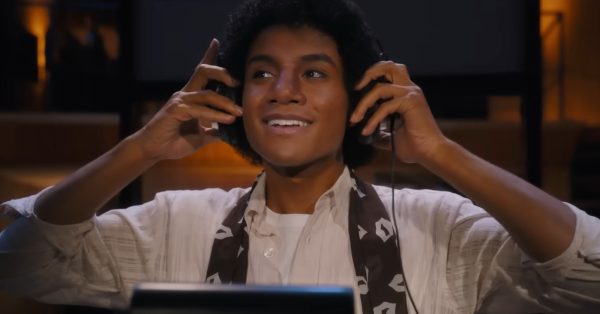
Michael is a film sanctioned by his family. It’s not even a question of what stance the story will take when it gets to that point in however many years. The problem isn’t that it will be sanitized, but rather that it’s not even here. The film tells even less of a story, often moving from one studio recording or live performance or montage to the next as Michael Jackson strives to separate himself from the Jackson 5 (comprised of his brothers, whom he grows distant from, as with less ambition and popularity, they choose to live more standard lives hanging out with girlfriends and such) and, by extension, his domineering father who believes that the brand needs to be the family and is too short sighted to see what allowing his son to embark on his own path would do for him and everyone else.
Now, there is something to appreciate in the fact that the film doesn’t try to stuff all of Michael’s life into a 2-hour movie, but the trade-off too often feels like it is gesturing towards recognizable things about Michael Jackson rather than engaging with any of it or with how it affected or defined who he is. It’s comfortable bringing up Neverland and abuse, or showing a grown man routinely shopping at a toy store, as if he isn’t ready to become an adult or give up the childhood that he never had in the first place, except the film (written by John Logan) has no interest in doing anything with it. A small exception is the understated dynamic between Michael and his security detail (KelLyn Durrell Jones), who is always around and seems to understand some of the hurt underneath the surface, even if it’s all unsaid.
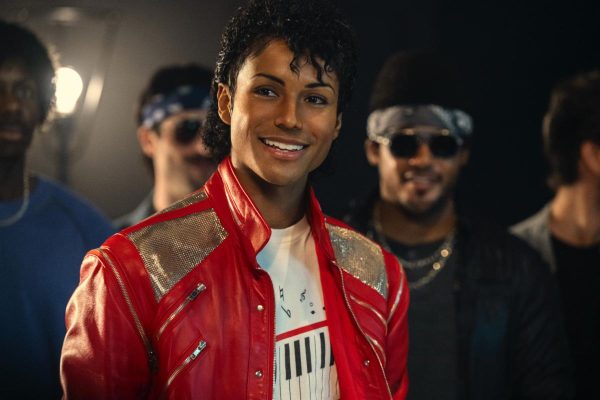
It is unclear whether the majority of this is meant to be nostalgia-pandering in the same vein as the hits that are played over and over here, or whether the Jackson estate far too creatively constrains the filmmakers from fleshing it out. Sure, it’s most likely the latter, but this is narratively barren even by the standards of musical biopics. Regardless, the result is a lifeless series of checklist moments, and that’s without accounting for the liberties taken with the facts.
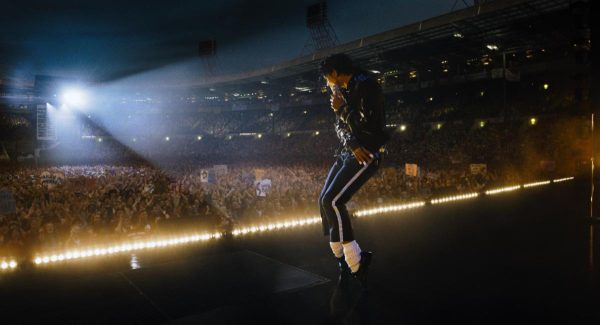
Even the musical performances are somehow dry, exuding none of the excitement and energy that packed, ravenous crowds give. This has less to do with Jaafar Jackson’s performance and more to do with flat cinematography and clunky editing that do nothing to help the rhythm of the singing or the presentation. A good chunk of the time, the camera angles are set up to focus on Michael as if he is delivering a TED talk. Naturally, all of this does a complete disservice to the nephew, who has admittedly gone to great lengths to nail many of the iconic dance moves, from signature spins to moonwalking.
Dialogue doesn’t fare better, as most of it comes down to having someone give Michael a motivational speech every 20 minutes, telling him he is special and has talent, as if we, the audience, don’t already know this. As for the drama between Michael and his father, the resolution is more befitting of an act-one ending than of an entire movie.
An incomplete film, the aspects of Michael’s life that deserve to be in conversation with one another are apparently being saved for the next chapter. I’m already feeling defeated; Michael is bad, it’s bad!
Flickering Myth Rating – Film: ★ ★ / Movie: ★ ★
Robert Kojder