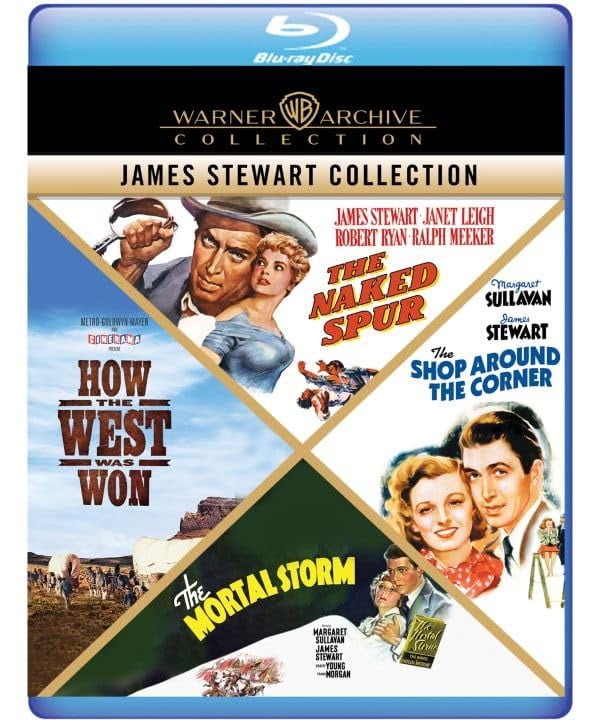
4-Film Collection: James Stewart
SYNOPSIS:
With 80 movies to his credit between 1935 and 1991, James Stewart would easily be worthy of a few of these 4-film sets, but we’ll settle for one. Join us for four major highlights from his illustrious career.

No series of 4-Film Collections would be complete without a quartet of performances from James “Jimmy” Stewart, right? This one serves up four movies that would each be worthy of their Special Edition releases by themselves: The Shop Around the Corner, The Mortal Storm, The Naked Spur, and How the West Was Won.
Yes, these are the same discs Warner Archive Collection previously issued. I’m saying that each film would be worthy of a more elaborate release in a world where studio accountants didn’t nickel and dime everything. (I know, it’s show business, but isn’t there a little extra room on the P&L for elaborate classic movie home video releases that don’t necessarily turn a profit?)
Before we get into the films, I should point out that the last one in the set, How the West Was Won, has a great lineup of extras befitting a lavish epic. However, the second Blu-ray from the previously released two-disc set isn’t found here.
The Shop Around the Corner (1940)
Directed by Ernst Lubitsch.
Starring Margaret Sullavan, James Stewart, Frank Morgan, and Joseph Schildkraut.

Remade as Nora Ephron’s 1998 film You’ve Got Mail, which starred Tom Hanks and Meg Ryan, and based on the 1937 Hungarian play Parfumerie, The Shop Around the Corner teams up Stewart and Margaret Sullavan as co-workers in a leather goods shop who can’t stand each other but turn out to be the other party in an anonymous letter correspondence.
Stewart is Alfred Krallik, the top salesman in a store owned by Hugo Matuschek (Frank Morgan). Sullavan is Klara Novak, who talks her way into a job at the store but chafes under Alfred’s management.
Alfred confides to his co-worker Pirovitch (Felix Bressart) that he has been exchanging letters with a woman who placed an ad in a local newspaper. They have been withholding their names and specific details about their personal lives, but each has given enough information to the other that they’re both infatuated with their correspondent.

As Christmas nears, the two arrange to meet at a cafe one evening. When Alfred discovers the identity of his mystery woman, he’s disappointed, but he decides to try to get to know her better without tipping her off. It’s not hard to imagine where the story goes from there, but this is one of those films where the fun is simply in watching the cast play off each other.
The bonus features found here lead off with the 11-minute The Miracle of Sound, which looks at this movie and others from MGM during the pre-war era. You also get a pair of radio adaptations from 1940 and 1941, with the former featuring most of the cast of the film, and the four-minute trailer.
Flickering Myth Rating – Film: ★ ★ ★ ★ / Movie: ★ ★ ★ ★
The Mortal Storm (1940)
Directed by Frank Borzage.
Starring Margaret Sullavan, James Stewart, Robert Young, Frank Morgan, Robert Stack, Bonita Granville, Irene Rich, William T. Orr, Maria Ouspenskaya, and Gene Reynolds.

From light-hearted rom-com we move to heavy subject matter dealing with a world at war. Set in 1933 as Hitler took power in Germany, The Mortal Storm stars Stewart as Martin Breitner, a friend and neighbor to Professor Viktor Roth (Frank Morgan), whose sons Erich (William T. Orr) and Otto (Robert Stack) become full-flegded, goose-stepping Nazis overnight.
Professor Roth, his daughter Freya (Margaret Sullavan), and Martin are disturbed by what they see happening in their small town, which is symptomatic of a disease spreading across their country. I know, the saying “The more things change, the more they stay the same” has become a trite cliche, but The Mortal Storm shows how easily people can adopt a pernicious view of their neighbors when egged on by their leaders.

As the professor is arrested and placed in a work camp, Freya and Martin realize that the best thing they can do is try to make their way over the nearby mountains and into Austria and freedom. Audiences in 1940, of course, knew full well that Nazi Germany had annexed Austria in 1938, which gave that flight to seeming freedom in 1933 ominous overtones.
This is a film that would certainly be worthy of at least a commentary track, but, alas, there’s nothing specific to The Mortal Storm in the bonus features. Instead, we get a short film and a cartoon from that era, along with the trailer. Maybe the accountants will find it in their hearts to set aside some budget for a commentary by a film scholar (or even a film scholar and a historian) one of these days.
Flickering Myth Rating – Film: ★ ★ ★ ★ / Movie: ★ ★ ★ ★
The Naked Spur (1953)
Directed by Anthony Mann.
Starring James Stewart, Janet Leigh, Robert Ryan, Ralph Meeker, and Millard Mitchell.
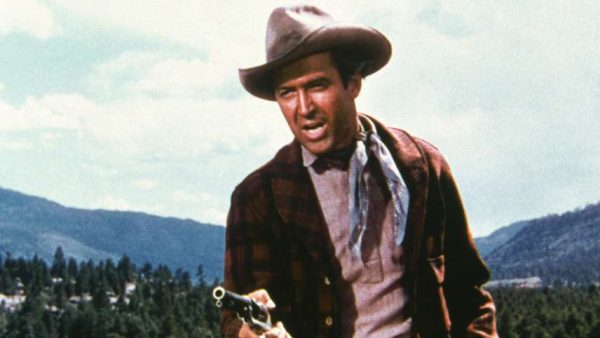
We jump ahead 13 years for the next movie, the taut, 91-minute western The Naked Spur. Stewart is Howard Kemp, who stumbles across the grizzled prospector Jesse Tate (Millard Mitchell) during his search for the fugitive Ben Vandergroat (Robert Ryan), who has a $5,000 price on his head.
Howard offers Jesse $20 to help him find Ben, and the pair end up in a shootout with him at a cliffside. Civil War veteran Roy Anderson (Ralph Meeker) hears the shots and investigates, becoming the third member of the group.
They capture Ben, but not without discovering that he has Lina Patch (Janet Leigh) with him. She’s the daughter of a now-deceased friend of his, and she joins the trip back to Abilene so she can start a new life after Ben is turned over to the authorities and hung for his crimes. She also has divided loyalties, however, and Howard, Roy, and Jesse are all unsure if they can trust her or each other, especially since Howard would prefer to collect the reward by himself.

This is another solid film full of tension and lively repartee among a cast of characters who sometimes seem noble and at other times are the type you wouldn’t trust with your back turned. Even Roy is a charismatic guy whose escape from his captors doesn’t seem like an awful thing, at least until we see his darker side.
Unfortunately, the bonus features found here are also not film-specific. As with The Mortal Storm, you get a short film, a cartoon, and the trailer. Alas.
Flickering Myth Rating – Film: ★ ★ ★ ★ / Movie: ★ ★ ★ ★
How the West Was Won (1963)
Directed by Henry Hathaway, John Ford, and George Marshall.
Starring Carroll Baker, Lee J. Cobb, Henry Fonda, Carolyn Jones, Karl Malden, Gregory Peck, George Peppard, Robert Preston, Debbie Reynolds, James Stewart, Eli Wallach, John Wayne, Richard Widmark, Brigid Bazlen, Walter Brennan, David Brian, Andy Devine, Raymond Massey, Agnes Moorehead, Henry (Harry) Morgan, Thelma Ritter, Mickey Shaughnessy, Russ Tamblyn, and Spencer Tracy.

A rip-roaring epic western closes out this set. Clocking in at 164 minutes, How the West Was Won plays out over five chapters — The Rivers, The Plains, The Civil War, The Railroad, and The Outlaws — across 50 years of history. The story is so large and sprawling that three directors — Henry Hathaway, John Ford, and George Marshall — were required to shoot it, and a large ensemble cast was hired to portray multiple generations of the Prescott family.
The film is narrated by Spencer Tracy and opens in 1839 with Zebulon (Zeb) Prescott (Karl Malden) and his family headed for the frontier. Along the way, they meet Linus Rawlings (Stewart), who falls for Zeb’s oldest daughter, Eve (Carroll Baker), but isn’t ready to settle down yet.
Eve’s sister, Lilith (Debbie Reynolds) later leaves the family at one point to become a singer and dancer in St. Louis and attracts the attention of Cleve van Valen (Gregory Peck), who wants to swindle her out of her inheritance. Later, Linus, now married to Eve, joins the Civil War along with his son Zeb (George Peppard), and the story continues beyond that conflict as newly built railroad lines begin to open up more of the west.
The story follows Zeb during and after the Civil War as he gets married, has children, and becomes a marshal in Arizona. In 1889, Zeb must contend with an outlaw whose brother he had killed. And thus the old west begins to fade into memory.

Unlike the other films in this set, How the West Was Won actually did receive a more lavish two-disc release in 2008, but only the first platter is found here. If you’re a fan of this film, you might want to track down that previous release, whose second disc features a “Smilebox” version of the film meant to mimic the curved screen presentation of the movie’s Cinerama release in 1963.
However, the bonus features found here do raise the bar for this collection. You get the 96-minute Cinerama Adventure documentary, which examines the three-camera, three-projector process used for How the West Was Won that was meant to help Hollywood offer an experience viewers couldn’t get on their TVs at home. It’s a comprehensive look at a key transitional period in Hollywood history.
You also get an extensive commentary track with filmmaker David Strohmaier, Director of Cinerama Inc. John Sittig, film historian Rudy Behlmer, music historian Jon Burlingame, and stuntman Loren James. While group commentaries can be hit-or-miss, this one delivers the goods with plenty of great information about the movie from beginning to end.
The film’s trailer rounds out the platter.
Flickering Myth Rating – Film: ★ ★ ★ ★ / Movie: ★ ★ ★ ★
Brad Cook