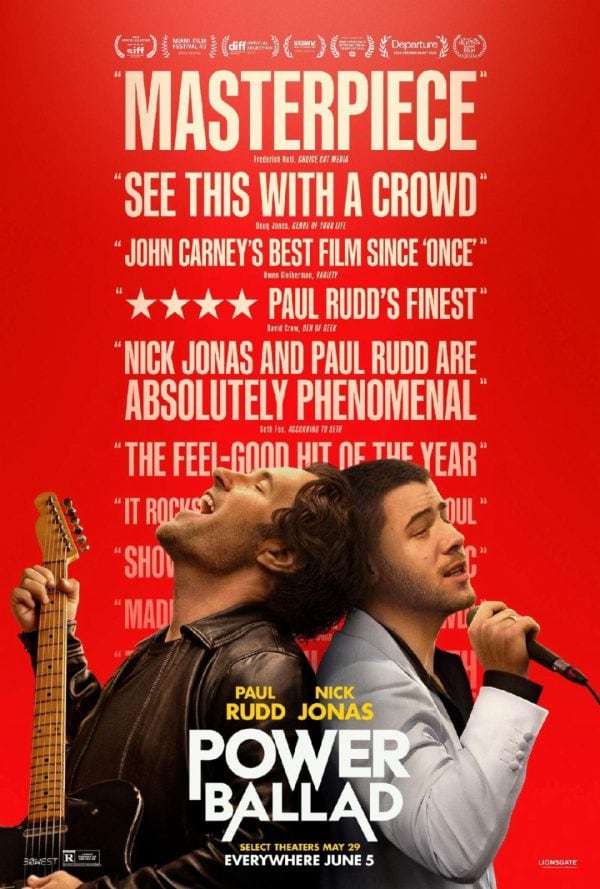
Power Ballad, 2026.
Directed by John Carney.
Starring Paul Rudd, Nick Jonas, Peter McDonald, Marcella Plunkett, Rory Keenan, Keith McErlean, Paul Reid, Beth Fallon, Havana Rose Liu, Jack Reynor, Naoimh Whelton, Mae Higgins, Ian Dillon, Kelly Thornton, Ebimie Anthony, Ruby Conway Dunne, Dean Panter, Juliette Crosbie, Robert Mitchell, Martha Breen, Dylan Kelly, Kellie El Mayss, and Alexa Scout Fagen.
SYNOPSIS:
Rick, a washed-up wedding singer, and Danny, a fading boy band star, bond over music and a late-night jam session. When Danny turns Rick’s song into a hit, Rick sets out to reclaim the recognition he believes he deserves.

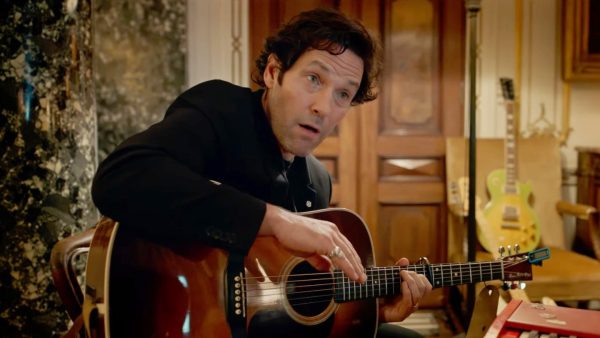
Co-writer/director John Carney (here crafting the screenplay alongside supporting actor Peter McDonald) has an established track record of contemporary musicals with catchy original tunes that have long been flying under the radar for Academy Award consideration, but it should also be pointed out that the success of his films also comes from placing a sharp and acutely insightful emphasis on the creative process and the characters themselves. That is especially true for his latest work, Power Ballad, which features Paul Rudd as an Ireland-based wedding singer cover band frontman, Rick Power, perhaps like many of us coming into the film, still living in another time, or maligning the fact that rock and roll, for the most part, is dying off to other genres, particularly bubblegum mainstream-friendly pop.
As such, Rick’s next gig takes him and the band to Los Angeles for the wedding of a relative of once-popular musician Danny Wilson (played by Nick Jonas, which gives viewers some idea of the music the character creates), failing to keep up with his fellow boy band mates, who have all apparently gone on to bigger and brighter things in the wake of breaking up and going their separate ways. In the hours after the ceremony, they drunkenly get together to kick around ideas, experiment with collaborating on music, and mostly conclude that, while they may come from different genres with wildly different perspectives on art and on each other, there is real talent. In the moment, it appears that mutual respect has been agreed upon.
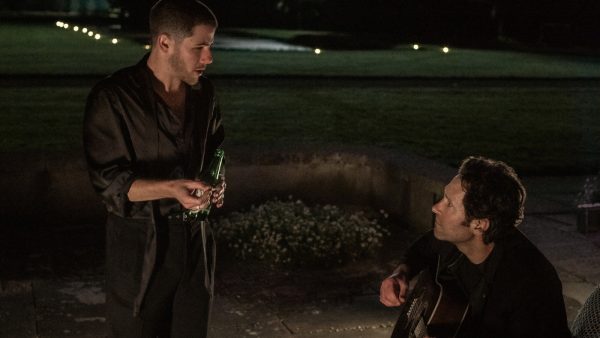
That only lasts for about 6 months, when Rick Power, amusingly, finds out while walking around a mall that Danny has taken the song he wrote, ” I Don’t Know How To Write a Song Without You”, slapped a bridge on it, and become a worldwide sensation without even asking if he would like to be cut into a fraction of the profits. More frustrating and possibly even defeating regarding the happiness of his family is that neither Rick’s wife (Marcella Plunkett) nor his teenage daughter (Beth Fallon) expresses any belief that he could be capable of writing those lyrics. On some level, it’s also likely humiliating that said daughter, who regularly playfully mocks his songwriting ideas, sings along to the hit song.
And since this is a John Carney film, the song is undoubtedly going to stick with viewers not only for its catchiness and rhythms, but also for what the lyrics mean for each character and art bearing a more personal meaning to the actual creator, who oftentimes might be the only one who knows the true emotional core and intent behind it. For Danny, it seems like a love song, but throughout, there is a sense that it might have meant something else to Rick when they were originally writing it together. Meanwhile, whenever Danny shows a trace of an awakening consciousness regarding his lack of moral ethics, his manager (played by John Carney regular Jack Reynor) is there to insist he bury those feelings, that it would be a bad look if word got out he mostly stole the song from a wedding singer of all people.

Nevertheless, with The Wedding Singer‘s DNA in its humor, the ensuing spiral eventually leads Rick Power (with Paul Rudd channeling some of that effortless charm into righteous anger) and his loyal bandmate, Sandy (Peter McDonald), to Los Angeles to confront Danny in person. Naturally, there are plenty of laughs along the way, all while the storytelling shifts into emotional territory, where it is no longer just about being cheated out of fame and fortune but about pursuing the truth and having that ambition and talent validated. For as much as Danny’s reasonings and justifications will make one want to punch him in the face, there is also some merit to his argument that no matter how good a piece of art is, it’s also about how it is packaged and who is putting it out there in the world.
This might also sound like a film with predictable plotting, which is true, but only to an extent. Some characters are confoundingly shoved aside, others are entirely one-dimensional, and there are a number of contrivances here to set the conflict in motion, not to mention the occasional scene that is perhaps a bit too much (a car accident that is almost immediately brushed off and comes to feel unnecessary in hindsight, for example), but there are genuinely subversive qualities in how this story unfolds, where it goes, and where it ultimately ends up.
That is also what lends Power Ballad much of its power: it’s not about lingering and hammering home those emotional beats and reveals, but about tucking them away into something smaller and more minimalist that turns out to be much more moving and sincere.
Flickering Myth Rating – Film: ★ ★ ★ / Movie: ★ ★ ★
Robert Kojder
Originally published May 4, 2026. Updated May 6, 2026.