Casey Chong with ten essential fugitive on-the-run movies…
So, what makes a movie that explores the fugitive or man/woman-on-the-run subgenre such a gripping cinematic experience? Among them is the thrill of the chase between the fugitive(s) and the pursuer(s) within a high-stakes scenario. Depending on the storytelling, they can be movies about those who are wrongfully accused of a crime they didn’t commit, escaped criminals wanted by the law, or perhaps, innocent protagonists become an unlikely target. Here is our curated list of ten essential fugitive movies…
A Perfect World (1993)
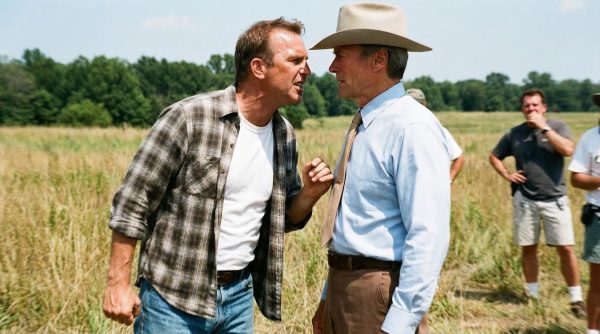
The star-studded combo of Kevin Costner playing the escaped convict and Clint Eastwood as the Texas Ranger seems like a perfect recipe for success. But instead of approaching A Perfect World in a traditional high-stakes action thriller synonymous with the manhunt, director Eastwood subverts the usual expectations by highlighting the emotional and dramatic weight of his characters, specifically Costner’s Butch Haynes and the boy that he kidnapped, played by T.J. Lowther.
This may come across as a disappointment for anyone expecting this to be an action-driven story, which probably explained why A Perfect World underperformed in the stateside, despite the overseas box office fared a lot better. And yet, Eastwood’s unconventional strategy works in his favor, thanks to John Lee Hancock’s nuanced screenplay and the actor-director’s engrossing direction in bringing enough pathos to the story. Although Butch is a runaway convict, he’s not being portrayed as a mere villain but rather a fugitive with a surprising heart of gold, particularly after he develops an unlikely father-like bond with Phillip throughout their journey together. Interestingly, Eastwood’s lawman character is far from the typical no-nonsense and stoic action persona synonymous with his on-screen persona, marking a refreshing change of pace in his filmography.
The Hunted (2003)
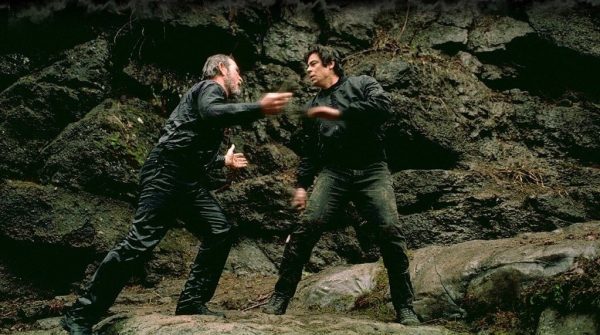
William Friedkin’s knack for grounded realism is put to good use in The Hunted, which stars Tommy Lee Jones as an ex-survival instructor enlisted to assist an FBI task force to track down his former student (Benicio del Toro), a PTSD-inflicted special forces operator who turns rogue and becomes a wanted fugitive. Clocking in at just 94 minutes, Friedkin strips off the excess fat, leaving only the essentials of a no-frills, minimalist action thriller emphasizing the cat-and-mouse chase between Tommy Lee Jones and Benicio del Toro’s characters.
The Hunted is best described as First Blood meets The Fugitive, while the movie benefits from the two leads’ engaging performances. The action is crisply put together, notably the final Sayoc Kali-style knife fight that is mostly shot in wide-angle and dynamic camerawork to capture the brutal close-combat choreography. Despite all that, The Hunted somehow failed to click with the audiences, resulting in a box-office flop which failed to recoup its $55 million budget.
Enemy of the State (1998)
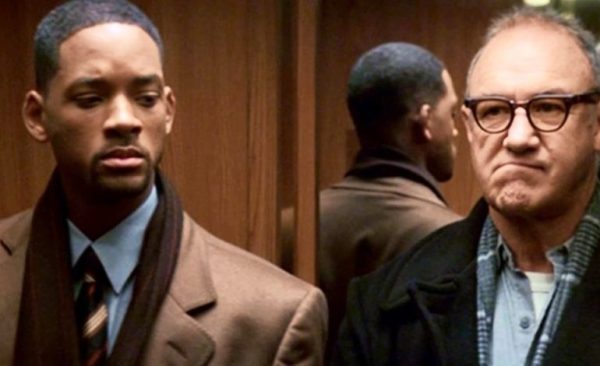
A fugitive movie with a technological surveillance twist, Will Smith sheds his usual confident action-hero presence to play an everyman lawyer for a change in Enemy of the State. A labor lawyer, to be exact, who unexpectedly finds himself becoming a target for the NSA. Apparently, a guy (Jason Lee) slips in important evidence into Robert Clayton Dean’s (Smith) shopping bag. That evidence contains the footage of a shady NSA assistant director (Jon Voight) and his men for the assassination of a congressman, who opposes the counterterrorism bill.
Smith retains his usual charisma, but he’s pretty much grounded his performance into a desperate and confused individual, who is completely out of his depth, facing omnipresent state-of-the-art threats involving GPS trackers, bugs and satellites used to track him down wherever he goes. Tony Scott does a great job mirroring the fear of breached privacy with his frenetic directing style, while the recurring busy visuals of the surveillance screens established an uneasy feeling of Robert being closely monitored by Big Brother all the time.
The Sugarland Express (1974)
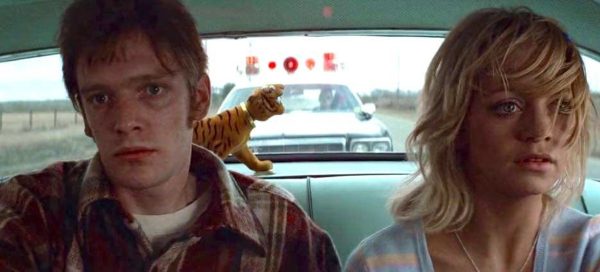
Before then-young Steven Spielberg made his mark in pioneering the modern Hollywood era with the summer movie blockbuster Jaws, his first theatrical film, The Sugarland Express was more of a crime drama about a fugitive couple (Goldie Hawn and William Atherton) on a cross-country journey to retrieve their son from foster care. Based on the 1969 true story of Ila Fae Holiday and Robert “Bobby” Dent, the movie showcases Spielberg’s expert handling in blending action, suspense, drama and even some levity throughout its well-paced 110 minutes. It helps that Hawn and Atherton’s on-screen dynamic isn’t merely depicted as typical fugitives and criminals but rather a desperate couple trying to get their son back, even if it means to break the law, including kidnapping a patrolman (Michael Sacks).
The Sugarland Express is notable for Spielberg’s first collaboration with John Williams, whose music score highlights the harmonica-tinged rhythm with a recurring, unique thumping sound to evoke a sense of escalating dread and tension. As proven in Duel in Spielberg’s TV movie, he knows well how to stage a series of thrilling car chases, one of which is brilliantly captured from the inside of a moving vehicle. It’s a pity that The Sugarland Express didn’t resonate well with audiences at the time, resulting in a commercial box-office flop, even though Spielberg managed to bounce back in his groundbreaking 1975 blockbuster.
Thelma & Louise (1991)
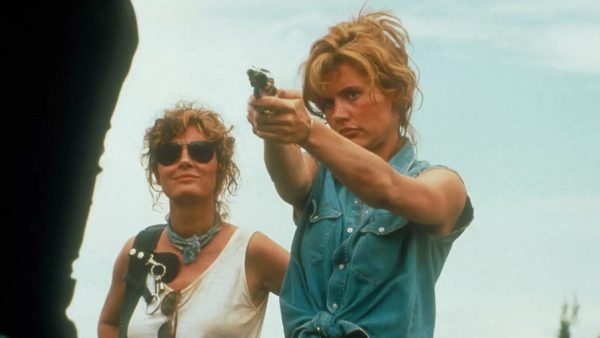
One of Ridley Scott’s finest hours, Thelma & Louise adds a then-unconventional feminist spin by subverting the usual male-dominated fugitive film tropes in favor of two women on the run. These titular characters, played by Geena Davis and Susan Sarandon, are first depicted as ordinary women – one’s a housewife, and the other is a waitress – who go on a cross-country road trip together to have some fun. But their vacation turns into a nightmare when Thelma nearly becomes a rape victim following an encounter with a stranger in the bar (Timothy Carhart) before Louise comes to the rescue and kills him. Everything changes from here as they choose to flee the scene instead of going to the police.
Thelma & Louise is more than a typical fugitive(s)-on-the-run movie as Scott incorporates elements of road movie, notably on these characters’ self-discoveries, highlighting their transformations (e.g., Thelma goes from being a repressed housewife to a bold and assertive person), and buddy-movie dynamics (it helps that Davis and Sarandon share great on-screen chemistry). Those who have seen Thelma & Louise would remember the iconic finale the most: A poignant scene, where the two best friends decide to drive their Thunderbird convertible off the cliff after the police surrounded them, before the screen fades to white.
North by Northwest (1959)

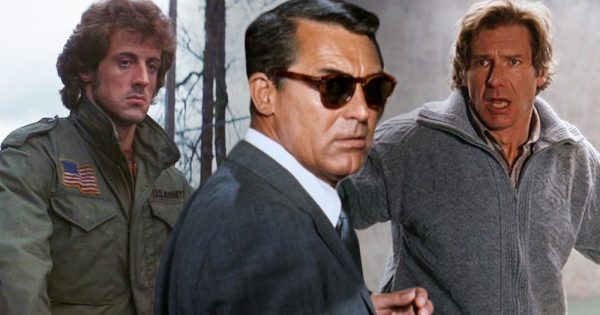
A year before Alfred Hitchcock made people afraid of taking a shower in the seminal slasher-horror classic Psycho, he gave us one of his best movies, which deftly combines thrilling suspense, action and adventure wrapped in an ingenious storytelling about a man on the run. That man in question is Roger Thornhill, played by Cary Grant, an advertising executive who somehow suffers from a whirlwind case of mistaken identity as a government agent named “George Kaplan”. Hitchcock’s equally breakneck pace keeps his movie interesting while ratcheting up the tension with one chase sequence after another, notably the famous set-piece where Roger finds himself becoming a target of a crop-duster plane attack in a wide-open cornfield.
Not to mention the climactic night-time pursuit atop Mount Rushmore, which was primarily filmed on elaborate studio sets using a nifty combination of full-scale recreations, matte paintings and rear-projection backgrounds to create the illusion of on-location authenticity. Grant’s everyman yet witty and charming performance as an ordinary citizen caught in an unlikely high-stakes scenario has since become a template for like-minded characters for future films, even spy movie franchises like James Bond and Mission: Impossible.
First Blood (1982)
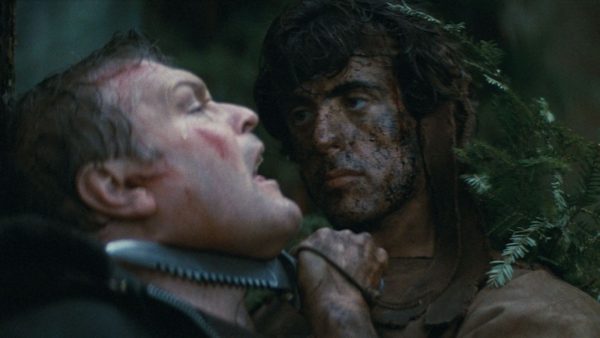
All John Rambo (Sylvester Stallone) wanted was to pass by the small town of Hope and have a meal. But Sheriff Will Teasle (Brian Dennehy) isn’t comfortable allowing a drifter like him, despite Rambo being an honorably discharged war hero. Unlike the subsequent Rambo sequels, First Blood is more grounded in a war between a traumatized army veteran and an arrogant sheriff. After Rambo ignores his warning and walks back towards the town, the sheriff has no choice but to arrest him. Rambo’s subsequent escape from the station leads to an action-packed stretch from a high-speed pursuit to a widespread manhunt across the woods and mountains.
Director Ted Kotcheff shows enough visceral flair to this man-on-the-run action thriller while bringing out the best in his two main stars, beginning with Stallone’s stoic lead performance as an angry, PTSD-inflicted soldier who is being pushed to the edge. His performance contrasts well with Dennehy’s authoritative antagonist turn. Interestingly, First Blood was supposed to be a one-off film just like in David Morrell’s novel, but the popularity of the first movie paved the way for a blockbuster franchise.
The Bourne Trilogy (2002-2007)
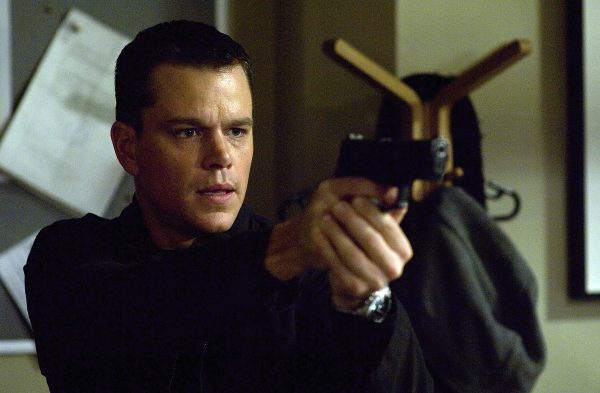
When the first Bourne film – titled The Bourne Identity – made its theatrical debut during the crowded summer movie season in 2002, it’s hard to imagine an actor like Matt Damon would go on to become an action star. And a convincing one at that, too, playing an amnesiac ex-CIA assassin, who is hunted by a top-secret government agency. The Bourne Identity marks a significant change of pace for Doug Liman, whose earlier filmography – Getting In, Swingers, and Go – belong to the comedy genre.
But his first big-budget action thriller proves to be a work of an ace visual stylist, who deftly combines spy genre and action-movie tropes. The fight scenes are expertly choreographed with amazing clarity, while Damon elevates his otherwise typical man-on-the-run character with subtle stoicism and emotional depth.
The success of The Bourne Identity led to two more sequels, both of which were given a significant visual shift towards a documentary-style realism using lots of handheld camerawork. Paul Greengrass, who’s in charge of The Bourne Supremacy and The Bourne Ultimatum, successfully adopts the shaky-cam aesthetics to his advantage, notably on the palpable car chase sequences.
Bonnie and Clyde (1967)
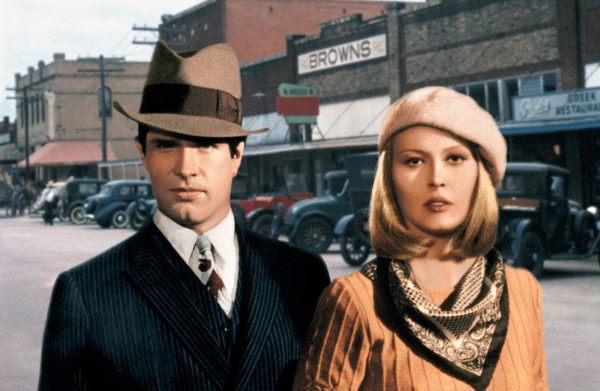
By the 1960s, the film market had undergone a major shift with the new generation of audience at the time began to embrace movies that weren’t confined to strict and traditional Old Hollywood types of storytelling. The arrival of New Hollywood saw several key releases, such as Bonnie and Clyde, a groundbreaking 1967 film about the true story of the notorious 1930s outlaws and lovers Clyde Barrow (Warren Beatty) and Bonnie Parker (Faye Dunaway), who were responsible for armed bank robberies and killing police officers.
Director Arthur Penn boldly combines matter-of-fact crime drama with added humor, romance, and even goes as far as glamorizing these wanted criminals on the run from the law. Bonnie and Clyde aren’t just mere villains but portrayed as sympathetic and disillusioned criminals viewed as charismatic rebels during the Great Depression era.
The movie is also notable for its shocking violence, where Penn pushes the boundaries of how acts of crime and law enforcement are graphically depicted on the screen. One of the movie’s most memorable sequences comes from the pessimistic finale – the famous ambush where the couple find themselves riddled with a hail of bullets filmed in a mix of stylized slow-motion and graphic realism. Bonnie and Clyde garnered nine Oscar nominations including Best Picture (lost to In the Heat of the Night) and brought home two awards: Best Supporting Actress for Estelle Parsons and Best Cinematography.
The Fugitive (1993)
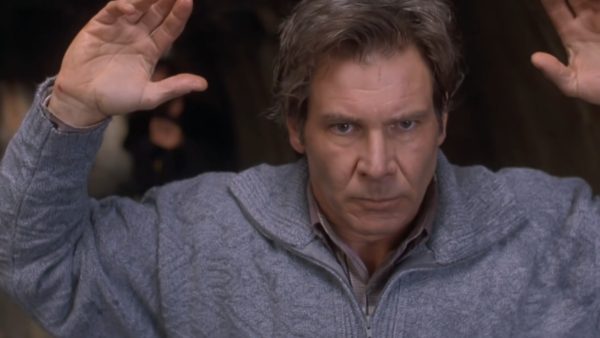
The combination of Harrison Ford’s star power and Andrew Davis’ engrossing direction, highlighting on the verisimilitude, makes The Fugitive the numero uno in our list. Based on the 1960s TV series of the same name, the movie follows Dr. Richard Kimble (Harrison Ford), a respected surgeon who is wrongly accused of the murder of his wife. Believing that he’s innocent, he manages to escape following the collision of a prison bus with the train, which is also the movie’s most spectacular action set-piece. The chase is on, as the relentless Deputy US Marshal Samuel Gerard (a no-nonsense Tommy Lee Jones, who won an Oscar for Best Supporting Actor) and his team are tracking him down at all costs.
Davis, who is no stranger to action movies from Code to Silence to Above the Law and Under Siege, knows well how to put together some of the best thrilling chase sequences with enough visceral tension and suspense. The Fugitive was a big hit that year and even made its mark as one of the rare genre movies in the action thriller category that earned a Best Picture nomination, even though it lost to Schindler’s List.
What are your favourite fugitive on the run movies? Let us know on our social channels @FlickeringMyth…
Casey Chong