Adam Page on David Cronenberg’s sci-fi body horror classic The Fly…
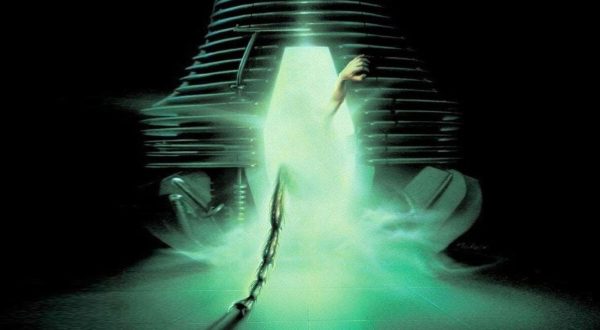
There is a moment in The Fly from David Cronenberg, and if you haven’t seen it yet, stop reading, go watch it and come back, I’ll wait. Okay, then? It’s where Jeff Goldblum’s Seth Brundle pulls off his fingernail. Just…lifts it away clean to show the flesh underneath glistening and wrong, and spurting pus. The look on his face isn’t horror. It’s more like scientific curiosity. Wonder, maybe. He catalogues it all in his notebooks like a man who has accepted that the weather is what it is.
It’s that moment which makes The Fly. That moment is pure Cronenberg. And that moment is why, forty years on, this movie still makes people put down their popcorn and stare thoughtfully at their own hands.
I won’t dress this up. On paper, the premise of The Fly is not exactly prestige cinema. Scientist creates teleportation pod, gets drunk and teleports himself, doesn’t notice the housefly that came in with him and gradually becomes monstrous. It’s a 1950s B-movie premise, which is just what it was before Cronenberg got his hands on it.
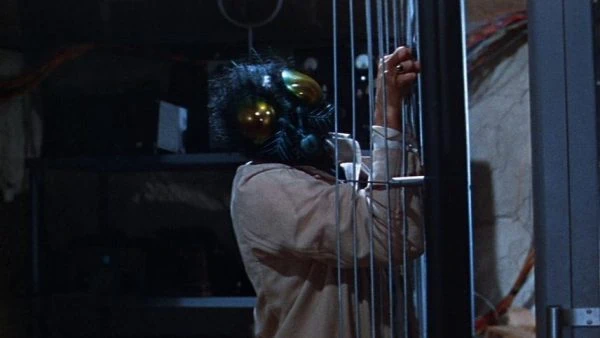
The original The Fly, made in 1958 and starring Vincent Price at his most perfectly hammy, is a regular piece of Cold War anxiety cinema. A man tampers with nature? Nature will bite back. Its rightly famous final image: the tiny human-headed fly stuck on a spider’s web screaming “Help me! Help meeee!” in a voice like a mouse with an existential crisis, seared itself into the retinas of a whole generation. It’s camp and delightful. But it is not, by any real measure, art.
Cronenberg did something rarer and more dangerous in 1986: he took that silly little story and asked what if we meant it? If we actually cared about these characters? What if that transformation wasn’t punishment for hubris, but instead something more intimate and terrible; a disease. It’s that word, disease, which is the key to unlock everything.
Cronenberg had been circling that territory his whole career. Shivers in 1975 asked what happens when parasites turn the body into a pleasure machine. Rabid in 1977 put a feeding orifice in Rose’s armpit and called it an evolution. Videodrome added a stomach cavity on James Woods which ate VHS tapes, and that might be the most Canadian thing ever put on screen. Scanners made telepathy look like a migraine that could kill from across the room.

By the time he got around to The Fly, Cronenberg had developed a theology of flesh. A real, rigorous philosophy regarding the body as both identity and prison. The body isn’t a vehicle for the self; the body is the self. When it changes, you change. When it fails, you fail. The ghost in the machine isn’t there, it’s just the machine.
This isn’t a comfortable idea. Enormous cultural energy is spent on the notion that our “true selves” are somehow separable from our physical form. That a person stuck in a degenerating body remains, basically, themselves. It’s a nice and consoling fiction. Cronenberg, bless his cold, Canadian heart, doesn’t do consolations.
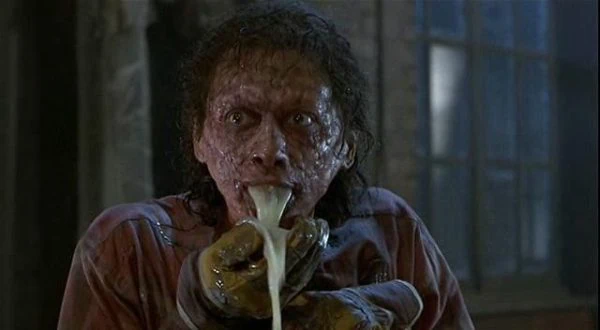
Seth Brundle does more than acquire fly characteristics, he becomes enthusiastic about them. He can climb walls and ceilings, he can eat by vomiting up enzymes onto his food and drinking the results. He has superhuman strength. For a while, and this is the most disturbing move, it seems like maybe this will be good. Brundle is energised and focused. Physically speaking, he is the best version of himself. He knows it, he loves it, and he pushes away the woman who loves him because she can’t keep up with his incredible new metabolism.
Sound familiar? It should, because it sounds like every person we’ve ever known in the grip of something which is consuming them, whether it’s a new obsession or a bad relationship. Or a substance which makes them feel, for a moment, superhuman. The fly is the addiction, and Brundle is the one who opened the door to it.
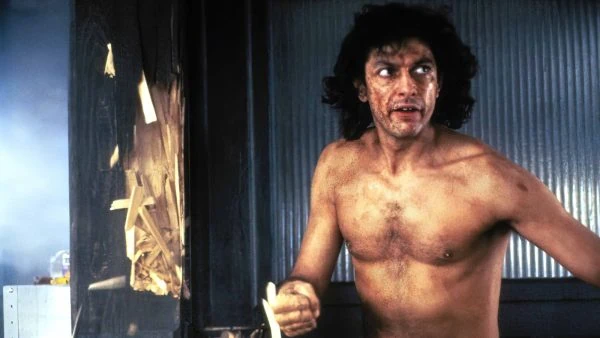
Something which is criminally unstated is that Jeff Goldblum gives one of the greatest physical performances in American cinema here. Everyone talks about the makeup, and I will too, but we don’t talk enough about what Goldblum does before the makeup starts its incredible work. He is a thoroughbred of a human being, all limbs, angles and that certain charisma that works like a frequency only a few people can hear. He plays Brundle in the movie’s early scenes as a classic movie scientist. As one who is brilliant and awkward, slightly apart from social reality and the kind of man who never learned to talk to people because he never needed to. He talks to his machines.
Pay attention to how he moves in those scenes. Watch how he inhabits spaces like he’s never quite sure where his body ends and the room begins. This isn’t acting in a conventional sense, it’s more a kind of physical articulation. The rendering of a man who so completely lives in his head that the body beneath is largely decorative. Then watch that change.
As Brundlefly starts to emerge, Goldblum does something I think no other actor would have the nerve to do: he plays it straight. He plays the appetites and exhilaration. He plays the slowly dawning horror not as horror but rather information. He catalogues and observes it with the cold precision of a scientist who, at last, has found a subject that’s worthy of his full attention. And the subject is his own dissolution.
By the final act of the movie, under the extraordinary prosthetics of Oscar-winning Chris Walas, Goldblum is hardly recognisable as a human being, but his performance never loses the thread. You know who it is behind all that rotting flesh, and you know what he wants. And what he wants is maybe the most heartbreaking thing in the movie. Not to live, exactly, but to be remembered as having once been human.
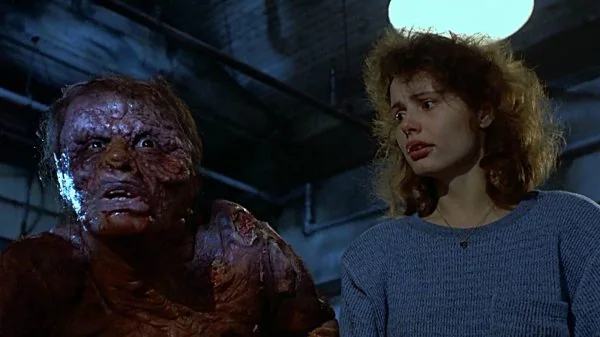
We also need to talk about Veronica Quaife, because Cronenberg does something here which was honestly unusual for its genre in 1986, and is still unusual now; he gives her an interior life.
Geena Davis plays Ronnie not as some screaming witness to the male genius, but as a real person with ambition, genuine desire and the specific, complicated love of someone watching a person they care for lose themselves into something they can’t reach. She isn’t the audience surrogate for fear. She is there as the human anchor for the story, the one person who knew Seth Brundle when he was simply a man, and who will end it when he is no longer.
At its core, the relationship between Seth and Ronnie is the movie’s central horror. Not the transformation, but the love story which the transformation consumes. They are two people who really like each other and spark off each other. They are better together than apart.
And this, of course, is the setup for the most brutal violation of that warmth. The pregnancy subplot, Ronnie discovering she is pregnant by Seth and suspecting the child might not be completely human, is the most overtly allegorical passage of the movie. Also, I think, the most visceral. Her dream of giving birth to a living, writhing maggot may be the single most disturbing 30 seconds of 1980s mainstream cinema, and I include everything in Aliens which came out the same year, and the one people think of as the scarier movie. These people are wrong.
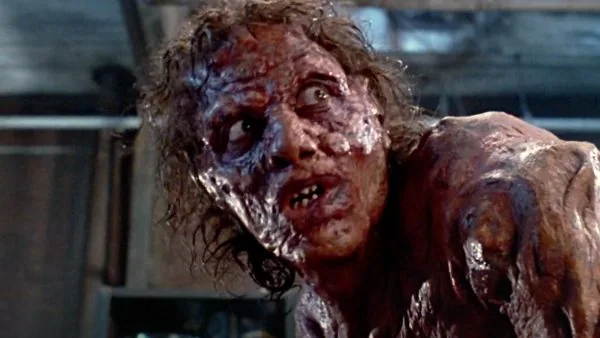
Chris Walas and Stephan Dupuis won the Academy Award for Best Makeup for The Fly, and if you want an argument for that category’s legitimacy, then watch this movie. Seth Brundle’s transformation isn’t a dramatic and sudden event. It’s a process. Careful. In its way, patient.
Cronenberg shoots the decay in stages. At first it’s something just slightly…off. His skin is a little mottled. Hairs on his back that seem a little too coarse. Fingernails start to peel. Then an ear falls off. The flesh starts to assume new geometries. By the end, there is a thing which was once a man standing in a lab, barely operating the machinery of human language yet asking to be made whole. It cannot be made whole and yet we understand, against all reason, why it’s asking.
The practical effects in the movie have a quality that just can’t be replicated with CGI: weight. They have mass. When a part of Brundle detaches and hits the floor, it sounds like a thing landing. When the final Brundlefly moves, we feel that wrongness of its movement in our spine, not our eyes. There is definitely something about watching a real object of latex and foam that communicates biological truth in a way that pixels, no matter how sophisticated, just can’t fake.
This is more than simple nostalgia talking, it’s mechanics. Our skin-crawling response is triggered by real evidence of physical reality. However perfect, a digital effect lives in the uncanny valley of our threat assessment. Practical effects land in the lizard brain with a thud.
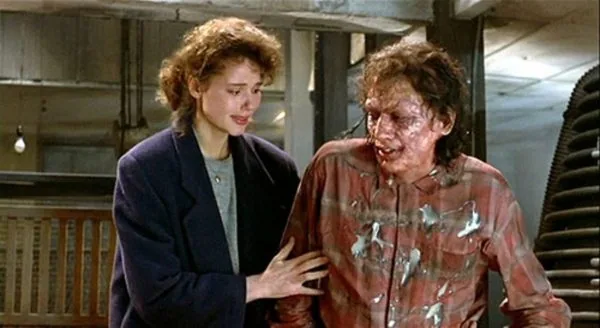
We can’t talk about The Fly in 1986 without talking about what The Fly was talking about without talking about it. In 1986, the AIDS crisis was at its most terrifying and misunderstood. It was a disease which changed the body, and was transmitted through intimacy. A disease that consumed people slowly, in stages. It stripped away capacities and features, and made them unrecognisable to those who loved them. In the cultural imagination of the mid-80s, it was a disease that carried a weight of shame and transformation. The sense that if you contracted it, you became something other than human in the eyes of all those around you.
Cronenberg has never confirmed explicitly that The Fly is an AIDS allegory. That’s exactly what an intelligent moviemaker does with allegory. You don’t hang a sign, you build the building and let people read the architecture.
But the movie knows. It knows in how Ronnie’s reaction to Brundle’s transformation goes through every stage of loving someone with a degenerative illness. The disbelief at first, then research and bargaining. Furious helplessness and the final mercy. It knows it in the way the initial euphoria of Brundle before the disease takes hold mirrors that time before diagnosis. And it knows in how the body’s betrayal isn’t rendered as punishment for a sin, but pure and indifferent biological fact.
There isn’t a moral to The Fly. A housefly just got in. Brundle just didn’t check. And the universe just doesn’t care. It’s that refusal of a moral which makes it art instead of parable. Parables teach lessons. The Fly just shows us what happens.
So. Forty years. Two full generations, and The Fly hasn’t dated in any of the ways that matter. The telepods look like 1986. The computer interfaces, with Brundle trying to teach his machine to understand the poetry in the flesh, look like 1986. Some of the dialogue lands with that slightly too earnest quality of the era. These are costs of time, and hardly worth talking about.
What hasn’t dated is what’s at the centre. The terror of watching a body change against the will of the owner. And the specific, terrible intimacy of loving someone going through that change.
We are, each of us, running that experiment. We are all Seth Brundle, getting into that pod each morning while not totally sure what we’ll be on the other side. The body ages, and begins to fail. In the end, the body does what it was always going to do, which is come apart. We know this but mostly don’t want to think about it. For a hundred minutes, Cronenberg makes us think about it then pushes us, blinking, back into the light, and we immediately start thinking about dinner instead.
And that’s appropriate. Dinner is good. It’s a celebration of a body that still works, an appetite which still fires. A celebration of the remarkable, temporary fact of being a biological organism with memories and opinions and people you love.
Seth Brundle didn’t get to have dinner. He got the fly instead. But for a while, and underneath all the rot this is what the movie gives you, he got the girl, the work and that moment of standing in his lab watching something impossible become real. He got to feel like a genius in love, which really is one of the better things a person can feel.
That fly just got in. That’s all.
Adam Page
Originally published May 9, 2026. Updated June 27, 2026.