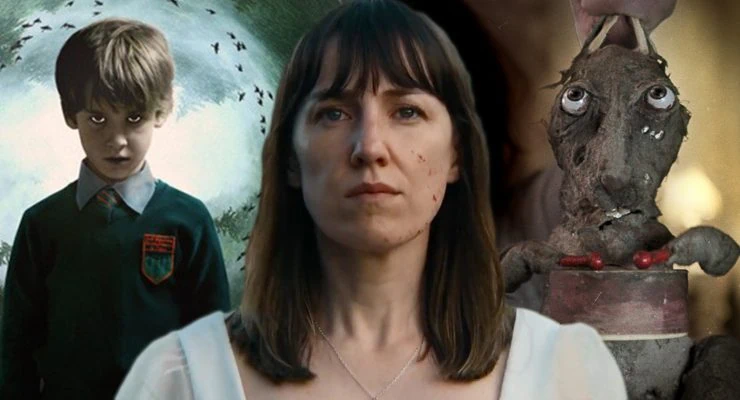
Heel (a.k.a. The Good Boy), 2025.
Directed by Jan Komasa.
Starring Stephen Graham, Andrea Riseborough, Anson Boon, Kit Rakusen, Austin Haynes, Callum Booth-Ford, Monika Frajczyk, and Savannah Steyn.

SYNOPSIS:
A 19-year-old criminal, Tommy, is kidnapped and forced into a rehabilitation process by a dysfunctional couple, Chris and Kathryn, who try to make him a “good boy.” Tommy must find a way to escape.
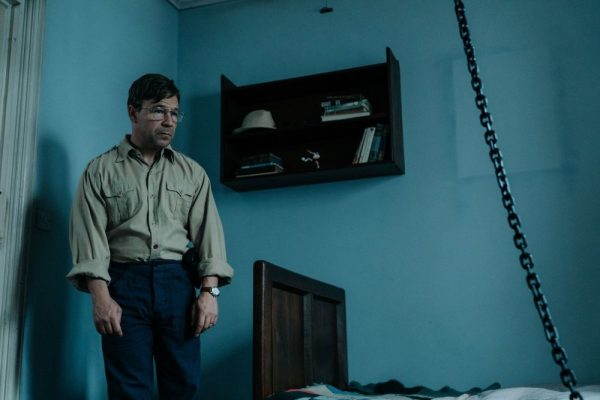
Patriarch Chris (Stephen Graham) of the family at the center of director Jan Komasa’s Heel (from a screenplay by Bartek Bartosik and Naqqash Khalid) has a young man collared and chained to the ceiling in his basement. The terrifyingly bold part: the film places us somewhat on his side.
One hesitates to even reveal that, as the film’s setup, brilliantly structured from the perspective of a housemaid interviewing for a job with the family, entirely throws one off track. Prior to that, a prologue sees us spending some unpleasant time with the previously mentioned man, a real loony, belligerent degenerate named Tommy (Anson Boon), a recklessly intoxicated driver, a violent bully, and all-around chaos factor, whether roaming the streets of London or partying in clubs (which typically leads to some consent-questionable, drugged-up bathroom sex). By the time the early reveal comes, that he has been kidnapped and thrown into someone’s basement, whatever sympathy there would normally be has already plummeted through the earth’s soil.
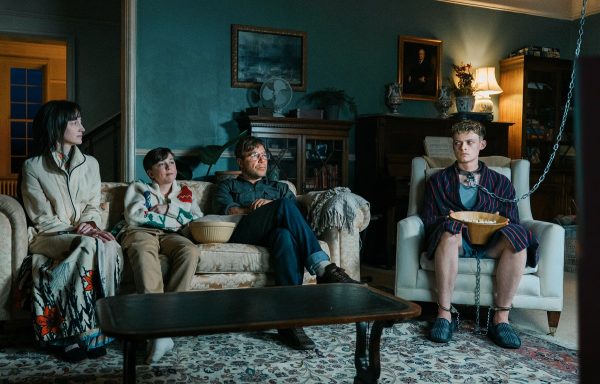
With clear family tragedies of their own, especially crystallized through Andrea Riseborough’s near catatonic performance as Chris’s depressed wife Kathryn, the goal isn’t to abuse and torture Tommy for sport or twisted fun (everyone, including the housemaid, seems to have a stun gun in case he gets out of line), but rather to rehabilitate him back into society. Stephen Graham isn’t playing Chris as an unhinged lunatic, but rather as calm, rational, and mannered. At one point, Tommy is shown footage of car accidents and, in another scene, social media footage from one of his accounts mouthing off to and physically harming someone to remind him of his misdeeds. Naturally, one also begins to wonder if part of this deranged social experiment is a direct result of Tommy inadvertently or intentionally harming someone who used to be part of or close to this family.
Naturally, Tommy is mortified at the situation he has found himself in, resorting to verbal insults and disobedience even when brought a portion of the family’s dinner. However, Chris is here to play fair with Tommy, gradually expanding what little interior world he has; think of it as rewarding good behavior. Soon, Tommy has a toilet, some books to read, and even a track installed along more ceilings so he can roam around this isolated, remote home. He develops an interest in the similarly aged housemaid (Monika Frajczyk) and generates a sibling bond with his young son Jonathan (Kit Rakusen), although the remarkable performance conveys both an easing into this new home and a dynamic with an understanding deep down that this is not his true family. Perhaps it should be considering no one in the real world seems to be looking for him.

Even more uneasiness comes from Heel when one realizes that, in its fascinating moral dilemma, it is essentially pro-Stockholm syndrome. There’s no arguing with the results here, even if it’s an odd message to deliver. Some aspects regarding the family feel a bit too vague, or other areas aren’t as fleshed out (the housemaid character serves a point to an extent, but comes with another subplot going on that makes for an intriguing juxtaposition regarding family bonds, albeit clunkily handled), with an ending that doesn’t quite feel earned.
However, the performances and interplay between Chris and Tommy are compellingly rich. They know exactly how to play this uncomfortable material and shifting dynamics, forcing us to sit with that uncomfortability and play along, asking these difficult moral questions and pondering this inhumane but effective social experiment, and that age-old question of what the hell family means. The other side of this coin is that I’m also not entirely sure what Heel wants to say about any of this, but it is nonetheless a quietly deranged, thought-provoking take on captivity.
Flickering Myth Rating – Film: ★ ★ ★ / Movie: ★ ★ ★
Robert Kojder