Adan Page on the knowingly bad horror movie…
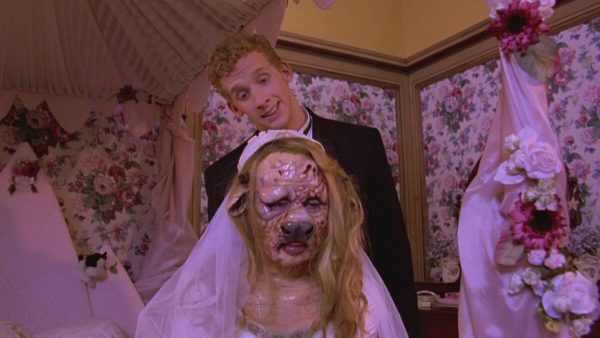
There are plenty of bad movies out there, and us online writers come to depend on them for an endless stream of material. But there is one particular type of bad movie, and I’m being careful here as I’m making an important distinction, that knows just what it is. It’s the one which has looked itself in the mirror, assessed the damage it sees and has decided the damage is the point. It has laughed at itself pre-emptively just so you can’t. And I’m not talking about the glorious and unhinged incompetence of someone like Ed Wood, who believed in each frame of Plan 9 from Outer Space with all the conviction of a man who found God in a cardboard flying saucer. That’s accidentally sublime, and a totally different creature; one that should be spoken of only with reverence.
What I’m talking about here is something more calculated and culturally specific, and I think in its own way more revealing: the deliberately campy horror movies of the late 80s and 90s. Those movies which built their irony up from the foundations and wink at you so hard they strain a muscle. If you look at it clearly, it’s obviously a defence mechanism, and one which tells you an awful lot about the decade that produced it.
To set the scene; it’s the early 1990s and you’re a low-budget moviemaker with maybe $40,000, a friend who owns a swamp and access to a rubber monster that looks all too much like a novelty pool float. You could make a sincere movie, pouring yourself into it and attempting genuine dread, all the while exposing your artistic ambitions to the cold surgical lights of critical scrutiny and watch them be laughed off screen. OR, and stay with me here, you could get there first. You could make a movie which is so aggressively ridiculous that anyone calling it stupid is just describing its operating thesis. In essence, you have immunised the patient against the very disease it’s carrying.
This is clever strategy rather than cowardice. It is, if you’ll allow me a pretentiously academic moment, a deeply postmodern response to a media culture which had grown too sophisticated for its own good.
By the early 90s, the viewing public had been marinating in mass media’s self-awareness for close to a decade. Pee-Wee’s Big Adventure showed children that artificiality could be funny, David Letterman had made ironic detachment a late-night sacrament. Even The Simpsons were dismantling the grammar of television storytelling in real time, every week at 8pm while families watched. The audiences, even the horror audience of the faithful congregation of people still showing up to the multiplex or video store for something with a monster on the cover, had been trained. They had been taught to read the seams and appreciate the construction of the thing, and to experience some pleasure in the gap between pretension and execution.
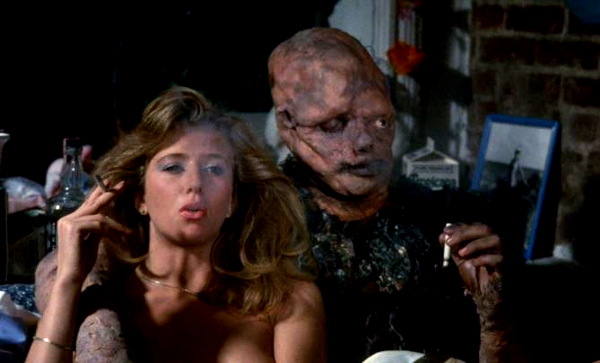
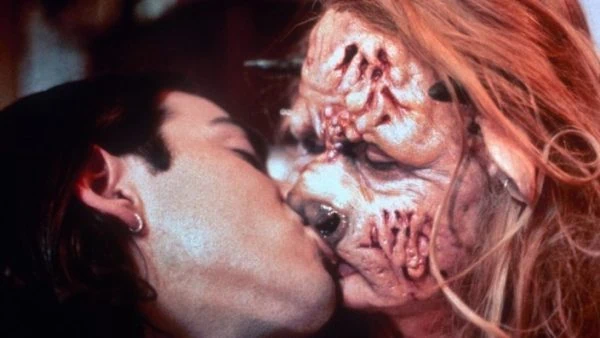
Troma Entertainment absolutely understood this. They had been working in the schlockier precincts of exploitation cinema since the mid-70s, but they really crystallised in the 90s. Lloyd Kaufman’s studio, a beloved and genuinely weird operation based in a building that always looked as though it should have been condemned, leaned into its cheapness with the enthusiasm of a man doing a cannonball. The Toxic Avenger in 1984 had established the template: gore so excessive you can’t help but laugh, heroism so earnest it becomes absurd, and politics so blunt that they warp back around to become pointed. By the time Tromeo and Juliet came along in 1996, with Shakespeare being filtered through real anarchic energy and pig intestines, the Troma mode had fully articulated itself: “We know this is ridiculous, you know it’s ridiculous, and in our shared acknowledgement of that ridiculousness, we created a communion.”
This really is more interesting than it sounds. I’ve eaten in restaurants that took themselves deeply seriously and produced food that was almost aggressively forgettable. And I’ve also had burgers from a greasy and unpretentious hole-in-the wall in Belfast, served by a middle-aged woman, cigarette in mouth, and twenty years on I still think about how good it was. There is a real honesty in knowing your register. At their best, the Troma movies were that hole-in-the-wall.
But Troma, I think, was the purist expression of something which spread much wider. The horror landscape of the 90s is filled with movies that adopted campiness as a sort of armour, and not all of them were operating from real artistic commitment. Some were just hedging their bets, with the wink acting as a liability shield.
Think of the trajectory. The slasher cycle of the late 70s and 80s had burned itself out with repetition, and all those sequels with the diminishing returns of a photocopied photocopy. By the time you were five instalments deep into the franchise, the horror had pretty much evaporated and been replaced with something like the comfort of ritual. You knew the beats, the movies knew you knew the beats, and you had reached an uneasy accommodation.
What the deliberately campy horror movies of the 90s did was solidify this accommodation into a real aesthetic principle. If the audience was already going to laugh at the cheap effects, or the formulaic structure, and kill scenes which had become so elaborate they were basically slapstick, then why not collaborate with them? Why not design the laughter in? Because if you designed the laughter in, then any critical failure becomes a category error. You can’t call the movie bad for being funny if it was trying to be funny, or accuse it of cheap effects when the cheap effects were the joke. The moviemakers had, in the argot of today’s era, made the subtext the text, which I still argue is brilliance rather than cowardice.
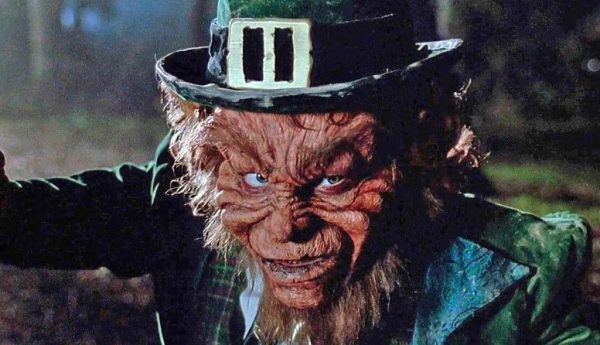
Leprechaun in 1993 gave us Jennifer Aniston and a killer Irish folklore creature in the same movie, and with a deadpan that oscillates between absurd and sincere but doesn’t ever fully commit to either. Critters and its four sequels knew that the menace of small biting creatures is inherently funny and leaned into the comedy instead of fighting it. Even Army of Darkness, which definitely belongs in this lineage even though it defies easy categorisation, essentially dispensed with horror and gave us Bruce Campbell spitting out one-liners while fighting skeletons and it made that transition explicit. Sam Raimi knew just what movie he was making, and he knew you know. He winked, we winked back, and we all went home satisfied.
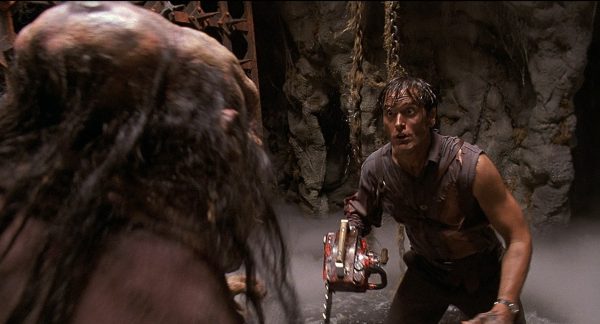
In this sense, the theatrical contract of the knowingly campy movie is a sort of populist democracy, in that it meets you where you are. It doesn’t demand that you achieve a state of suspended disbelief, it wants you to enjoy the disbelief itself. It’s why these movies have continued to build devoted followings decades after their release, while other technically accomplished, earnest genre movies from the same era fade away into indifference. The campy movie is offering a social experience. You aren’t watching it alone, even when you are alone, as the moviemaker is right there in the frame with you, nudging you and pointing at the seams.
Ah, but then… There comes a point when the wink becomes exhausting, and the knowing quality of the thing curdles into contempt. For the audience and material, for the whole enterprise of making movies. Not every self-aware movie of the 90s was working from a position of real affection; some were just lazy, and using the ironic frame as an excuse not to do any harder work. The hedge-your-bets campiness of a DTV cheapie that’s winking because it can’t afford not to is a totally different thing from the real ecstatic absurdity of a Troma movie or the Raimi mode of controlled chaos.
This distinction matters because it reveals something about the postmodern condition a bit more broadly. As a cultural stance, postmodernism can be a real intellectual and artistic position, a way of honestly engaging with the constructed nature of representation, and the way our stories are already filled with prior stories and the impossibility of innocence. Or it can be a pose, a fashion, and a way of seeming smart while committing to nothing. The 90s got both versions, usually in the same multiplex on the same weekend.
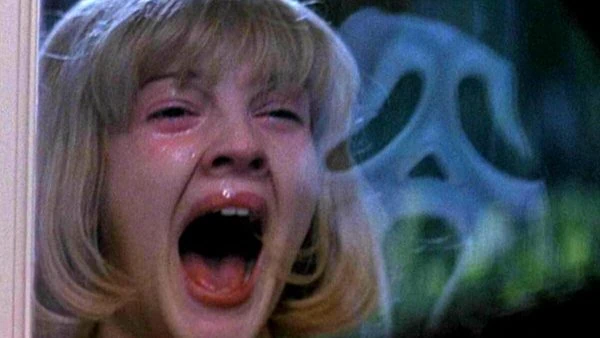
For example, when Scream arrived in 1996, Kevin Williamson and Wes Craven had done something that felt honestly intelligent: putting ironic awareness inside the narrative and made the characters themselves literate in the conventions of horror, and also showed that literacy wouldn’t protect them. The central horror of the movie is that knowing the rules won’t save you. That’s a real idea, one that gave the self-referential mode a moral weight it usually lacked. But Scream also opened a door that a lot of moviemakers walked through without having Craven’s craftsmanship or the wit of Williamson, and came up with a wave of self-aware slashers that had the irony without the intelligence, and the wink without the substance.
In the wake of Scream, what we got were movies that thought referentiality enough; movies that quoted other movies, acknowledged genre conventions and gave their characters knowing smirks but forgot to have any ideas of their own. The campiness became a substitute for content instead of a frame around it; the dead end of the mode and it arrived uncomfortably quickly.
There’s a useful analogy in food, as that well never runs dry. The taco truck that knows it’s a taco truck and celebrates the efficiency and simplicity of what it does, that’s thought carefully about the few things it makes and does it with genuine expertise. That is a lot different from the restaurant performing casualness as a brand identity while charging £40 for a dish that doesn’t quite work. The first is honest about its register and operates within its skill set. The second is using the aesthetic of the casual to hide from the scrutiny which would reveal the inadequacy of the execution.
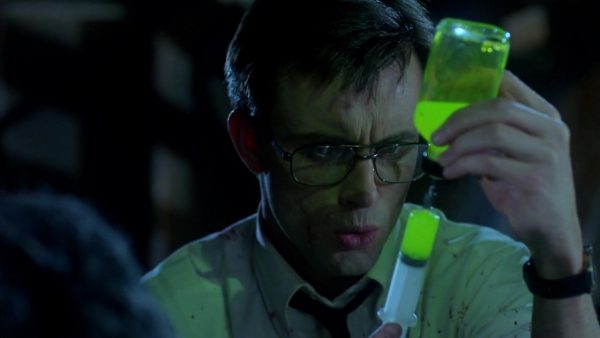
The best of these deliberately campy horror movies: Troma at its most anarchic, the Evil Dead movies, or the movies of Stuart Gordon when he was playing H.P. Lovecraft’s cosmic horror off against B-movie aesthetics, or even something like Tremors which is a really well-constructed movie wearing its schlock credentials like a badge of honour, these were the taco truck. They knew their register and worked it with skill. The campiness of them was the architecture and not just a hedge.
The worst of the mode were something else; a £40 taco that can’t quite justify itself.
Looking back from this historical distance, what’s striking is how accurately this cultural moment mapped onto the broad anxieties of that decade. The 90s were a period of real existential uncertainty; not in the dramatic and crisis-led way of the earlier decades, but a more low-level and ambient way. The Cold War was over: that organising narrative of American life for forty years had just stopped and the culture was flailing about for what to do next. Irony was the available tool, with detachment the available posture. If you couldn’t be sincere without feeling naïve, if earnestness had so completely been taken over by advertising that it couldn’t be trusted anymore, well then the wink was the only honest gesture.
Horror would feel this more acutely than other genres as horror depends, on a basic level, on sincerity. You have to believe, or at least consent to the possibility, that the monster in the dark is real and dangerous. Irony is an antidote to that belief, not a companion. The deliberately campy horror movies were attempting a real paradox: making a horror movie that acknowledged the impossibility of horror, used comedy and self-awareness as tools for exploring the genre while at the same time ripping out its primary function.
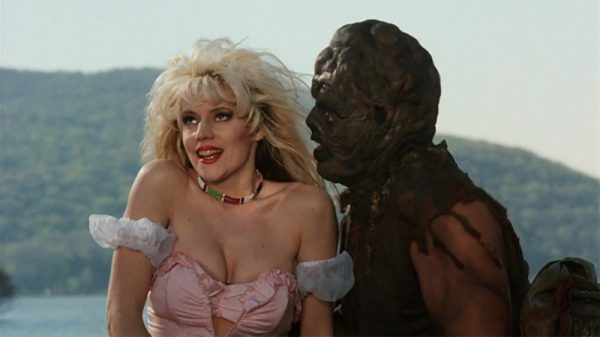
It’s why the best of these movies are more interesting as cultural artifacts than they are as horror experiences. They’re documents of a moment when a genre was wrestling with its own survival in a culture that had grown a bit too knowing for the genres more traditional methods. They found a solution, or at the very least a workaround, by making the problem into the subject. The monster is ridiculous? No problem, here is a movie about the ridiculous monster. This ridiculousness is embraced and celebrated. And in that celebration, now and then something genuine and strange and worth your time will emerge.
It rarely really frightened you. But hell, neither did most of the sincere alternatives. But at least the campy horror movie had the honesty to admit what it was.
And that isn’t a small thing, in the end. In a decade that produced a lot of entertainment which pretended to be something it wasn’t, the movie that looked you in the eye and said “Yeah I know, but just come along for the ride” had a strange and lasting integrity. The rubber monster was always rubber, and the only question was whether the movie was in on the joke.
The best ones always were.
And that was enough.
Adam Page