Robert Ewing reviews Star Wars: Visions Presents – The Ninth Jedi…
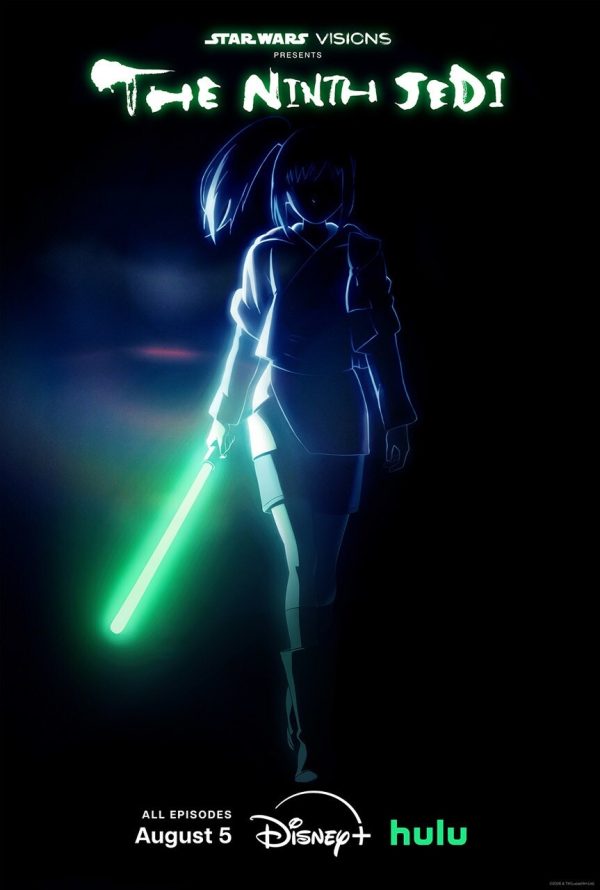
A bold new direction for the Visions series begins with Star Wars: Visions Presents – The Ninth Jedi, the first project in the Presents line, which allows creators to expand upon the shorts originally produced for the anthology show. This show builds upon the titular Ninth Jedi shorts featured in Volumes One and Three. Under the supervision of Kenji Kamiyama, celebrated for his work on Ghost in the Shell: Stand Alone Complex and Eden of the East, and with animation by sci-fi legends Production I.G, the studio behind Ghost in the Shell, Patlabor, and Psycho-Pass, The Ninth Jedi offers a familiar and safe expansion that remains absolutely engrossing throughout its eight-episode run.
We pick up where Child of Hope left off: Lah Kara (Kimiko Glenn and Chinatsu Akasaki) and the rest of the masterless Jedi, Juro (Andrew Kishino and Tetsuo Kanao) and Homen (Patrick Seitz and Hinata Tadokoro), are on the run as General Nawaam’s (Young Mazino and Nao Ōmori) army, led by the Sith Gennoh, pursues them. Juro is determined to restore the Jedi Order and rally new allies to stand against Nawaam, all while seeking to rescue Lah Kara’s father, Lah Zhima (Simu Liu and Shin-ichiro Miki), who is far more than a mere sabersmith.
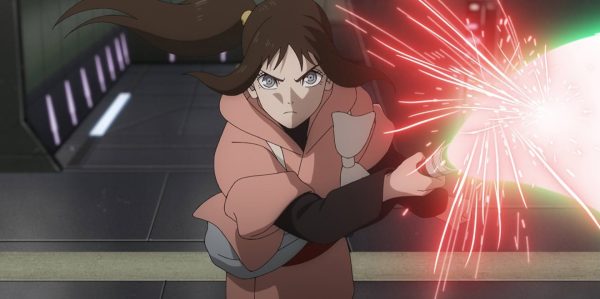
Despite being produced outside the dominant production committee system that shapes much of anime and Japanese live-action filmmaking, certain sequences received a disproportionate share of the animation budget, resulting in a noticeably inconsistent presentation, which can be common with traditional TV anime. Every ship has a hyper-detailed, glossy 3D look that makes them stand out against the more traditional 2D and less detailed character models and locales. Even then, many dialogue scenes feature little to no movement, further revealing how the animation was prioritised across the production.
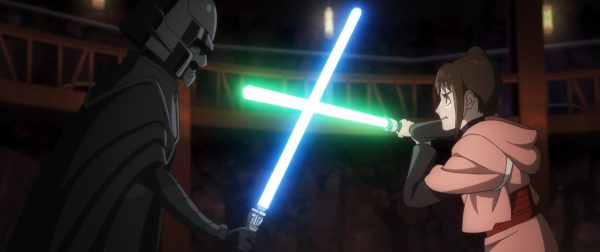
However, there are just as many times where the animation is truly beautiful and could easily stand among the best-looking sequences of the year. An early lightsaber fight features stunning light refraction that glows on screen and is genuinely breathtaking in execution. When a laser weapon is introduced and fires its warning shot, the way it visually cuts through the galaxy is nothing short of mesmerising, leaving you in absolute awe of its destruction. The show also employs a distinct art style for its flashbacks, a choice that feels both unique and creatively absorbing, keeping the series’ visual palette fresh throughout.
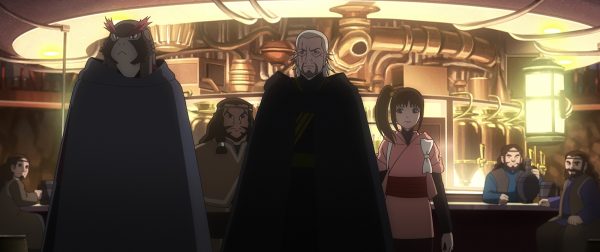
Narratively, the show delivers a safe yet engaging Star Wars story. Despite being untethered from the canon of this franchise, it leans heavily on familiar narrative formulas. From the contemplation and complexity around what defines a Sith or a Jedi, to a laser weapon threatening the galaxy, to even succumbing to the dark side of the Force. However, the show attempts to introduce moral nuance by exploring a state of nothingness, where one’s actions are not driven by emotions, which is showcased effectively through the colour-changing lightsabers. However, unlike series such as Psycho-Pass, which fully explore such thematic intricacies, this show merely scratches the surface and never dares to dive deeper into that complexity.
The voice acting from the English cast is inconsistent, with some stellar performances from Simu Liu as Lah Zhima and Andrew Kishino as Juro, who bring much of the show’s emotional weight. Kimiko Glenn’s portrayal of Lah Kara, however, feels tonally out of place; it sounds as though she is trying to replicate the delivery of the Japanese actress, but something is lost in translation as the vocal inflections do not match the character. Another letdown is the score, which is far from bad but leans heavily on motifs reminiscent of John Williams’ work rather than establishing something wholly original.
Despite all its flaws, Star Wars: Visions Presents – The Ninth Jedi left me wanting more. Yet throughout its eight-episode run, I couldn’t help but be captivated by what unfolded on screen. Narratively, it could be more thematically rich and supported by more polished animation, but when the show sinks its claws into you, it’s impossible not to be enamoured and to find yourself loading the next episode the moment the credits roll.
Robert Ewing