Exit 8, 2025.
Directed by Genki Kawamura.
Starring Kazunari Ninomiya, Yamato Kochi, Nana Komatsu, Naru Asanuma, Kotone Hanase, Hirota Otsuka, Tara Nakashima, Reo Soda, Mikio Ueda, and HIKAKIN.
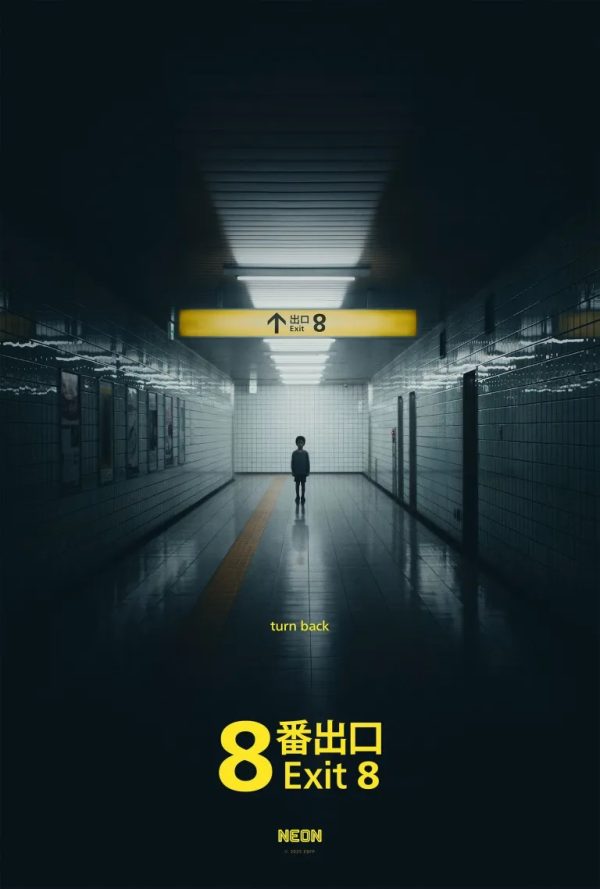
SYNOPSIS:
A man becomes increasingly desperate when he realizes he is trapped in a subway station, needing to complete a mission to get out.
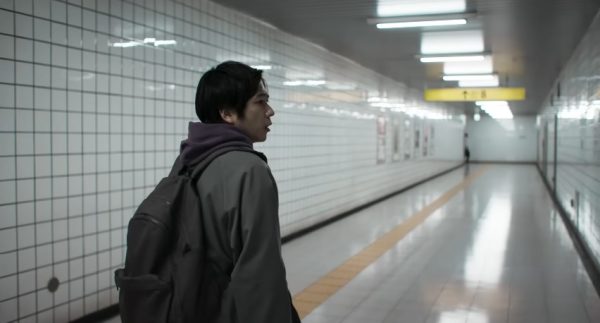
Setting that aside, for the most part, I have typically already played a video game that has been adapted into a film, director Genki Kawamura’s Exit 8 compelled me enough to check out the fairly recent source material, which has to count for something. During that play/research, it also became apparent that the filmmaker (co-writing alongside Kentaro Hirase) is taking some expansive psychological horror liberties with the game developed by Kotake Create, a narrative-free walking simulator that has an unsettling atmosphere, for sure, but is strictly about a gameplay loop built around testing the player’s perceptiveness of whether anything is visually or audibly changing about this subway station loop that, here, is also doubling as a Silent Hill-like purgatory state with an emphasis on punishing those it traps for their moral failings.
Naturally, this gives the cinematic adaptation something to engage with beyond just picking up what this game is supposed to be and how it is played (something one doesn’t necessarily need to do to understand, since the film explains it so well). It’s also refreshing to watch a film adaptation of a video game that, simply put, works by taking gameplay elements and directly translating them onto the screen. There are characters here, but the nature of the premise adds a layer that we still feel inclined, and even immersed, in playing along.
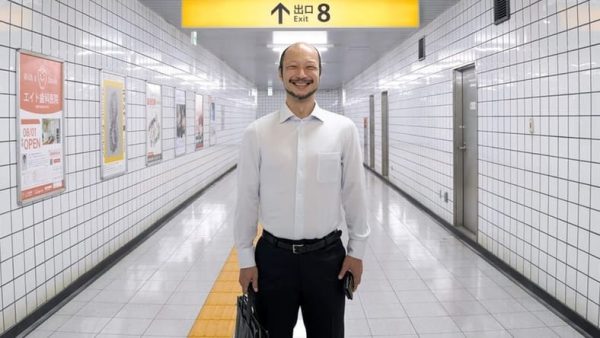
Following an awkward phone call where a man (Kazunari Ninomiya, credited as The Lost Man) is uncertain about whether he wants to be a father and if he should support or perhaps encourage his girlfriend (Nana Komatsu) to get an abortion, which takes place adjacent to an upsetting encounter on the subway train where an aggressively rude man berates a woman for bringing a crying baby on, he steps out and begins to walk through the station, either en route to his temp job or on the way to visit her, and come to a decision. In a pleasantly twisted Japanese psychological-horror fashion, that walk turns into an endless loop of puzzles and mysteries, complete with symbolism involving The Lost Man and two other characters he encounters along the way.
The rules, or the briefest how-to-plays, state that if an anomaly within these corridors is detected, the participant must turn around and return to the start to progress forward to the next floor. If no anomaly is spotted, they must continue forward as normal to find the next floor. Anomalies range from something as obvious as blood falling from the ceiling to more eagle-eyed instances, such as doorknobs changing places or an upside-down 8. Of course, there are also more symbolic touches, such as a crying baby heard in a locker (this is a man contemplating whether or not he is fit to be a father, after all). Incorrectly assuming an anomaly or missing one brings the participant back to the beginning of the loop. The only way to escape is to do this right eight consecutive times.
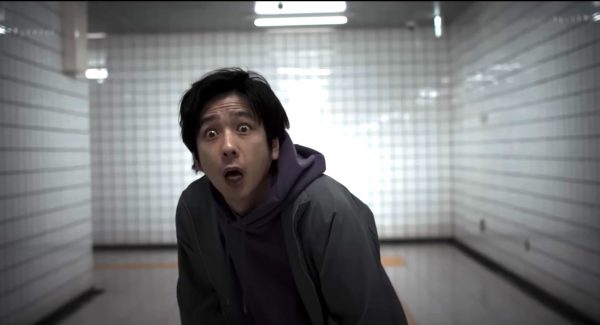
With that said, it’s easy to see how any viewer might join in on The Lost Man, enjoying themselves testing their acuity as they observe the psychological horrors that unfold around him. However, the filmmakers also might be stretching a 30-minute game with virtually no story into a 95-minute mind-meld that occasionally gets too heady. As mentioned, there are other characters here, ranging from The Walking Man (Yamato Kochi) and The Boy (Naru Asanuma), who could also be real people stuck in this loop or pieces of the game being played.
At times, Exit 8 boldly switches perspectives, which comes with rewards and frustrations. On the one hand, it is slightly annoying to have to go back to the beginning to watch another character do this after spending 30 or so minutes becoming connected to and involved with The Lost Man. On the other hand, the film does smartly take new angles in suggesting why they might be here, even raising the fascinating question of whether the real nightmarish loop is going through the same mundane work routine every day of the week. The presence of each character also complements the others, and ultimately makes for a creative decision that pays off in a trippy, if also somewhat predictable, manner.
There is also no denying the success of immersing a viewer in a gameplay loop through a film, while capitalizing on the premise for some muted psychological freak-outs inspired by some of the best Japanese horror has to offer in that department across both film and gaming.
Flickering Myth Rating – Film: ★ ★ ★ / Movie: ★ ★ ★
Robert Kojder