Wasteman, 2025.
Directed by Cal McMau.
Starring David Jonsson, Tom Blyth, Alex Hassell, Neil Linpow, Paul Hilton, Corin Silva, Layton Blake, Jack Barker, Fred Muthui, Lunga Skosana, Robert Rhodes, Keaton Ancona-Francis, and Cole Martin.

SYNOPSIS:
Follows parolee Taylor whose fresh start hopes are jeopardized by cellmate Dee’s arrival. As Dee takes Taylor under his wing, a vicious attack tests their bond, forcing Taylor to choose between protecting Dee and his own parole chances.

Backing up its intentions and messaging with real spliced-in cell phone footage of rowdy, uncontrollable prison behavior in an understaffed British penitentiary, director Cal McMau’s narrative debut feature Wasteman (from a screenplay by Eoin Doran and Hunter Andrews) is often purposely, effectively disorienting. That’s not merely limited to be incorporated leaked footage (this is a prison that, in some respects, is more of a recreational facility than one for rehabilitation, since the guards are in such low quantity, all while the incarcerated are rather easily smuggling drugs through drone technology while typically unbothered in their jail cells playing video games in between hard partying or fighting one another), but the brutality as well, with claustrophobic, tilted camera angles and a shakiness that lends a visceral grime to that physicality.
The exception to this disorder seems to be rising star David Jonsson’s Taylor, still using drugs but also consistently avoiding any such drama. He is quiet and timid to the point where he not only comes across empathetic, but one wonders how he became locked up alongside an otherwise degenerate bunch. It turns out that due to a new law going into effect, some prisoners will be released on good behavior, which, in Taylor’s case, means that he is far from a problem here despite abusing drugs. Nevertheless, he is nervously excited about the possibility of reconnecting with his teenage son, even if a phone call with his separated ex-partner makes it clear that she is firmly against such a reunion.

There also wouldn’t be a film here without a wrench being thrown into that impending release back into society, which is where the introduction of new cellmate Dee (a manipulative and psychotic Tom Blyth) enters as an inmate more concerned with taking over the in-house drug dealing hierarchy rather than fronting anything remotely close to good behavior. By extension, this jeopardizes Taylor’s chances of being released. That’s also not to say Dee doesn’t have his friendly moments, such as letting Taylor use his phone to reconnect with his son on social media.
Where Wasteman makes up for in familiar plotting is its sense of authenticity, which comes through not only in the previously mentioned cuts to rowdy cell phone footage but also in the decision to work with a charity and round out the rest of the ensemble with formerly incarcerated individuals who are now reformed. One gets a full sense of the microcosmic incarceration society, the pecking order, and just how low on the rung Taylor is, since he isn’t like most of the others. There is also a full-blown riot at one point that parallels and mirrors the clips of authentic footage. It’s scripted, somehow almost feeling as dangerous.
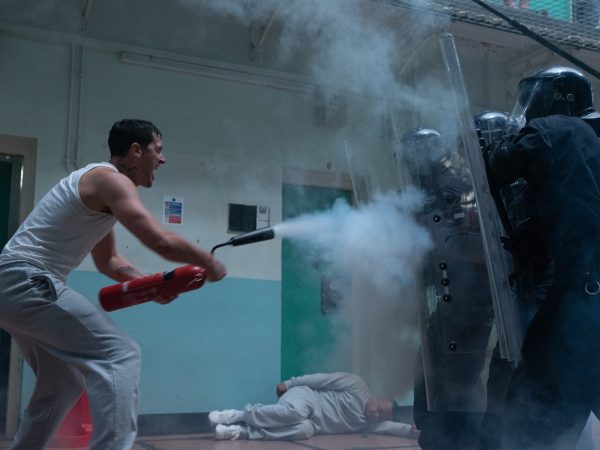
When Wasteman inevitably comes down to a bond tested between Taylor and Dee, that too is less about thrills and more to do with capturing rawness; part of a brawl here contains one character vomiting on another, driving home just how dirty, literally and figuratively, the film gets in its unflinching depictions of life on the inside for this particular penitentiary. It’s fiction with a dash of documentary, each with bracing importance. It’s enough to ensure the film doesn’t go to waste for its minor shortcomings.
Flickering Myth Rating – Film: ★ ★ ★ / Movie: ★ ★ ★
Robert Kojder