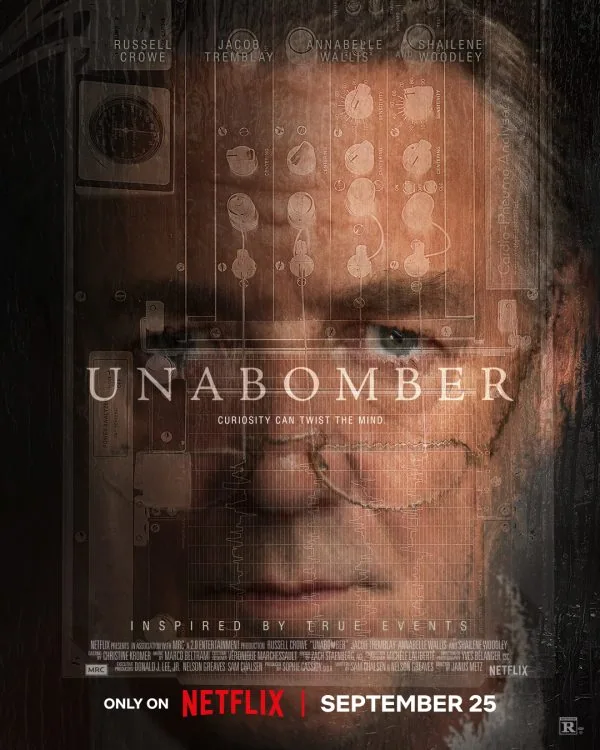
Unabomber, 2026.
Directed by Janus Metz.
Starring Jacob Tremblay, Russell Crowe, Shailene Woodley, Annabelle Wallis, Alexander Ludwig, Steven Ogg, Marc Menchaca.
SYNOPSIS:
A Harvard student becomes the Unabomber after psychological experiments. Years later, an FBI agent’s pursuit reveals how his past shaped his deadly campaign that killed 3 and injured 23 from 1978-1995.
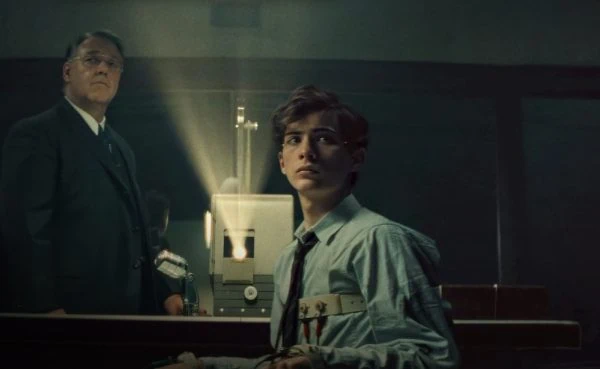
Credit to director Janus Metz for giving Unabomber somewhat of a fresh hook exploring the academic life of Ted Kaczynski (played by Jacob Tremblay as a socially maladjusted, self-described martian), who would go on to send anonymous mail-in bombs targeted at anyone with anything to do with moving technology forward, complete with a deranged but sharply written manifesto.
However, either the filmmaker (alongside screenwriters Sam Chalsen and Nelson Greaves) doesn’t trust the strength of this premise or doesn’t know how to properly stretch it into the length of the feature film, as there is also a section set in the 1990s leading up to his eventual arrest at the hands of a fairly routine and blasé FBI investigation, headed up by Shailene Woodley’s Agent Joanne Miller. Essentially, that portion is about her trying to convince Ted Kaczynski’s brother (Matthew Kevin Anderson) that there might be something to his wife’s suspicions regarding similar linguistics

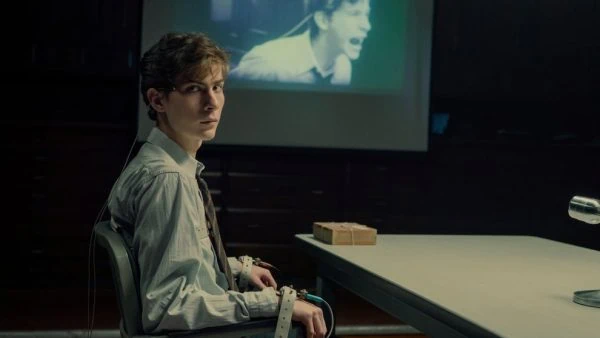
Aside from the initial jarring reveal in appearance of the type of recluse Ted Kaczynski became (sparsely glimpsed here and played by Michael Laurence), making for one hell of a visual juxtaposition of past and present, there isn’t a whole lot in his days at Harvard University – undergoing a series of ruthless psychological experimental debates under the tutelage of Russell Crowe’s Prof. Henry Murray and his associate Christiana Morgan (Annabelle Wallis) – that strongly make a case for how the verbal sparring that consistently bordered more on insulting and condescension rather than attacking opposing talking points, and the crushing betrayal that followed brought about the penning of that manifesto, Industrial Society and Its Future.
That’s not to deny that it clearly snapped something inside the mind of someone who, at one point, wanted to make the world a better place and cared about the have-nots. It’s also not to say the general story isn’t compelling on its own, because it is, as it transitions into a series of clever, crafty, manipulative mind games with Ted and Henry laying out ulterior, malicious motives. And while one would be hard-pressed to believe anything Ted Kaczynski has said in real life, there is no divorcing this film from his own words that the psychological warfare and fallout in his dynamic with Henry Murray had nothing to do with becoming the Unabomber. Psychological damage is clearly done, but it’s hard to say it’s a straight line from point A to point B in the Ted Kaczynski arc. A case could also be made that it isn’t supposed to be, since there are still 30 or so more years between events.
This also means the generic investigative scenes (showing one of the agents played by Steven Ogg, best known as Trevor from Grand Theft Auto V) aren’t only boring but also lack purpose and propulsion. There is also a decent chance anyone interested in this movie has already seen Ted K, the other, better movie about the Unabomber, which came out less than five years ago and covers much of the same ground in this section, including the discovery of his location and the arrest. The filmmakers probably could have saved some of that Netflix money by pulling scenes from that movie and inserting them here.
Unabomber isn’t a bad movie, but half of it is interesting, while the other half lacks awareness and feels disconnected from the origin story it’s trying to tell, not to mention retreading familiar ground. Think if someone released a movie about the childhood of the Zodiac killer three years after David Fincher made his movie, with that movie occasionally jumping forward in time to copy his work. Perhaps they did it simply to appease the insatiable true-crime Netflix junkie crowd. Regardless, the results entirely diminish and overwhelm the compelling aspects of Ted Kaczynski’s academic life told here, and, in turn, some stellar work from Jacob Tremblay and Russell Crowe.
Flickering Myth Rating – Film: ★ ★ / Movie: ★ ★
Robert Kojder