Dan Carville revisits Howard the Duck on its 40th anniversary…

If you asked anyone to name some of the biggest critical and commercial flops in Hollywood history, chances are Howard the Duck will pop up. You’ll find it in lists of the worst Marvel films, the worst cape flicks, even the worst movies of all time – it’s not exactly a beloved classic.
Nevertheless, in the 40 years since its release, the movie has cultivated a following of fans, ironic enjoyers, and a select few defenders. And as the first major Marvel theatrical effort, unless you count the previous year’s Red Sonja or the 1944 Captain America serial, it holds undeniable weight. But like those other examples, Howard the Duck stretches its comic ties as far as they’ll go.
All this raises the obvious yet complex question – does notorious cinematic laughing stock Howard the Duck deserve its rotten reputation? How has it changed over the last 40 years? And how has it affected broader perceptions of the character in media? As Howard the Duck turns 40, we’re diving back to where it all started, in 1973…
Bizarre Beginnings
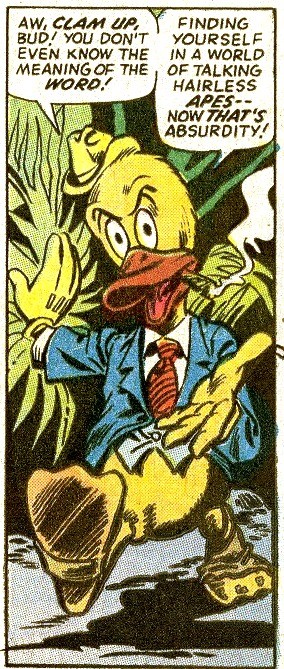
Like many breakout oddballs, Howard’s first appearance came in someone else’s story – Adventure into Fear #19 in 1973, written by Steve Gerber, with art by Val Mayerik. In the issue, Howard is plucked from his home-world of anthropomorphic animals (not exclusively ducks), and dropped into the midst of Man-Thing’s battle with Thog the Nether-Spawn, who caused a shift in the cosmic axis.
This wise-cracking fowl-out-of-water was popular enough to spawn a couple of solo stories in 1975, in the back of Giant-Size Man Thing (I know) #4 and #5. These stories, penned again by Gerber, with Frank Brunner on art, see Howard tumble through a space between worlds, before landing in Cleveland, Ohio, of all places. From there, he attempts to adjust to life on Earth, while battling such villains as Garko the Man-Frog, and Bessie the HellCow.
These stories, which feature several key moments that would appear in the film – Howard’s journey through space, his duck dollar bill, his strip-search by cops who assume him to be a small man in a duck suit – set the template for his ongoing series, which Gerber wrote from 1976-‘78, and which caught the eye of a certain George Lucas…
Howard’s Journey to the Screen
Following their collaboration on American Graffiti (1973), Lucas approached his old university pals Gloria Katz and Willard Huyck with the idea of adapting Gerber’s Howard series to film – he felt the absurdist humour and noir style would translate well to the big screen. Despite Huyck and Katz’s initial hesitancy, the project germinated until they had a vision – an adventure with Howard in Hawaii, where his presence amongst the people of Earth goes unexplained.
At the will of Hollywood producers, this was reworked into a story that more closely resembled the comics, following Howard’s intergalactic deportation to Cleveland, and his mission to return to his own kind.
This is where the timeline gets a little messy – the story goes that the film was conceived as animated, but that Universal insisted on a live-action production. Huyck, however, claims that the initial Hawaii concept came about because he and Katz “thought it’d be fun to shoot there,” (Huyck, W. 2009) so they had been considering a live-action shoot early on.
Conflicting Accounts
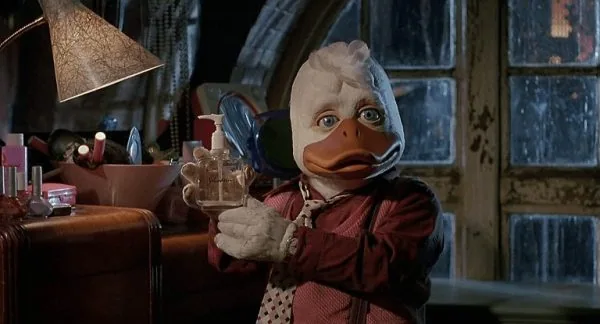
The reason for the switch to live-action is the source of some debate too – Katz claims that Universal wanted a movie for the summer of ’86, and that an animated production would take too long, so Lucas suggested a live-action shoot with practical effects. Yet this may have been a cynical move on his part, as rumour has it his contract with Universal required him to produce a live-action film within the year.
On top of this, Disney’s legal threats to Marvel in 1977, over Howard’s resemblance to Donald Duck, had necessitated a visual redesign of the character – his wide eyes were shrunk, his slim bill fattened, his off-white feathers turned yellow, and his blue-jacket-no-pants look replaced with a full red-and-brown suit. Since the filmmakers already had to work side-by-side with the Mouse to ensure their Howard didn’t look too Donald-y, it’s possible that an animated film would have run into trouble.
There was no singular reason, but all these factors played a part in the decision to bring the duck to life with suits, puppets and animatronics.
A Troubled Production
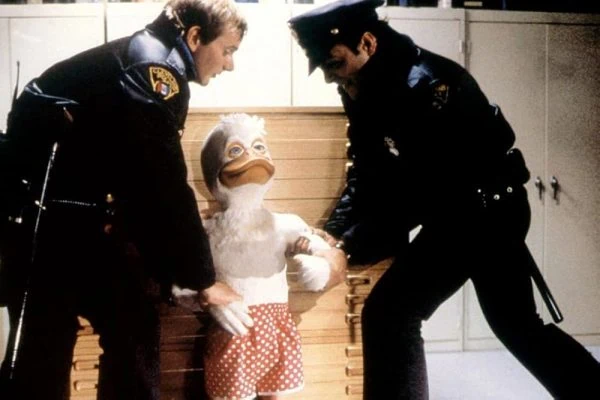
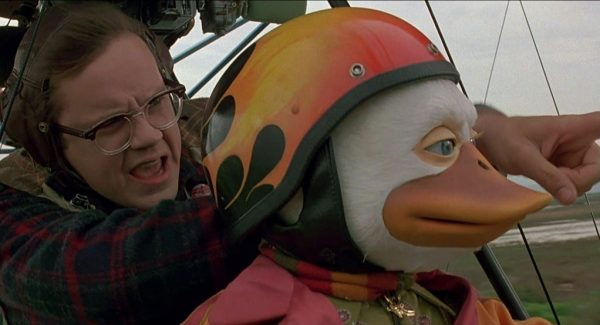
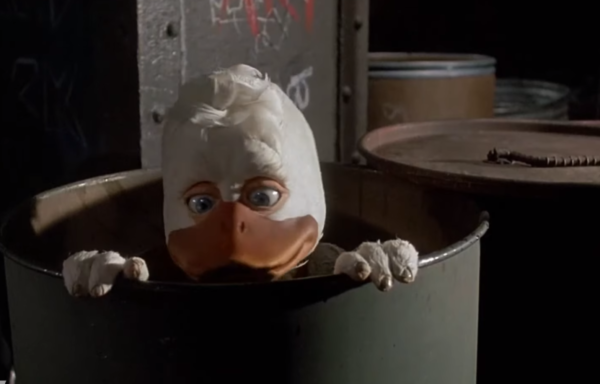
Like many effects-heavy productions of the pre-CGI age, the Howard the Duck shoot was rife with issues. Huyck has said he regrets the technology wasn’t further along at the time, as the Howard suits were known to lose feathers, break apart, and spontaneously combust.
Early on, a hand-puppet was used for some shots, but this approach was abandoned as the effect didn’t match the animatronic suits, which were then used to reshoot all the puppet scenes. With each setback, the team learned and developed, and the suits improved over the course of the production, both in functionality and appearance.
When the film released in the summer of ’86, though not all were convinced of Howard’s duckness, the practical and visual effects were a general point of praise, among outlets like Time Out and The New York Times.
Sadly, this was one of the only aspects critics appreciated…
A “Mixed” Reception
Gene Siskel and Roger Ebert, America’s most popular and influential film critics of the day, led the charge on the Howard hate train in a 1986 episode of At The Movies, later ranking Howard the Duck as one of the worst films of 1986, a sentiment that reverberated across the critical space, and has come to haunt the film in the years since.
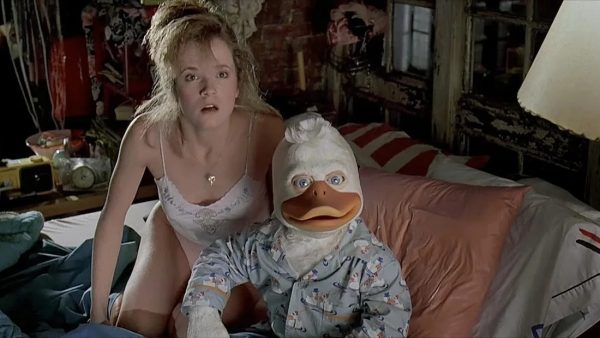
A frequent critique was the movie’s uneven tone. Critics and audiences, especially those with children, expecting a light-hearted family comedy were perturbed by the sex jokes, smoking and drinking, as well as the surprisingly gruesome body horror – the film at times reads like an adult-oriented late-night b-movie.
An Offbeat Sense of Humour
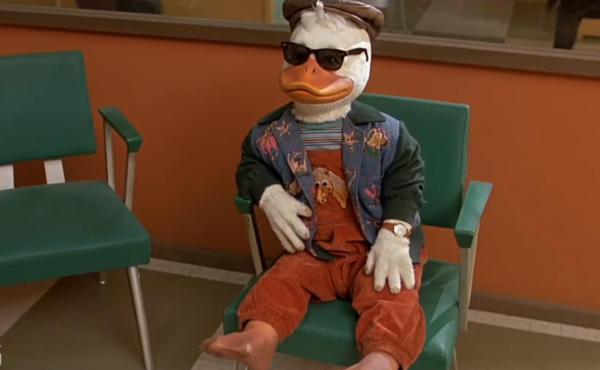
The film’s humour proved divisive, to say the least. A heavy reliance on lazy duck puns – “No more Mr. Nice Duck” – wore thin pretty quickly, while the innuendo and human-duck dynamics were more uncomfortable than amusing. This too would be alienating for fans of the comic, whose humour stemmed mainly from social satire and existential absurdism, with minimal innuendo (due in part to the comics code), and sparing, tasteful use of duck puns.
Although, it’s worth remembering that this was the eighties, a decade defined by movies that tested the definitions of PG. For example, Ghostbusters had performed a similar tonal and comedic juggling act two years prior, balancing family-oriented fun with adult humour and horror. The movie pulled this off masterfully, becoming a critical and commercial success, and a time-honoured classic.
So, it seems the problem lies less in the movie’s subject matter, and more in its execution, which in Howard the Duck’s case, left something to be desired.
An Ideological Clash
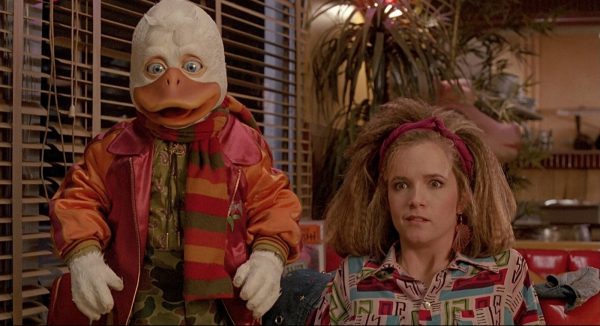
In an interview prior to the film’s release, Steve Gerber discussed his involvement in development, and the filmmakers’ approach to adapting his work: “they were very, very conversant with the comic books and with what I had done in them. They obviously had a real genuine affection for the material”(Gerber, S. 1986).
But when faced with negative reactions to the film, co-writer and producer Gloria Katz reflected: “It’s a film about a duck from outer space […] It’s not supposed to be an existential experience” (Katz, G), ironically summarising the creative misinterpretation at the centre of the adaptation – existentialism was a core theme of Gerber’s comics, and their primary source of humour.
As Gerber had put it: “Life’s most serious moments and most incredibly dumb moments are often distinguishable only by a momentary point of view. Anyone who doesn’t believe this probably cannot enjoy reading Howard the Duck.” (Gerber, S. 1977)
While Huyck and Katz may have set out to produce a faithful adaptation, they just didn’t quite get the “cosmic giggle. The funniest gag in the universe.” (Gerber, S. 1977)
Core Character Correctness
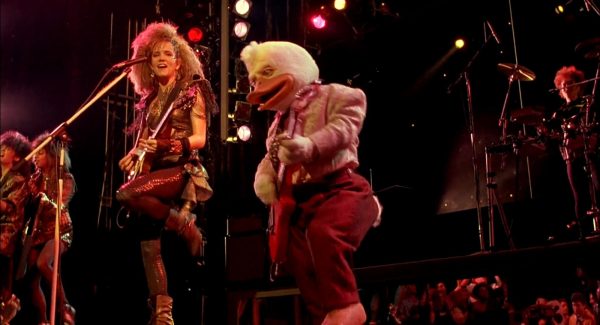
Despite the differences in tone and humour, Gerber considered the onscreen representation of Howard to be faithful to his comic-book creation, stating that the film “did capture Howard very, very well. The character of Howard will be immediately recognizable and identifiable to anybody who liked the comic books.”
Supposedly, prior to production, it was decided that the film should soften the character for audiences, toning down his bad-tempered cynicism, to make him more likeable. This decision, though, hardly comes through in the film, where Howard is just as prone to sarcastic remarks and angry outbursts. And for some reason, they chose to add a sleaziness not found in his comic counterpart, who is typically disgusted by the casual misogyny he comes across. Nevertheless, Howard’s core characterisation shines through, despite these changes.
Beverly Switzler (Lea Thompson), the only other comic-based character in the film, “is a bit different, and yet similar.” (Gerber, 1986). She is the leader of a punk rock group, rather than a life-drawing model, although this doesn’t give her the fiery, independent spirit you might expect; hers is a mostly passive role. Gerber’s Beverly was more apt to speak her mind, and call Howard out when he was in the wrong.
While the two central characters remained more or less intact in their journey from panel to screen, as did the setting of Cleveland, the same can’t be said for the supporting cast.
Twists, Turns and Changes
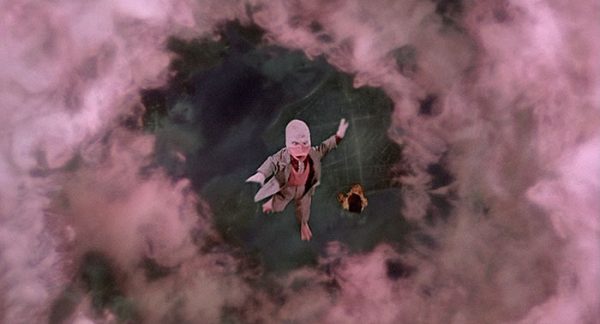
An early point of departure comes in the form of Howard’s arrival on Earth – in the comics, it was caused by the Nether-Spawn’s meddling with the nexus of all realities, bringing beings from various worlds into one dimensional plane. In the film, Howard is dragged from Duckworld by a malfunctioning ‘laser spectroscope’, somehow surviving the exit of his planet’s atmosphere, the vacuum of outer space, re-entry into Earth’s atmosphere, and a crash-landing into Cleveland.
The switch from a mystical to a sci-fi approach makes sense, streamlining Howard’s journey for general audiences. But it doesn’t stop there.
Beverly’s all-girl glam rock group Cherry Bomb were invented for the film, as was her scientist friend Phil Blumburtt, played by an alarmingly off-kilter Tim Robbins. His acquaintance Dr Walter Jenning, played by Jeffrey Jones, was also an original character, as was the galactic demon that possessed him…
The Dark Overlord of the Universe
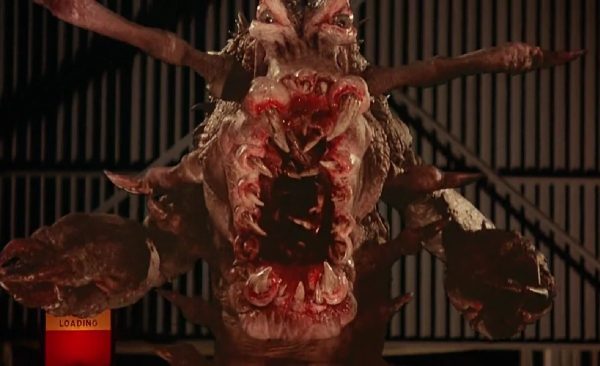
This being grotesquely transforms Jenning’s body throughout the third act, before emerging in the finale as an impressively gnarly stop-motion monster, brought to life by legend of the medium Phil Tippet. While an original creation, the Dark Overlord has some roots in the comics, hailing from “the Nexus of Sominus… a region of demons” (Howard the Duck, 1986) – an amalgam of the Nexus of All Realities, and the demon-dimension Sominus, both of which feature in Howard’s early appearances.
While the Dark Overlord remains one of the more impressive aspects of the film, it doesn’t hold a candle to the sheer insanity of Howard’s comic villains – Turnip-man, the Kidney Lady, the Giant Gingerbread Man, Le Beaver, and Doctor Bong to name a few. Howard the Duck’s rogues gallery riffs on the absurdity of the superhero genre, and for the film to present such a self-serious antagonist, drawing more on Howard’s Man-Thing appearances than his own series, is more evidence that they simply didn’t get the joke.
A Reputational Reappraisal?
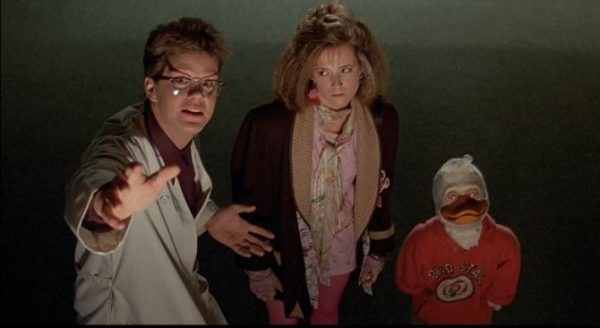
It’s hard to stay mad at a movie for long, especially one as silly and harmless as Howard the Duck. While the film is still regularly listed amongst the worst of its kind, it has amassed a cult following among those who grew up watching it, those who’ve discovered it since, and fans of the comic who appreciate its relative character accuracy. Many fans share similar sentiments – an initial unawareness of the movie’s reputation, and a belief that, while far from perfect, it doesn’t deserve to be considered one of the worst movies ever made.
Despite this, the movie’s awful reputation is undeniable, and has arguably done irreparable damage to the character’s image – when most people think Howard the Duck, they think of the maligned ‘80s flop film, rather than the smart, subversive ‘70s comic series.
The Adaptational Curse

There have been two other attempts to bring Howard to the screen; the first being an animated series announced around the time of the film’s release, which never saw the light of day, most likely due to the movie’s critical and financial failure. In 2019, after a modest spike in interest following Howard’s Guardians of the Galaxy cameos (voiced by Seth Green), and his subsequent comic series by Chip Zdarsky and Joe Quinones, plans for another animated series were unveiled, this time with Kevin Smith attached as showrunner.
The series would have followed Howard and Beverly’s quest to find the Darkhold, a dark-magic book, to help him return home, while being pursued by Dr Bong. It was announced for HULU, alongside M.O.D.O.K, Hit-Monkey and Tigra & Dazzler, but after the Disney-Fox merger and the creation of Disney+, only the first two were produced, leaving Howard the Duck dead in the water, alongside Tigra, Dazzler, and the planned Offenders team-up show.
Fortunately for fans, Howard would appear as a recurring character in Marvel’s What If?, voiced again by Green, eventually getting his own spotlight episode in season three, What If… Howard the Duck Got Hitched? (2024). Yet Marvel seems hesitant to roll the dice on another Howard solo project.
Final Thoughts
At the beginning of this retrospective, I set out to address a few questions – does Howard the Duck deserve to be considered one of the worst movies ever made? Is it a faithful adaptation of Steve Gerber’s comics? And is it time for the character to return in a major way?
First of all, a movie’s quality is subjective, so we can’t expect any clear, conclusive answers. But the case of Howard the Duck is interesting – despite its cult following, and the ever-growing presence of much, much worse films, Huyck and Katz’s creation can’t seem to escape its label as one of the worst cinematic abominations of all time. This speaks less to the film itself, and more to the hyperbolic, label-driven nature of film discourse. If enough people say it, it must be true, right?
While Steve Gerber attested to the faithful representations of Howard and Beverly, the movie’s central thematic misinterpretation resulted in a spiritual opposition to the comics. It doesn’t help that the plot, villain and supporting cast are completely different too. Yet it’s pleasing for fans to see Howard and Bev on the big screen, even if the film around them barely resembles their surreal misadventures on the page.
And yes, I do feel it’s time for Howard to make a proper comeback, whether that’s on the big or small screen. Steve Gerber’s original series is too smart, funny and original to remain buried by a big-budget box office blunder forever, and if a new adaptation were to emerge, one true to its origins, it might lead a new generation of fans to rediscover the classic comics. All it would take is for Marvel to get past the stink surrounding the movie, and take that first, web-footed step.
What are your thoughts on Howard the Duck? Let us know on our social channels @FlickeringMyth…
Dan Carville