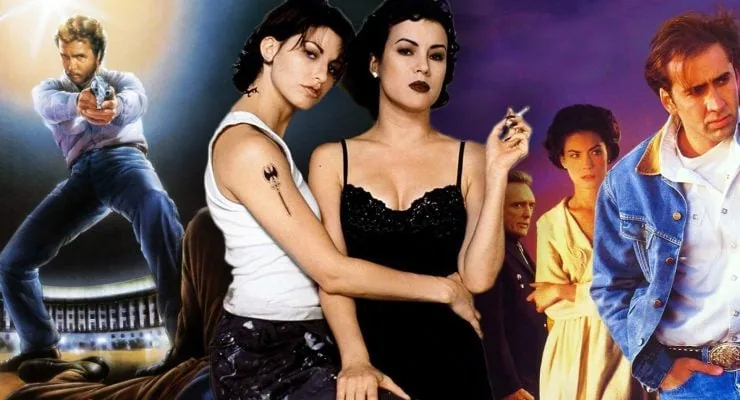
Adam Page revisits Oliver Stone’s Natural Born Killers…
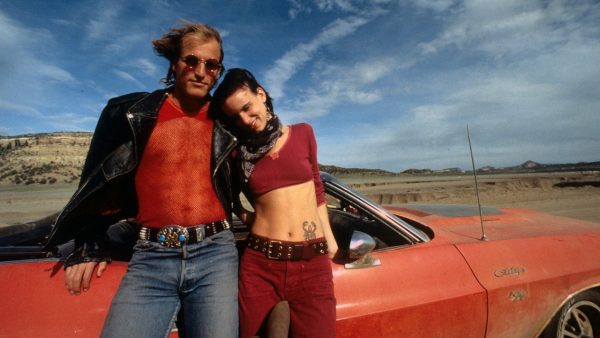
I want to start with a theory I’ve long held about America and its relationship with its own ugliness: they love it. They love it the way a dog loves rolling in something smelly and dead; with complete and shameless abandon, every single time. Oliver Stone understood this back in 1994, and the country has never quite forgiven him for it.
Natural Born Killers is one of the most misread movies in American cinema. It is labelled with words like “ultraviolent,” “exploitative,” “the movie Quentin Tarantino disowned,” as if Tarantino, a man who wrote the screenplay where Mickey and Mallory Knox murder their way across the American Southwest as a love story, has earned the moral high ground on pretty much anything. The real crime of NBK isn’t that it’s too violent; the crime is that it’s too funny, and nobody wanted to admit what they were laughing at.
Because the thing that Stone is doing, and the thing most of the critics missed while they were busy being outraged, he’s making a comedy. It may be a grotesque, convulsive, and deeply uncomfortable one, but yes, still a comedy. It’s a satire so corrosive that it dissolves the container it comes in. And the tonal whiplashing, the sensation of laughing then feeling ill about laughing, isn’t a flaw in Stone’s moviemaking, but the entire point of the movie.
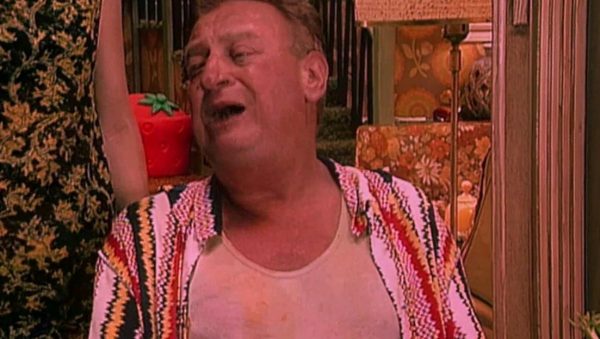
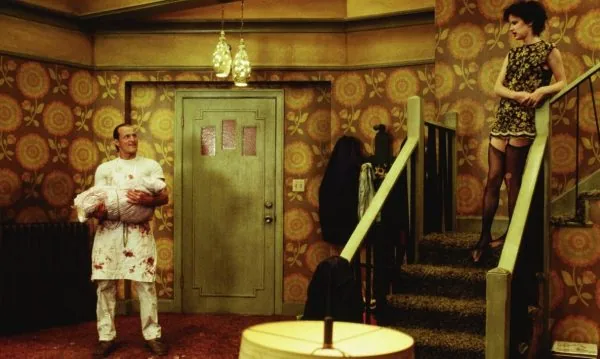
Start with the Mallory flashback. Here Stone gives us Mallory Knox’s earlier abusive home life; her father molests her; her mother ignores it and her slow violent dissolution. Stone films it all as a three-camera sitcom, laugh track included. The audience at a test screening reportedly sat there in horrified silence for this sequence, then somewhere around the third canned laugh over something truly appalling, started to laugh too. It wasn’t because child abuse was funny, but because the laugh track was insisting it was funny. The gap between what you’re seeing and what the form tells you to feel is so vertiginous that the laughter becomes the only release valve available.
This is a Brechtian technique but filtered through a Times Square sensibility. Brecht with a bag of fast food in his lap. The framing of the sitcom is a critique of the form itself, the way American domestic comedy has always acted as a pressure release valve for the dysfunctional family. It packages real horror into something palatable, something you can chuckle over in 22 minutes with a warm resolution. Stone just ripped away the resolution and leaves us with a laugh track over the abyss.
Rodney Dangerfield plays Mallory’s father, and that’s no coincidence. He’s a man whose whole career was built on a single joke; “I get no respect”, delivered with a cadence that is almost hypnotic. Stone then weaponizes that familiarity, as every time Dangerfield opens his mouth, every time that comedic timing kicks in, we are conditioned to laugh. And what he says and does is truly horrific. The form and the content are at war, and it’s us who are the battlefield.
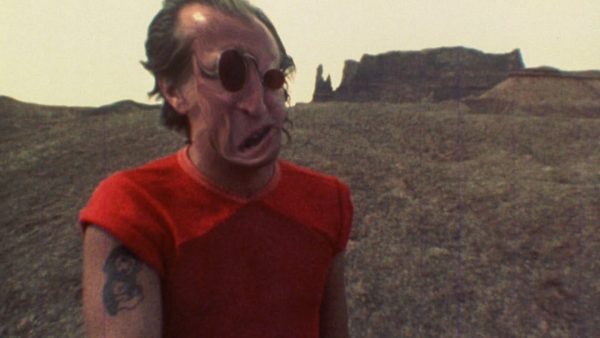
Then we have the Navajo shaman. Lost somewhere in the New Mexico desert, Mickey and Mallory come across the camp of an old Native man, a medicine man and elder, played with total, unironic dignity by Russel Means. And bless Oliver Stone’s maximalist heart, he films this scene as something very close to hallucination. There’s peyote logic, warm lighting, and a man who can see straight into Mickey’s darkness and name it without flinching.
Then Mickey shoots him. While having a nightmare as the old man chants over him. Because Mickey Knox is not capable of accepting grace. He kills the only person in the movie who sees him clearly, as being seen clearly is the one thing that terrifies him.
What makes this funny, and it is funny in the blackest possible way, is the sheer, cosmic absurdity of it all. Here is one moment of real human connection in a movie filled with performed connection, and Mickey responds to it the way he does to everything: with a bullet. The universe is offering a door, and he uses it for target practice. Stone doesn’t linger on it for the pathos, he goes through it with the movie’s relentless velocity, and we’re left processing the laugh that gets caught in the throat halfway up.
It’s this structure which makes the best dark comedy; setting up the expectation of meaning, deliver it with absolute sincerity, then have something awful happen to it. Not because meaning is worthless, but because we live in a world that always destroys meaning, and to pretend otherwise is its own form of dishonesty.
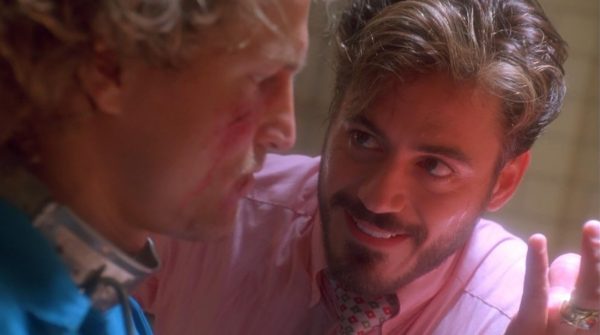
But if there’s one performance in NBK which shows what Stone is doing, It’s Robert Downey Jr. as Wayne Gale, the Australian tabloid journalist who turns Mickey and Mallory into celebrities. Gale isn’t some satirical sketch, he’s a portrait. He is every entertainment journalist who ever made a career out of proximity to horror, who confuses access with insight and who seriously believes that his charm and a microphone elevate whatever darkness he is packaging into something meaningful.
Downey plays him like a man who is in on a joke he doesn’t know he’s the punchline to. His accent wobbles, and his enthusiasm is manic and performative, a little too large for whatever room he’s in. Functionally, he’s a cartoon, apart from the fact that cartoons don’t have the real-world consequences that Gale sets in motion when he arranges to interview Mickey live on Super Bowl Sunday. And Stone using that day for a prison riot is so on-the-nose that it comes around the other side to genius.
The live broadcast meltdown is the centrepiece of the movie, and it really is hilarious. Gale is swept up in the events, his professionalism crumbles in real time and his moral architecture collapses floor by floor while Mickey turns the prison into a charnel house. All the while, Gale keeps broadcasting. He keeps the microphone up and keeps narrating. Because this is the biggest story of his life, the one that will make him, and the fact people are dying all around him is just, in the calculus of tabloid TV, a production value.
His meltdown is the funniest thing in the movie, and that makes it the most horrifying thing in the movie. Because we recognise it. We’ve all seen that face on actual television, during real disasters, events real journalists treated with exactly that ratio of performative gravity to barely hidden excitement. Stone is transcribing it, not making it up, and he just turned the dial up until the mechanism is visible.

There is a standard complaint about Natural Born Killers which is that it can’t decide what it is. Satire? Horror? Road movie, or love story? Stone shifts register so quickly and mixes visual styles so aggressively; 16mm, 35mm, video, black and white, that viewers have reported feeling seasick. Unmoored, as though the movie is having a crisis.
But this is just what television does. It’s exactly what the media landscape it’s critiquing does. Channel-surf for ten minutes in 1994, hell even ten minutes today, and you’ll get war, a car commercial, a cooking show, a political scandal, a pharmaceutical ad listing side-effects up to and including death, and a local news anchor delivering all this with the same practiced and soothing intonation. The tonal instability in NBK is a formally accurate depiction of the media environment Stone is attacking, not a failure of his control.
It feels like too much because it is too much. That’s the whole argument. We live in too much; we are marinated in it, and have developed a smooth, professional numbness to it that lets us process a human atrocity and a furniture sale all in the same 30 seconds without blinking. Stone just makes you blink, making the process visible. He makes us aware of the machinery running just underneath our noticing, and that machinery, when we see it, is both terrible and ridiculous. And by that, I mean it’s funny.
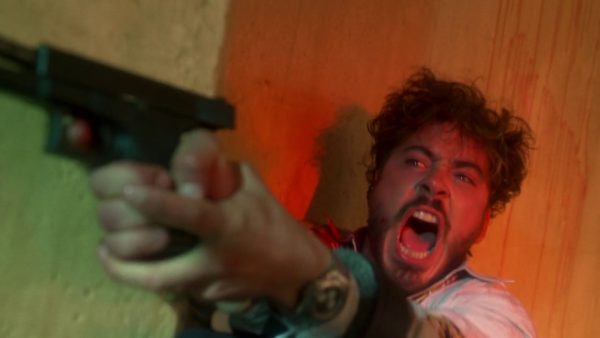
The problem with acknowledging the comedy in Natural Born Killers is that it implicates us. Laughing at the sitcom flashback means you recognised the form even when it was wrapped around something awful. Laughing at Wayne Gale means acknowledging you’ve laughed at the real Wayne Gale in real situations. Laughing at the prison riot, at its operatic excess, Downey’s increasingly deranged performance edging ever closer to Looney Tunes, means accepting that some part of you finds spectacle entertaining and it doesn’t matter what the spectacle consists of.
Stone doesn’t let us watch the movie without becoming a part of it. It’s the oldest trick in satire’s book, and it’s deployed here with a sledgehammer. We watch a movie about media consumption while consuming it as media. The fact it’s compelling and disgusting at the same time is the condition, not a paradox. It’s the whole condition.
Tarantino wrote the original screenplay then disowned the movie when Stone rewrote it into something more interested in ideas rather than cool, but was right about one thing: this isn’t the movie he intended to make. Stone made a better one, a movie that doesn’t let violence be cool. He made the violence funny and grotesque and sickening in quick-fire succession, until our response mechanisms start to misfire. We end up laughing at things we don’t want to laugh at, and that discomfort is the whole message delivered straight to your nervous system without the insulation of good taste.
Thirty years on, and the movie deserves more than its reputation as some violent curiosity from the 90s culture wars. It’s a work of real formal invention; yes it’s messy and occasionally self-indulgent and wielded with all the subtlety of a man who hasn’t once in his career been accused of restraint, but underneath that assault is the precision of a comedian. He has the right laugh track over the wrong image, the right actor at the right pitch, and the right cut from horror to farce at the perfect moment which makes you feel the seam.
Comedy is what happens when two incompatible things are occupying the same space; when the content is saying one thing and the form another. When the expected response and appropriate response are revealed to be completely different. Oliver Stone built a movie completely out of that terrible, not just American, gap between what we tell ourselves we are and what we actually do, between the laugh track and the behaviour under it.
It’s the funniest movie about America that America has ever hated. And that, in its own way, is the punchline he was going for all along.
What are your thoughts on Natural Born Killers? Let us know on our social channels @FlickeringMyth…
Adam Page