The Last House, 2026.
Directed by Louis Leterrier.
Starring Greta Lee, Wagner Moura, Gabriel Chung, Noah Alexander Sosnowski, Emma Ho, Riley Chung, Audrey Anderson, Sid Edwards, Lewis Goody, Nancy Baldwin, Tawny Fontana, Jed Aukin, and Oliver Henry Arnold.

SYNOPSIS:
A family of four is suddenly sealed inside their house with no way out and must work together to survive against both their dwindling resources and the mysterious, looming threat that is keeping them trapped.

There is a nightmarishly subversive premise and a refreshing angle to survivalism in director Louis Leterrier’s The Last House that bluntly never goes anywhere compelling. Yes, the idea of being trapped within one’s home to a degree that extraterrestrial forces have built some type of invisible barrier preventing the owners from opening the front door, escaping by smashing open a window, and barreling a car through the garage is horrifying, especially for the inevitable long-term physical and psychological effects.
These creatures are water-based (an opening card quotes Arthur C. Clarke pondering “how inappropriate to call this planet Earth when clearly it is ocean”, setting the stage for water-based creatures to invade, locking everyone in their homes. There is also an ecological angle at play (courtesy of Matthew Robinson, who expressed justifiable concerns about AI earlier in the year alongside Gore Verbinski collaborating on Good Luck, Have Fun, Don’t Die) in that this transformation of home into a prison without any Wi-Fi forces the family – dad Jason (Wagner Moura), mom Ann (Greta Lee), and their two children Ruth (Riley Chung) and Graham (Noah Alexander Sosnowski) – to come together through different bonding exercises – physical media becoming a key component for entertainment at what might be the most appropriate time given some recent horrendous anti-consumer directional choices from Sony PlayStation – while also noticing how quickly the sky clears up with nothing causing pollution (I’m not allowed to further divulge the scope of this apocalyptic scenario).
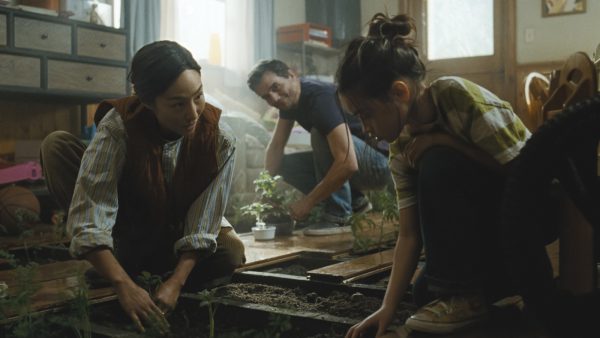
As the days go by with no help or solution in sight – just neighbors to regularly make small talk to by writing on whiteboards and holding them up to the window – the food is gradually all used up, even when strictly rationed (I’m also not at liberty to say how long this scenario goes on). This calls for Jason to dig deep and find determination and resourcefulness to help his family survive, coming up with a unique hunting method that brings animals from outside in for meal preparation. Meanwhile, Ann discovers how to develop a fully functioning garden in their house.
Over and over, this resilience is tested, with breadcrumbs scattered about what exactly this family is dealing with and why these creatures insist on keeping them locked up (even if someone smashes a window, it will only crack, as an invisible force field keeps everyone inside). As such, the performances also increase in intensity with dangerous scenarios and medical scares coming into play. There is no denying that The Last House successfully makes a point regarding humans destroying the outside world, but it’s at the expense of an idea that runs its course by the one hour mark, causing the film to somewhat shift and do something else I can’t talk about (Netflix really wants the details of this story kept under wraps for review, which makes sense, because the uncertainty of where it will actually go is one of the only elements working in its favor).

Talking circles around the film isn’t necessarily a frustration either, since there isn’t much to talk about in the first place. The special effects are muddled and hard to make heads or tails of (this is partially by design, as the creatures are often obscured by heavy rainfall or darkness), and the action sequences come far too late to matter or have any emotional or narrative impact. Perhaps it sounds as if there is a horror angle here, but that also doesn’t arrive until the third act and isn’t even satisfying.
What’s left are a couple of rising stars effectively conveying the escalating psychological toll the scenario takes on them, and a rather tedious tale of never giving up. There is a glass-half-full approach, with a family becoming more united as their lives are thrown into disarray and imprisonment with no Internet. It’s a film with interesting ideas and flat execution. The Last House is dull enough to make someone turn off Netflix and go outside, although not necessarily for the right reason.
Flickering Myth Rating – Film: ★ ★ / Movie: ★ ★
Robert Kojder