The Mosquito Bowl, 2026.
Directed by Peter Berg.
Starring Nicholas Galitzine, Bill Skarsgård, Ray Nicholson, Tom Francis, Brent Comer, Pat McAfee, Claudia Ware, Stacy Clausen, Ella Newton, Olga Petsa, Brodie Henson, Dominic Bogart, Olive Weeks, Thomas Dingle, Jack Scott, Emily Paxevanos, Brendan Egan, Lola Bond, Akira Fujii, and Sophie Arthur.

SYNOPSIS:
After Pearl Harbor, four star college footballers join the Marines. Before facing Okinawa’s invasion, they participate in a historic game with legendary players – for many, their final match.

There is every reason to believe that the only reason co-writer/director Peter Berg’s The Mosquito Bowl (with assistance from Mark L. Smith, based on the book by Buzz Bissinger) introduces each major (a term used loosely) American World War II soldier on college football fields is that the only discernible difference between them is the position they play. Yes, even with recognizable names like Bill Skarsgård and Nicholas Galitzine, it’s almost impossible to tell any of these guys apart on the battlefield; they blur into the same generic soldier archetype, albeit robbed of prodigious athletic potential. A case could be made either way for whether this film needed less or more football, but it is baffling how little the titular game (played on a beach before invading Okinawa to boost morale) matters to the characters or the grand scheme of the storytelling.
Ray Nicholson’s Touchdown Tony broke a record for exactly what it sounds like. Nicholas Galitzine stars as John McLaughry, apparently a skilled running back with a burst of speed. Bill Skarsgård (also, why on earth would they cast him, a known chameleon, in a film where most characters are already destined to become indistinguishable from one another by default) is an arrogant fellow who also plays football. Together, and among others, they are drafted into the war after Pearl Harbor, spotted by celebrity hounds on the battlefield, and try to devise a strategy based on what they learned from their various gridiron coaches, which goes about as well as one might expect.

In the middle of all this, for about five minutes, College Game Day sports analyst (now insufferably on the Monday Night Football pre-show panel) Pat McAfee has the right idea for a drill-instructor performance, but it’s still somehow stilted and overblown, rendering him as obnoxious as ever. Somehow, the movie around him is much more excruciating and disappointing. I’m sure he’s thrilled to have a role in a movie with lines of dialogue such as “I’m going to turn them Christian, and the best way to do that is by killing them so they see God” or some variation of that, where every Japanese soldier is presented as some animalistic rabid being to keep up with the jingoistic patriotism in a movie that seems confused about whether it’s condemning all of this or presenting it as an unfortunate but necessary tragedy.
What makes this more frustrating is that Peter Berg has certainly delivered immersive warfare and gridiron showmanship with ear-ringing sound design, whether it be bullets, explosions, or tackles (the physicality of the football is especially rough, holding nothing back about how dangerously brutal the game is). There isn’t an engaging story around it, and not one that actually cares about the futures of these young men being stripped away to be shuffled off into war. A couple of them have girlfriends, who also get about one scene each in the opening; it’s all window dressing for a movie that offers nothing beyond gritty violence. One might presume the Mosquito Bowl is a focal point or integral to the film, but it’s possible to miss entirely if someone skips out for a bathroom break at the right or wrong time, depending on perspective.
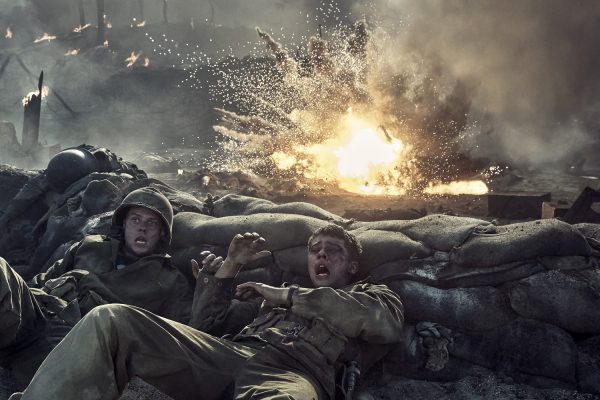
The Mosquito Bowl doesn’t earn an ounce of the emotion it’s going for in its ending. To call the film deeply confused would be an understatement. There are moments such as soldiers hashing out rivalries there once had on the football field or planning out flanks through football terminology where one gets a sense of what Peter Berg thought this could be, but it and the characterization are all drowned out in the epic scale action, which is admittedly the one thing the filmmaker excels at. As a sensory war experience, the film is solid but a fumble in every other aspect. When the rest of the movie is worse than Pat McAfee’s presence, that should say a lot.
Flickering Myth Rating – Film: ★ / Movie: ★ ★ ★
Robert Kojder