Simon Thompson revisits Waterworld, the 1995 movie that sunk Kevin Costner’s star status…
Infamous production cycles are something that fascinate me as a film fan, for whatever reason. Be it the huge egos involved, or the insane this couldn’t possibly happen in any other working environment anecdotes. In amongst the sheer absurdity of big productions and all the ego and financial resources that come with it, sometimes it results in masterpieces (e.g. Apocalypse Now, Sorcerer, The Abyss, Blade Runner, The Adventures of Baron Munchausen, Fitzcarraldo, and Jaws) but more often than not the end results turn out to be Cats, The Isle of Dr Moreau or The Room.
The subject of this article, Kevin Reynolds’s Waterworld, is a movie which can comfortably pull up a stool at the production nightmare saloon, with a shoot so hellish it basically ended one of Hollywood’s most successful partnerships for a long time afterwards, and practically knocked one of its biggest stars, Kevin Costner off his perch.
Chapter One – The Beginnings of Waterworld
The genesis of Waterworld began in the mid-1980s, when screenwriters Peter Rader and Brad Krevoy were discussing plans to make a post-apocalyptic action movie in the same vein as Mad Max. Inspired by a combination of Peter Milligan’s cult comic book series Freakwave – which is basically Mad Max with surfing- as well as various Old Testament stories and the Greek Myth of Helen of Troy, Rader wrote an initial draft in 1986, but it remained shelved until three years later.
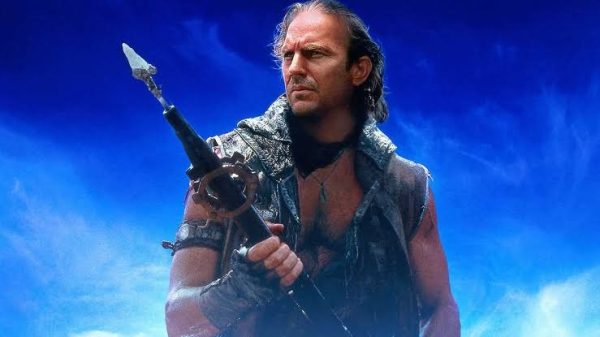
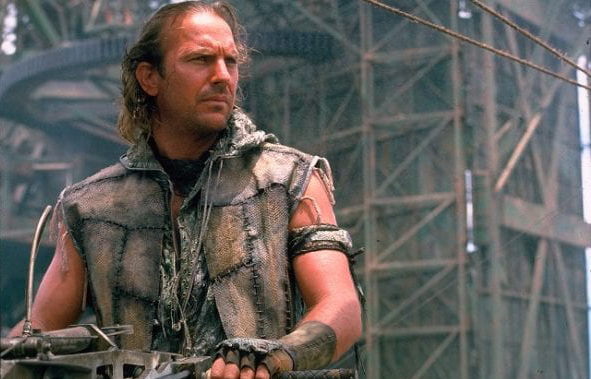
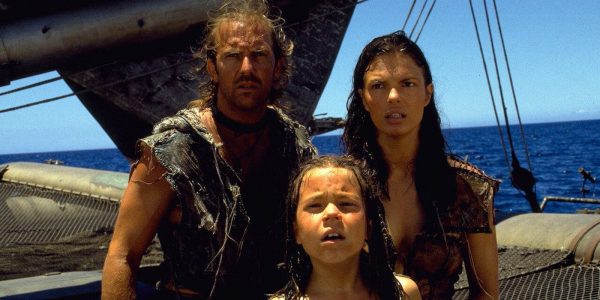
The story is set in a dystopian post-apocalyptic future Earth, in which the polar ice caps have melted, resulting in sea levels above 25,000 feet and the complete submersion of all land and humans living on separate atolls. Within this grim future, the protagonist known only enigmatically as The Mariner (Kevin Costner), begrudgingly helps Helen (Jeanne Tripplehorn), a young woman from one of the islands and her adopted daughter Enola ( Tina Majorino), escape from a brutal pirate gang known as The Smokers.
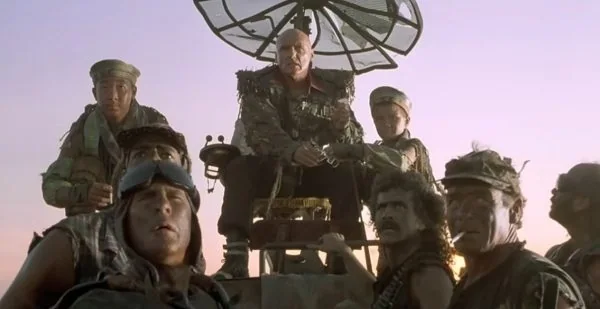
The Smokers are going after Helen and Enola in particular, because the group, led by the intimidating Deacon (Dennis Hopper) believe that Enola has a map tattooed on her back that will lead them to finding dry land.
There was a period of time when cult filmmaker Roger Corman was rumoured to be interested, but he quickly realised that the script was economically unfeasible, so backed out. Rader’s script was still stuck languishing in development hell until 1992 when star director Kevin Reynolds and Kevin Costner became interested in the project.
Chapter Two – Enter The Two Kevins

While Universal Studios who had bought Rader’s script, wanted Lawrence Kasdan or Robert Zemeckis in the director’s chair, Costner -being a certified Hollywood megastar at this point of his career – lobbied for his friend and reoccurring collaborator Kevin Reynolds to be in charge, having worked with him on Fandango, Robin Hood: Prince of Thieves, and he would also later serve as a co-producer on Reynolds’s project Rapa-Nui.
Before Waterworld, there had been cracks in the pair’s friendship during the making of Robin Hood: Prince of Thieves over control of the final cut. These fights were so bad that apparently Reynolds suggested going for another actor to play The Mariner, but Universal were steadfast in their commitment that it had to be Costner because of his status as a major box office draw.
With Costner and Reynolds’ involvement, Waterworld went from being a smaller scale project, to being a $100 million blockbuster (roughly $257 million in 2026) requiring extensive re-writes to accommodate the massive increase in budget.
Chapter Three – Hurricane Season: This Time It’s Personal
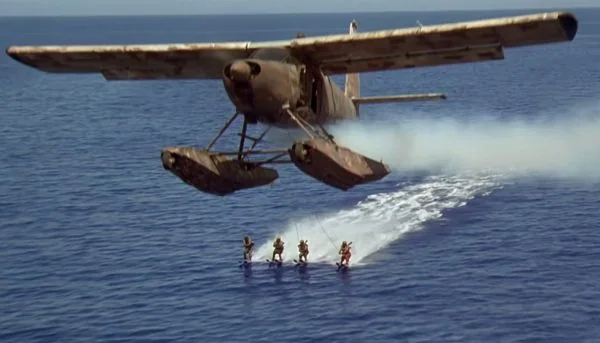
Before Waterworld was due to start shooting, Costner and Reynolds had a chance meeting with Steven Spielberg who warned the pair against shooting a movie out on open water, owing to his experiences making Jaws. Costner and Reynolds, in a feat of ignoring the Ides of March to make Julius Caesar blush, didn’t take his advice and began shooting off the west coast of Hawaii.
The atolls that the script called for cost millions to build, and in addition to their elaborate expense they were about as durable as Brandon Roy. To make matters worse, the sets in question were built right in the middle of hurricane season, and lo and behold a hurricane totalled one of the heaviest sets of the lot. This meant that even more money had to be spent on extensive reconstruction, bumping up the already $100 million budget to $135 million,
In addition to the hurricanes, the weather in general was absolutely miserable, with high winds constantly blowing the various camera crew out of position, slowing down shooting to a snail’s pace because of the constantly botched takes.
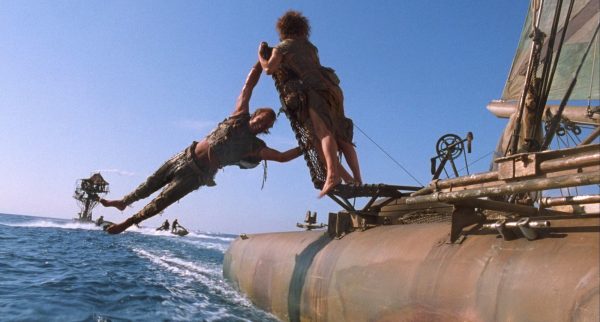
During an extensive scene on a boat, the bowsprit blew away because of the high winds, sending Jeanne Tripplehorn and Tina Majorino out into the water with it, forcing them to swim for hours until a rescue crew were able to bring them to safety. Costner, working six days a week, also fell foul of the set’s complete lack of safety, when, during a stunt that required him to be tied to the mast of his boat, a heavy wind came and blew him out to sea before anyone had the chance to untie him, almost being killed.
Pro-surfer Laird Hamilton, Costner’s stunt double, commuted to and from the set located forty miles from his beach home every day via his jet ski, an arrangement the cast and crew were unaware of at first. This continued until one day, when Hamilton forgot to refuel halfway into the commute, leaving him stranded. It wasn’t until the crew called his wife, who explained to them what happened that they found him, and by the time a rescue party got there, he had been stuck drifting on the ocean currents for hours.
Due to all of the various technical difficulties and weather related hazards, the shoot bloated from a projected 96 days to 150 instead. While the cast and crew were far from happy, the state of Hawaii was over the moon as the elongated shooting of Waterworld had put an estimated more than $35 million into the local economy.
Chapter Four – When The Two Kevins Clash
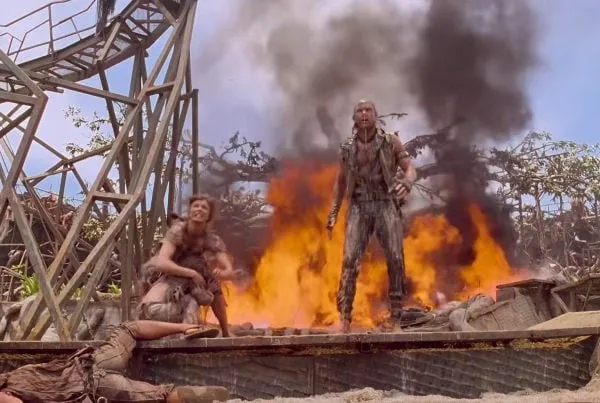
In addition to nature unleashing hell upon the set, Costner and Reynolds were constantly at each other’s throats due to creative differences. Costner, who was going through a bitterly expensive divorce from his wife at the time, which did little to help his overall disposition, and with the addition of his expensive demands of staying at a five star villa for the entire shoot, $14 million paycheque, and coming to set everyday on his personal luxury yacht – the budget was ballooning more and more.
Costner hated Reynolds’ rough cut of the movie, which was focused more towards world building and presented The Mariner character as more of an anti-hero in the vein of Snake Plissken or The Man With No Name. Instead Costner wanted a popcorn flick, that made The Mariner a more conventional hero, and was more geared towards action sequences than plot, using his power to cut the movie from 135 minutes from the rough cut’s (nicknamed the Ulysses Cut) 170 minute runtime.
This lead to Kevin Reynolds quitting the project, and the budget again increasing to finance script doctors and extensive re-shoots to be directed by Costner instead. A young, pre-Buffy The Vampire Slayer fame Joss Whedon was brought in for last minute script doctoring, and intelligently concluded that the production was a disaster, and that nothing less than a full scale re-write could fix it.
Chapter Five – Sinking At The Box Office
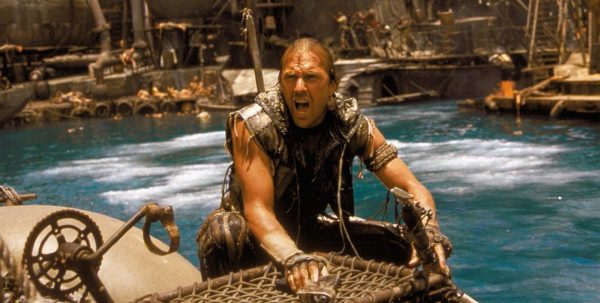
With the budget fully ballooned up to $175 million, not to mention marketing costs, salaries, and distribution to be added on, Waterworld had to be a resounding box office hit for Universal. To give an idea of what other special effects heavy movies were budgeted at in the same decade, Terminator 2, Jurassic Park, Dark City, and The Matrix all cost significantly less to make than Waterworld, which just goes to show the sheer scale of the cost of the production.
At opening weekend there were some encouraging signs about at least breaking even, as the movie debuted at number one, collecting a total of $21.6 million. After opening weekend however, its profits increasingly dwindled bringing only $260 million worldwide, not even close to what it needed to cover its budget.
In the months leading up to the release, the media got hold of the costs, and all moviegoers could talk about was the sheer expense that had gone into it, rather than anything about the actual movie itself, killing any hype or interest from potential audiences. The press were ruthless in their reviews of Waterworld, mockingly christening it Fishtar and Kevin’s Gate as a nod to similar large scale box office disasters Ishtar and Heaven’s Gate.
Some critics were pretty charitable in their assessments, with Roger Ebert giving the film 2 out of 4 stars and saying that; “ The cost controversy aside, Waterworld is a decent futuristic action picture with some great sets, some intriguing ideas, and a few images that will stay with me. It could have been more, it could have been better, and it could have made me care about the characters. It’s one of those marginal pictures you’re not unhappy to have seen, but can’t quite recommend.”
The movie even managed to find a few supporters in the shape of James Berardenelli who called it “ one of Hollywood’s most lavish features to date”, ‘… good escapist fun in the tradition of old westerns and Mad Max’ and a “ feast for the eyes and ears”, and Mick LaSalle reviewing its home video release, declaring that it didn’t deserve its scathingly negative press at all, and that “ Waterworld… has an elusive, appealing spirit that holds up for more than two hours. It’s a genuine vault at greatness that misses the mark – but survives.”
Unfortunately for every review against the tide of public opinion (pun very much intended), there were 3 or 4 negative ones in its place, and coupled with the horrible word of mouth, and the image of Costner and his monstrous ego overseeing a troubled production from behind the scenes the movie couldn’t shake its hostile reputation.
Chapter Six – The Aftermath
In the context of Costner’s career, Waterworld was the first movie that drove a gigantic steak knife through the actor’s Teflon reputation as a leading man box office juggernaut, with the ability to put audiences in their seats just through being on a poster. While it was The Postman two years later which fully finished that reputation off (which is an article in itself), Costner, despite working steadily for the last thirty years, has drifted more into supporting roles, and prestige TV work rather than being atop the marquee like he was in his mid-1980s and early 1990s heyday.
Kevin Reynolds has also had something of a chequered directing career, post Waterworld, once one of the more esteemed directors in the mainstream film industry responsible for two absolute masterpieces of 1980s cinema, Fandango and The Beast, he’s directed very few movies since 1995. This is a shame because what he has made has largely been pretty good, i.e. the criminally maligned One Eighty Seven (1997) which was nominated for the Grand Prix at The Tokyo International Film Festival yet ripped to shreds by critics back in the States, one of the better adaptations of Alexandre Dumas’ The Count Of Monte Cristo (2002), and the campily enjoyable Tristan and Isolde (2006).
After years of being on horrible terms , Costner and Reynolds finally patched things up in the 2010s, with Reynolds directing Costner’s executive produced (and starring) historical epic mini series Hatfields and McCoys (2012) which garnered multiple Emmy Award nominations and wins.
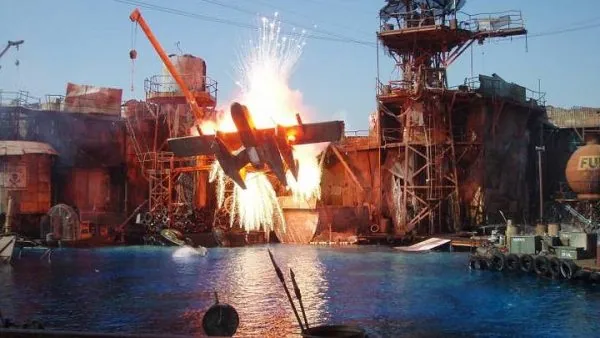
As for Waterworld itself, the film has enjoyed something of a cult revival in the 2010s and 20s largely because a new younger audience sees it as a relic from a time when Hollywood blockbusters were ruled by big interesting ideas, that while the ambition didn’t always quite measure up to the end result, but the imagination, world building, ingenuity of the practical effects, and the stunt work more than deserve to be praised.
Kevin Reynolds put it far better than I ever could when he said about the movie’s quality ; “My own personal take on the picture is that I don’t think it’s any better, any worse than most summer blockbusters, it’s somewhere in the middle. I think yeah, it’s certainly got its faults, but I think, you know, on another level I think it works quite well compared to some of the other big films. But by the end, people…they wanted it to be a disaster.”
While the theatrical version of Waterworld is an absolute mess, the Ulysses Cut which is the version Kevin Reynolds wanted to go with, really isn’t all that bad, given the gruelling logistical nightmare the movie was to make. The cinematography, handmade sets, and the effects haven’t dated one little bit, The Mariner is a far more interesting character in that version, and the post-apocalyptic world on screen is deeply characterful, in contrast to the bland, overly computer generated $300 million green screen movies churned out on an industrial scale today.
What are your thoughts on Waterworld? Let us know on our social channels @FlickeringMyth…
Simon Thompson