The Further Mis-Adventures of Cliff Booth, 2026.
Written by Quentin Tarantino and Directed by David Fincher.
Starring Brad Pitt, Elizabeth Debicki, Scott Caan, Yahya Abdul-Mateen II, Carla Gugino, Peter Weller, Matt Groove, JB Tadena, Corey Fogelmanis, Karren Karagulian, Holt McCallany, Timothy Olyphant, Barry Livingston, Lauren Glazier, Emily Alyn Lind, Jim Cummings, Hannah Christine Shetler, Nicholas Hammond, Tara Macken, Mike Cochrane, Ariel Felix, and Adam Leiva.
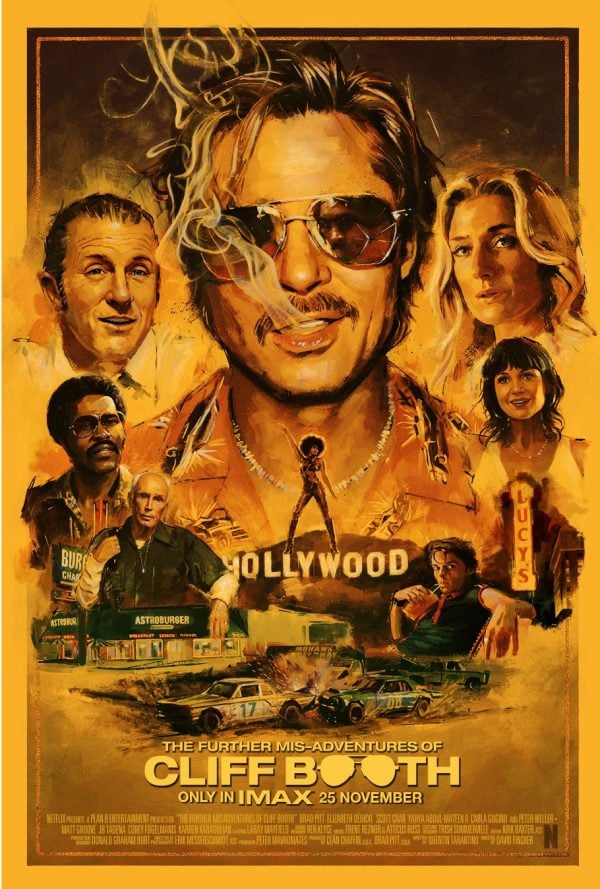
SYNOPSIS:
Eight years after the events of Once Upon a Time in… Hollywood, Cliff Booth returns to a changing Los Angeles. Now working as a fixer in the shadows of the Hollywood studio system, Cliff finds himself entangled in a dangerous web of secrets, crimes and betrayals that will test everything he knows about loyalty and survival.
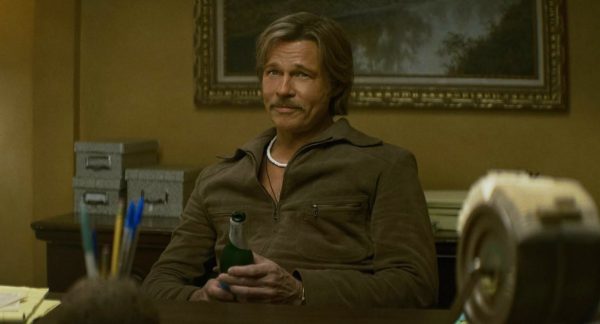
Quentin Tarantino has certainly earned a reputation for recycling movies in his original works with a vulgar and violent spin, despite receiving near-unanimous raves almost every time he helms a project, whether in front of the camera or on the page (which are also mostly earned – he is one of the absolute living legends of cinema). With The Further Mis-Adventures of Cliff Booth, a sequel to 2019’s Once Upon a Time in… Hollywood (which might be his most ambitious, accomplished, and rich of an outing as a filmmaker) that mostly plays like a spinoff that was, at one point, conceived to be the pilot for a TV series (even the title brings that possibility to mind), he (only credited as a screenwriter this time) seems to be reheating, recycling, and ripping off himself now, as evident by the 50th time a supporting or minor character enthusiastically chimes in awe that they are in the presence of former stuntman Cliff Booth (played by a returning Brad Pitt) rumored to have once kicked Bruce Lee’s ass on set.
One can’t help but wonder if the notoriously stingy filmmaker who has self-imposed ten movies on his directorial career (going as far as releasing a cut of Kill Bill joining the halves into one bloody affair as he originally intended) in a high risk effort to never let the quality of output go downhill gave director David Fincher a ring simply because he knew from the beginning that this would be a blemish on that resume (not that there already aren’t, as Death Proof remains largely forgettable no matter how terrifically committed Kurt Russell is in the climax to getting his ass kicked by a mob of women).
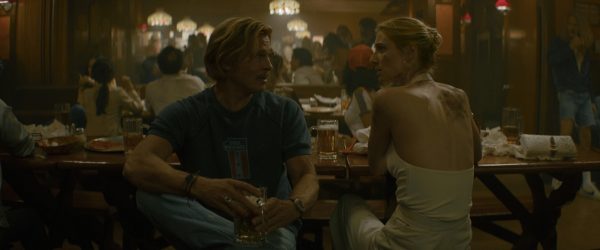
For as much as both films have a highly comedic hangout appeal to them with a never-ending barrage of inside Hollywood references (not to mention that first film rewriting history, as something that has become a climactic trademark of Tarantino’s works), this installment feels largely impersonal, inconsequential, and coasting a bit too much on dialogue and vibes even for arguably the greatest to ever write dialogue. It’s one thing to get sucked into Quentin Tarantino’s movies, even when the characters have extensive conversations about topics that have nothing to do with the plot, because they are such larger-than-life, vibrant, and enigmatic personalities. Then there is placing that style into a film that has almost no concern for actually building to something dramatically or thematically substantial. The danger that loomed from the Manson family in the predecessor, not to mention in part from who Margot Robbie was playing, put forth an unsettling, uncomfortable, doomed layer underneath the good times. Here, it’s maybe 90 minutes into the freewheeling story when some semblance of real plot and conflict kicks in.
Perhaps that’s the side effect of taking the B-character/sidekick and attempting to give them their own movie, which is a mixed bag through no fault of Brad Pitt; he remains effortlessly chill and unbothered, a man now out of the industry (Rick got famous and fat, meaning stunt doubling is no longer feasible) and seemingly working several odd jobs ranging from the projectionist at the New Beverly Cinema (yes, really) to bartending to other more daring professions that won’t be spoiled. Above all else, he is a Hollywood fixer, as seen in the opening trying to broker a blackmail deal for a filmmaker who had his Oscar stolen by a gay man he discreetly invited over for sex. Unsurprisingly, given the screenwriter and the times, it’s not exactly the most dignified role for a gay character, and fairly humiliating as it’s played for laughs, but also a reminder that even in a problematic mode, Tarantino can still wring out tension, laughs, and excitement. Once again, the fact that it’s 1977 makes it go down easier.

From there, and utilizing the same day-by-day chapter structure from the first film (now with more specific locations and listing distances from Hollywood), the film grounds viewers further into Cliff Booth’s life, which includes clocking in at those different jobs and hanging out talking movies and TV with his father Gus (played by a legend in Peter Weller). Much to Cliff’s chagrin, his dad owns a cat, in contrast to his trusted best friend pit bull seen last time. As such, David Fincher has taken a page from Quentin Tarantino and brought to life a time of yesteryear, replicating the types of programs and advertisements on television, with banter about the art form between father and son so easily digestible from a cinema-addicted screenwriter.
When Cliff is out and about in the real world, this mimicry is less convincing, stripped of the magic of Quentin Tarantino’s recreations and direction. It’s no surprise that those quick shots of 1960s Hollywood buildings and nightlife went viral, or that watching the stuntman casually drive through the highways and streets also felt endlessly watchable. They were alive in a manner that is mostly static and flat here. That’s not to say cinematographer Erik Messerschmidt is to blame, but it’s hard to match Quentin Tarantino’s vision for injecting life into a scene and period alongside his photographers.
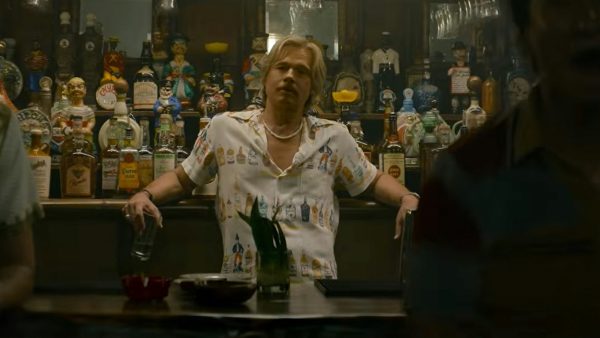
In keeping with the sense that Quentin Tarantino is now recycling his own work, aspects of this film come across as a copy of a copy, where someone else got hold of the second copy and made their own changes without much precision. Aside from being reunited with Trent Reznor and Atticus Ross, there isn’t much here that screams David Fincher; it’s as if he is a glorified director for hire. And one thing moviegoers have learned over the decades is that, love or hate Quentin Tarantino, he is impossible to imitate successfully. Thankfully, that’s not necessarily what David Fincher is doing here, but the result is a film that mostly only briskly moves and flows through dialogue, needle drops, and the occasional bursts of grim violence (which includes one scene in the first act that beggars belief this actually got away with an R-rating and a stamp of approval to be released on any streaming service).
Nevertheless, Hollywood agent Karen Crosby (Elizabeth Debicki) contacts Cliff when her client, Charlie Peters (Scott Caan), wants to meet with him, which confuses both of them, since the popular TV star is known for his commitment to performing his own reckless stunts. Granted, this film takes place in the 1970s, but given that behavior, the short stature, and an almost Napoleon-like complex of entitlement, bitching, and whining, there is reason to believe that, for whatever reason, Quentin Tarantino is tearing down Tom Cruise. It’s an amusing performance that also rips apart the nature of method acting.
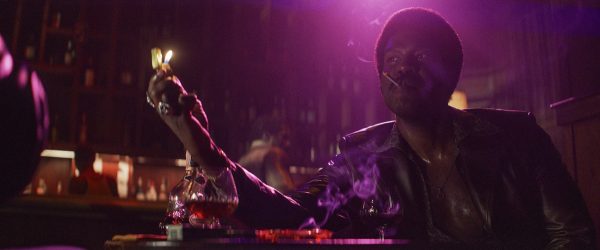
While trying to give Charlie advice and, eventually (basically by the time the damn movie is almost over), solve a problem for him involving a couple of ruthless Asian gangsters (Matt Groove and JB Tadena), he actively tries to seduce Karen despite saying she is in a semi-committed relationship. Naturally, Cliff persists and is somewhat too cool for us not to want him to succeed, roping her into some of his titular misadventures while also confessing some kinks and his intense attraction toward her. As for Charlie, he is currently dating a former actor and once-flame of Cliff, Toni (Carla Gugino). As far as the hangout shenanigans go, they’re undeniably aimless and don’t feel resolved or satisfyingly concluded. Despite the electrifying flurry of brutal violence, it’s equally surprising how abruptly this movie ends.
It’s as if Quentin Tarantino is far less concerned with what would have changed at all regarding the history he rewrites at the end of that first film, and only with hanging out with Cliff Booth. For all the frustrations and shortcomings laid out here, Brad Pitt and a scene-stealing Elizabeth Debicki carry it (anytime the two share the screen, the film really pops), with enough nonsense and hijinks to justify returning to this fictionalized real world.

At one point, Karen, a former film critic of family movies, perhaps controversially exclaims that she doesn’t perceive cinema as a legitimate art form. They are meant to entertain and be as digestible as fast food. Comparing them is no different than dissecting the differences between a Big Mac and a Whopper. For one, it sounds like Quentin Tarantino started cramming dialogue from other canceled projects into this one, which only adds to how shapeless some of this is. Another thought is, having seen The Further Mis-Adventures of Cliff Booth, touche for getting ahead with the metaphor. It’s enjoyable revisiting this world and Cliff Booth, even if the quality is more of a basic cheeseburger this time.
Flickering Myth Rating – Film: ★ ★ ★ / Movie: ★ ★ ★
Robert Kojder