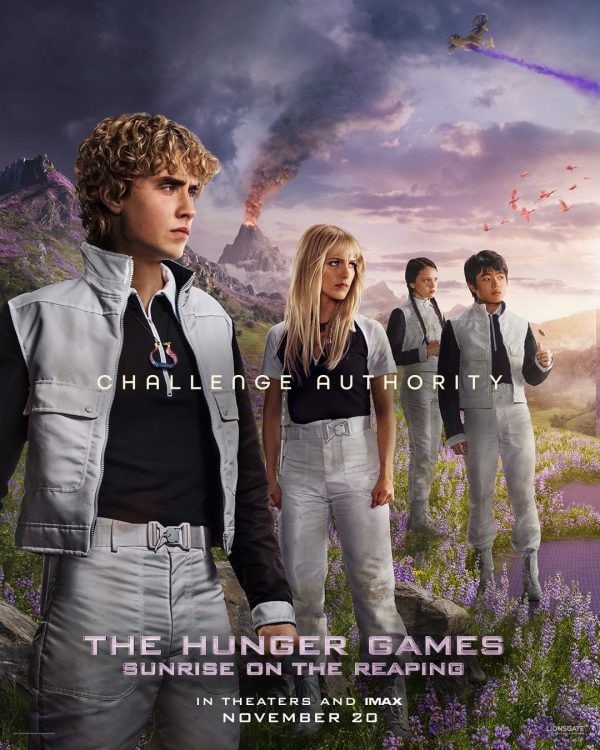
The Hunger Games: Sunrise on the Reaping, 2026.
Directed by Francis Lawrence.
Starring Joseph Zada, Mckenna Grace, Ralph Fiennes, Jesse Plemons, Glenn Close, Whitney Peak, Elle Fanning, Kieran Culkin, Maya Hawke, Kelvin Harrison Jr., Lili Taylor, Ben Wang, Molly McCann, Iona Bell, Billy Porter, Jhaleil Swaby, Laura Marcus, Percy Daggs IV, Rada Rae, Sky Frances, Tatyana Muzondo, Alina Reid, Salimou Thiam, Scot Greenan, Grace Ackary, John Doeble, Kaine Buffonge, Kara Tointon, Smylie Bradwell, Jeff Hallman, Serafin Mishiev, Melody Brown, Jefferson White, Iris Apatow, Edvin Ryding, Sandra Förster, Jax Guerrero, and Devon Singletary.
SYNOPSIS:
Revisit the world of Panem 24 years before the events of The Hunger Games, starting on the morning of the reaping of the 50th Hunger Games, also known as the Second Quarter Quell.

By now, the ‘games’ themselves are the least interesting part of The Hunger Games, which the previous installment seemed to realize, only for Sunrise on the Reaping to yield diminishing returns as director Francis Lawrence (working from a screenplay by Billy Ray and Michael Lesslie, adapting Suzanne Collins’ novel) goes back to the familiar, comforting well (at least as comforting as can be for a series following children forced to kill one another for sport).
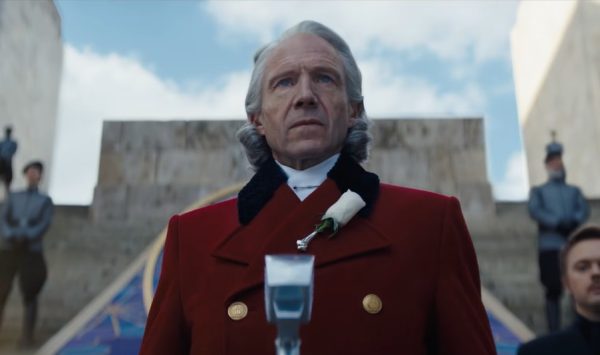
Even if there is much to admire in telling a prequel narrative centered on one of those deadly battle royales while demonstrating that resistance and rebellion had long been there before Jennifer Lawrence’s Katniss became the catalyst in taking down the totalitarian regime run by President Snow (here played by Ralph Fiennes, taking over for both the deceased Donald Sutherland and Tom Blyth portraying the younger, origin story version last time the filmmakers visited Panem), but had been twisted and hidden from the broadcast by those in power, there is a dulling, been there done that feeling this time around that The Ballad of Songbirds and Snakes avoided through heavy character exploration before and after the games, using them as a much more brief centerpiece sequence.

Once again, there are former winners and younger versions of characters previously seen in the series, eccentric hosts, mentors, publicity handlers, peppy costumers, and an overall enigmatic irreverence out of touch with the barbarism of what happens in the arena. Some of them are also new characters, but they may as well be returning ones given that they come with the same function and personality (Kieran Culkin is certainly having fun as host Caesar Flickerman, but at the end of the day it just comes across as repetition; a riff on Stanley Tucci in a similar role from years past). The IMAX ratio comes into play as elevators lift competitors into the arena, as if fan service has evolved into filmmaking itself (that’s without getting into the more shameless helping in the epilogue). Then there is the dialogue that can’t help but reference Catching Fire in what feels like almost every scene; if you take a shot for every reference, you might end up more drunk than Haymitch at his bitter, alcoholic worst.
Speaking of Haymitch, Katniss’s future mentor, here played by the mopey, angsty Joseph Zada, is the central character this time around, with a focus on the 50th Hunger Games (24 years before the events of the first film), also known as the Second Quarter Quell, which marks a doubling of the number of participants. And by the end, well, everything he endures and suffers through would drive anyone to a somewhat miserable, drunken state, but not without the flashes of sardonic wit and charm as played by Woody Harrelson. One of the more impressive elements of an otherwise blank performance is how well Joseph Zada does mimic the voice of that Hollywood veteran.

This isn’t necessarily a naïve Haymitch, but a defeated one who believes the Reaping (essentially draft day), which already takes place on his birthday no less, will always be around. His poet girlfriend, Lenore Dove Baird (Whitney Peak), tries to convince him otherwise while also urging him never to submit to oppressive forces. Naturally, the spark of rebellion is lit inside him when he’s chosen (with Glenn Close as Drusilla Sickle, in charge of the District 12 entrants), alongside his much younger neighbor Louella McCoy (Molly McCann) and Maysilee Donner, with Mckenna Grace playing her and her twin.
Essentially, Beetee Latier (Kelvin Harrison Jr.), a former victor and now mentor to his own son Ampert (Percy Daggs IV), concocts a scheme for Haymitch to take a lone-wolf approach so he can sabotage the arena itself, which is maintained by force fields. In one sense, this is slightly refreshing as there is a unique objective once the games begin. However, there also simply isn’t much compelling happening during the games anyway, this time with plenty of attacks from CGI robotic birds, fresh fruit, and other idiosyncratic threats. It’s imaginative, but the visual effects are unconvincing.
When there are shots of these mostly teenagers battling it out with various sharp weapons, this installment might be the most neutered and tame of them all regarding violence and bloodshed. It’s also the least dramatic, with several deaths that don’t land with the intended emotional force. The film isn’t necessarily in a rush, though it does shove perhaps too much into one narrative. Even the most sinister concept here that, to put it without spoiling it, forces Haymitch to look after another character with a drastically altered dynamic from before and when the games begin, feels shortchanged in execution and merely exists as a wasted solid idea.
Bluntly put, there is little shock or emotion watching The Hunger Games: Sunrise on the Reaping. Everything that once stood out about this series now feels recycled, continuing the franchise through prequels that, yes, admittedly flesh out the pasts of key characters, but without any of the excitement or freshness of when it began. Once the games are over and the film becomes interested in the psychological toll the suffering has taken on Haymitch, not to mention how he is tormented, the shape of a much more riveting character study starts to form, only for the movie to promptly end with the previously mentioned fan service (it’s as if parts of this installment get so dark toward the end that they felt the need to console anyone unfamiliar with the franchise that, a generation later, the Capitol is toppled). Panem remains a rich world to revisit, as the previous prequel showed without centering the Hunger Games. This disappointing entry takes a step back, returning to a blueprint that has run its course.
Flickering Myth Rating – Film: ★ ★ / Movie: ★ ★ ★
Robert Kojder