Adam Page on Basket Case and The Brood…
I always imagine a smell coming off a movie shot on the cheap in New York City in the early 80s. It’s a mixture of steam-pipe condensation, cigarette smoke gone deep into the drywall, and something underneath all of it that could be fear, or simply the fact that nobody’s cleaned the hall carpet since Gerald Ford was president. You get that smell watching 1981’s Basket Case. You can almost taste the Chelsea Hotel grime through the screen, the flophouse wallpaper and the odd light that only exists in rooms where the landlord hasn’t paid the electric bill on time in a decade. It is, and I really do mean this as a compliment, a movie that looks and feels like a crime scene that someone forgot to close off.
Now travel four hundred miles north, cross a border and step into a Toronto that’s been scrubbed antiseptic-white, all those beige institutional corridors and fluorescent hum, and you’ve got The Brood. Two years earlier but the same rancid subject; the family as an incubator of monstrosity, rage as something that grows teeth and leaves the house to go kill people and it’s filmed like a Kubrick fever dream administered by your least favourite doctor. One of these movies smells like blood and takeaway containers left for too long under a radiator, and the other smells like the bleach used to cover up the blood. But both, in a very short space of time, arrived at the same diagnosis: that it’s families which are the original horror movie, and that love curdles into something with claws. This brief window was apparently the moment two very different directors decided that the nuclear family was really a slow-cooking Chernobyl.
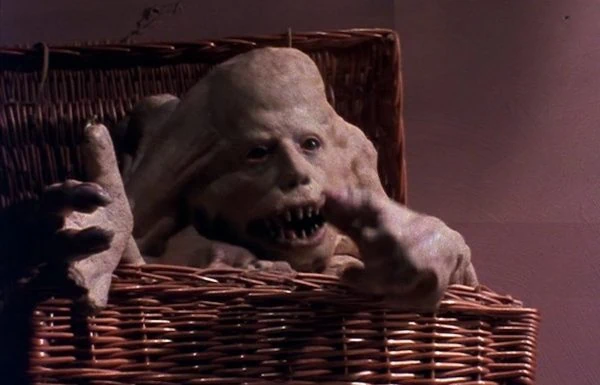
I’m going to talk about both these movies honestly and without the condescension that usually gets aimed at one of them, because the thing that nobody says out loud at the horror-nerd dinner table is that Frank Henenlotter and David Cronenberg were doing the same autopsy with their movies. It’s just that one had access to a real hospital, a real cinematographer and a real distributor with promotional muscle, while the other had a van, some friends, a rubber puppet with serious anger management issues, and something you could generously call guts and less generously call desperation. Both are correct diagnoses and neither one is subtle. And God help you if you go looking for subtlety in a movie about a wicker basket full of homicidal foetal twin.
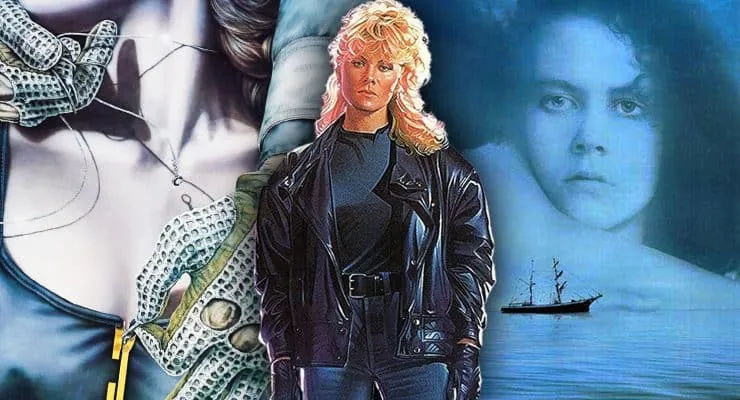
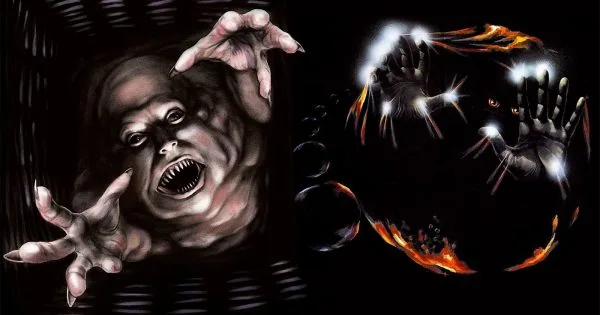
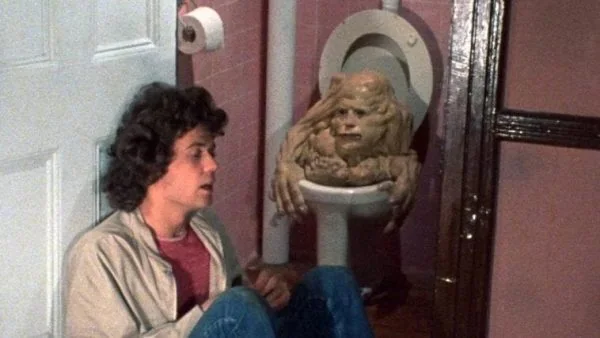
I’ll start with Basket Case because it’s the movie people apologise for loving, and the type of movie I usually end up defending in essays; something cooked up in a kitchen with no walk-in fridge or health inspector, just somebody who honestly loves the ingredients they’re working with even when the ingredients are, in this case, a deformed parasitic twin called Belial who lives in that wicker basket and has a taste for revenge surgery.
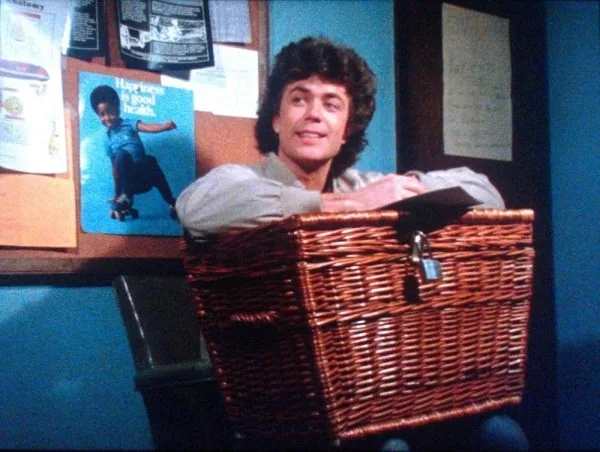
Duane Bradley walks into New York carrying his brother in a picnic basket like it’s the most normal thing in the world, and to be honest, by minute ten, you believe him. That’s the trick of this movie; it commits so hard to its own lunacy that it loops right around into something that plays almost tenderly. These two were surgically separated as infants against their will, the operation performed by doctors who saw Belial as nothing more than a tumour to be scraped off instead of a person, however monstrous, in his own right. What Henenlotter is cooking up here, under all the latex and Times Square sleaze, is a story about the violence inflicted by those who decide what counts as human and what doesn’t, with the quiet fascism of a doctor’s office and a family that colludes in the removal of an inconvenient child. It isn’t the fact he’s grotesque that makes Belial a monster, but the fact somebody decided he was disposable, and that decision metastasized.
There’s something almost sweet in how loyal these two are to each other despite everything, and the movie has real heart buried under all the gristle, in how Duane keeps talking to Belial like he’s a difficult roommate rather than a homicidal growth, feeding him and apologising to him, loving him with that strange loyalty of siblings who’ve survived things together that nobody else could understand. That’s family; that’s real, lived-in and dysfunctional family, the kind where you’d kill for your brother, and sometimes want to kill your brother, usually in the same afternoon. Henenlotter filmed this movie on fumes, on fifty-dollar days and favours, and what comes out the other end is, amazingly, something more emotionally honest about sibling co-dependency than most of the studio dramas that had ten times the budget and none of the guts.
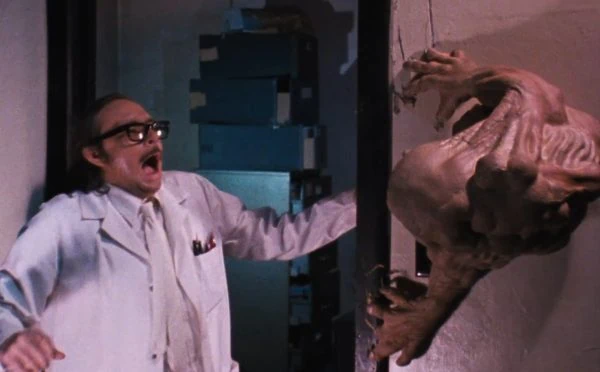
And look, of course the effects are a bit janky. The stop-motion basket-monster looks like something thrown up by a Muppet with a grudge. But I love it, and I love it like an old café that’s been serving the same burnt coffee for 40 years, because the imperfection is the point, and polish would kill the thing that makes it work. It’s a movie made by people who didn’t have the luxury of second takes, and you feel every corner they cut turn into a type of desperate and feral energy that a bigger budget would have sanded smooth.
Then you’ve got Cronenberg who, by 1979, had already given us Shivers and Rabid, and was about three years away from turning James Woods into a television-addicted psychosexual martyr in Videodrome and who had decided that the thing missing from his filmography was a movie about his own divorce. Because make no mistake, that’s what The Brood is; one of the most nakedly autobiographical horror movies ever made, a movie created by a man in the wreckage of a custody battle and using the genre like a scalpel to open up his own guts and show us what a messy divorce feels like from the inside: like something is going to crawl out of the person you used to love and come for your child.
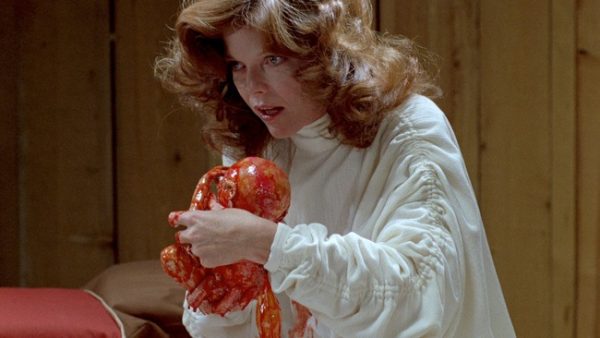
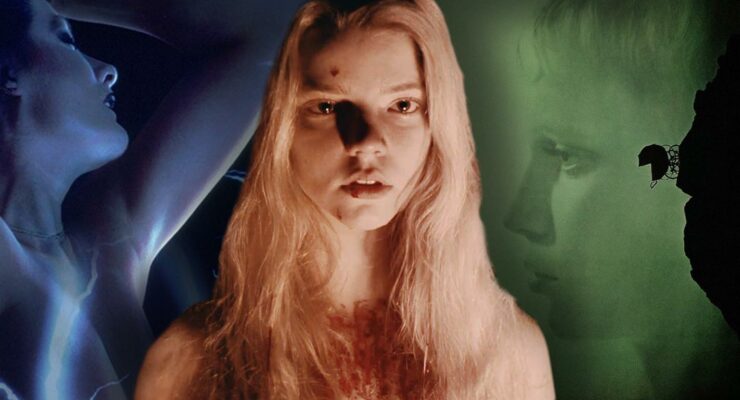
Nola Carveth is in a psychiatric institute run by Dr. Hal Raglan, a man who has created something called “psychoplasmics,” a therapy where the patients externalise their trauma as literal physical mutations: growths and boils, rage made flesh. And Cronenberg, cold as a Toronto February and twice as clinical, films the whole thing like a hospital procedure, all whites and beiges and jaundiced institutional lighting, so that when the horror finally arrives, the small, hooded creatures, the brood of the title, murdering people who’ve harmed Nola and born from an external womb she grows and licks clean like something from a nightmare about breastfeeding gone feral, it lands with the force of a diagnosis instead of a jump scare. This is more MRI than haunted house.
What gets me about The Brood, every single time I watch it, is just how unflinching it is about the horror of watching rage get passed down like a genetic disease, from parent to child, generation after generation, like a closed loop of psychic damage nobody consents to inherit. The final shot of the movie, which I won’t spoil for the three people reading this who haven’t seen it, although if you haven’t seen it by now that’s definitely on you, is one of the bleaker images in the history of the genre, a coda suggesting the cycle doesn’t break, and the wound just keeps finding new bodies to live in. Cronenberg doesn’t really do catharsis; he’s more interested in showing you the X-Ray of a family system then letting you sit with how ugly the picture is.
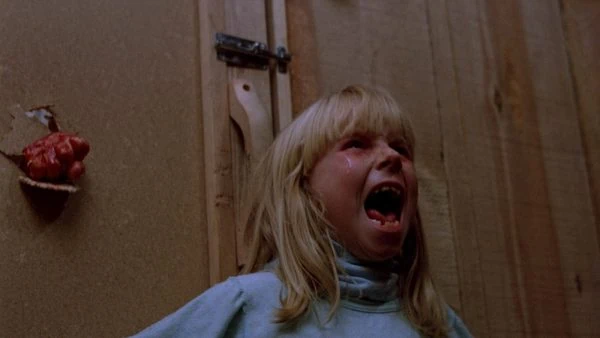
Samantha Eggar plays Nola like a woman who has been so stigmatised by every man in her life: husband, father, therapist, that the only real avenue of expression left to her is biological revolt. She gives a performance of pure, cornered rage and Cronenberg, to his credit, never lets his movie off the hook by making her just a monster. She’s a casualty, just like pretty much everyone in this movie. That’s the arthouse difference right there, where Henenlotter gives you two brothers who love each other despite all the horror, Cronenberg gives you a family that has been rendered incapable of love, each member so hardened by their own damage that connection becomes biologically impossible, and that may be one of the harshest things you can say about a marriage: that it ends not with a bang, but a birth, over and over, like an assembly line of grievance.
So here’s where I land after sitting watching both of these back-to-back, a whiskey or two on board admittedly, because that’s usually the honest way to watch either of them: they are the same movie wearing two very different outfits to the same funeral.
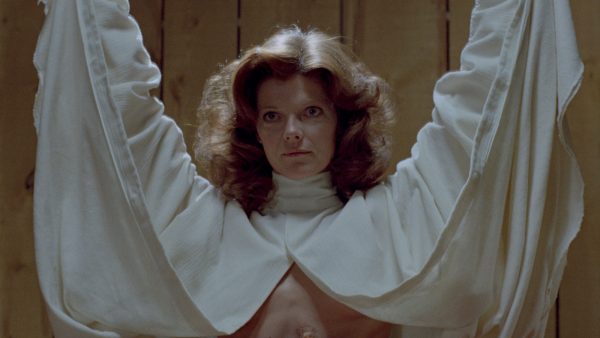
Both these movies understand something that a lot of “prestige horror” still hasn’t caught up to, which is that the family unit isn’t a safe harbour, it’s a pressure cooker. If you don’t vent the steam somehow, something will burst through the skin and start walking around on its own. Belial is Duane’s own repressed rage and guilt given a body and a taste for scalpels. The brood are Nola’s repressed rage given bodies and a taste for revenge on everyone who just diagnosed her instead of just listening to her. And both are stories about how institutions, whether medical, familial, or psychiatric, decide what parts of a person get to survive and what gets cut away, with both suggesting the cut-away part doesn’t just disappear. It waits, growing teeth, coming back for you in a basket or snowsuit, and either way, you should have seen it coming.
The difference, and it isn’t a small difference, is class and register. Henenlotter is telling his story from the bottom of the economic ladder, in flea-ridden hotels and Times Square grindhouses, with a protagonist who has no institutional power at all and whose only weapon against a medical establishment that mutilated him is in a picnic basket and a lot of anger. Cronenberg is telling the same basic story from inside the institute itself, a psychiatric clinic with money and credentials, with a doctor who has written a book about his methods and no doubt gets invited to dinner parties. One movie is about revenge from below, and the other is about horror generated from within a system that has all the resources and credibility in the world and still creates monsters, maybe because it has all that credibility, and power without accountability curdles just as fast as poverty does.
I think about my own family sometimes when watching these two movies. That’s the trick of good horror, I suppose, it turns your own dinner table into a crime scene you can’t look away from, and think about the things that get passed down that nobody wants to get passed down, rage that skips a generation to land twice as hard on the next one. Basket Case tells you that love can survive even the most hideous inheritance, that you can carry your worst self around in a basket and still call it family, as you feed it and still choose it every day even when it’s inconvenient and bloody and just deeply weird. The Brood tells you just the opposite, and tells you it with a lot more money and a lot less mercy: sometimes the inheritance just wins, the cycle doesn’t break and you can build all the psychoplasmatic institutes in the world and the rage will still find a body to live in.
Neither of them is wrong, and that’s the beautiful, miserable truth of it. We apparently needed two very different moviemakers, working with two very different budgets, to tell us the same thing about the family as a haunted structure: that we’re all carrying baskets, it’s just that some of us can’t see them yet.
So go watch both. Watch Basket Case first, with something greasy on your lap, the way God intended. Then watch The Brood sober, in the dark.
Just don’t call your mother right after.
Give it a day.
What are your thoughts on Basket Case and The Brood? Let us know on our social channels @FlickeringMyth…
Adam Page