Casey Chong with ten terrible horror movie sequels….
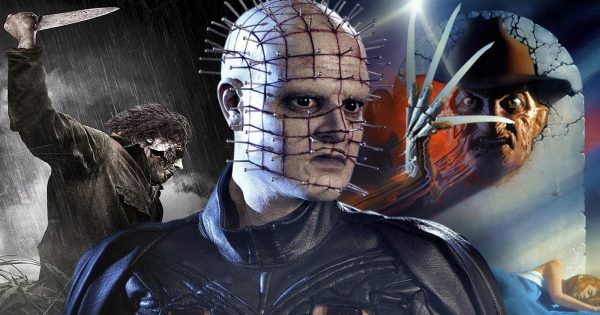
Not every horror franchise is consistent with its qualities, which can be seen in notable film series such as Evil Dead, Scream, and Final Destination. Shortlisting ten of the worst horror sequels ever made doesn’t come easy. But here goes anyway, covering from the rotten-egg entries of the slasher film franchise featuring Jason Voorhees, Freddy Krueger and Michael Myers to the vastly inferior follow-ups that failed to replicate the superior or groundbreaking original.
An American Werewolf in Paris (1997)
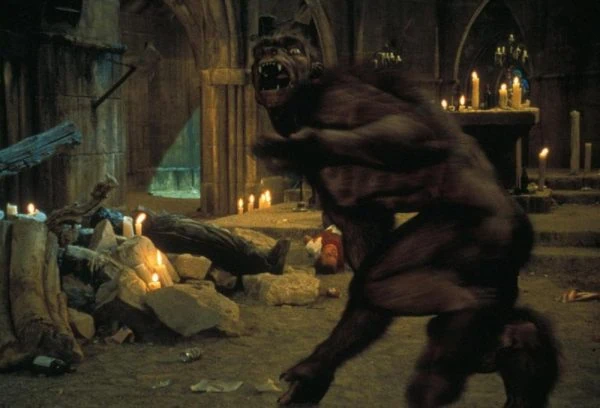
Among the reasons why An American Werewolf in London remains an enduring genre classic are Rick Baker’s legendary werewolf transformation practical effects, and of course, John Landis’s cynical mix of horror and comedy. Sixteen years later, director and co-writer Anthony Waller, who made his promising debut in 1995’s crafty Brian De Palma and Hitchcockian-style Mute Witness, messes up with an ill-fated sequel that’s rather in name only than a direct continuation.
Waller retains the horror-comedy formula, but none of them blend well since the werewolf terror lacks the genuine dread or fright. And it doesn’t help either when pivoting to a frat-boy comedy comes across as goofy and obnoxious. What further sinks An American Werewolf in Paris is the slapdash werewolf effects that rely heavily on video game-like CGI, particularly when it appears in the brightly lit setting (the final attack inside the subway train comes to mind). The story is also unnecessarily convoluted by the introduction of a secret werewolf society and the fact that werewolves can choose to transform with a specialized serum rather than embrace the traditional full-moon lore.
Friday the 13th Part VIII: Jason Takes Manhattan (1989)
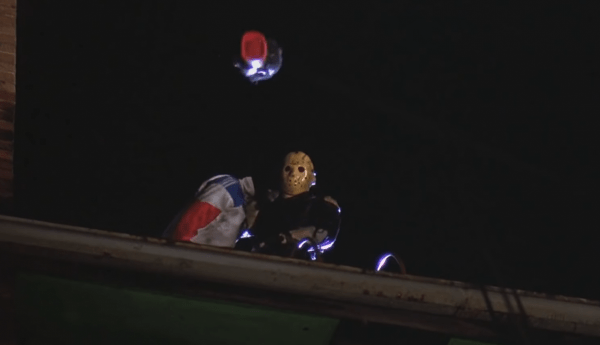
The idea of the seemingly unstoppable Jason Voorhees going on a killing spree in the big city of Manhattan rather than the usual rural backwoods setting sounds like a whole lot of gory fun. And although Rob Hedden, making his directorial debut in Friday the 13th Part VIII: Jason Takes Manhattan, did intend to pursue the premise as such, a significantly slashed-down $5 million budget rendered it impossible to fulfill that particular promise. So, what we get here is that the movie spends most of its time aboard the SS Lazarus cruise ship from Crystal Lake to New York City.
The story is a standard stalk-and-slash formula, but what always matters most in a Friday the 13th movie is the high body count and graphically violent kills. Too bad the movie is a victim of shockingly watered-down violence and gore, most of which takes place off-screen. And even if there’s one, the scene where Jason counters the attack by simply punching the victim’s head off his body looks more like a horror parody than a gory slasher.
Not to mention the awkwardly misplaced Metropolis’s soft rock “The Darkest Side of the Night” in the opening credits sounds better if the movie is a teen drama. Then, there’s the ending in the sewer system surrounding how Jason is defeated, resulting in an anticlimactic third act that falls flat.
Freddy’s Dead: The Final Nightmare (1991)

When Chuck Russell revitalized the Nightmare on Elm Street franchise in the third entry by making Freddy Krueger a quippy monster, at least he still managed to strike a balance between macabre humor and funhouse-style gore. By the sixth and purportedly final installment, the so-called Freddy’s Dead: The Final Nightmare should have borne the tagline “They Saved the Worst for Last”. Rachel Talalay’s directorial debut fully turned Freddy Krueger into a joke minus the menace.
The story’s unnecessary bait-and-switch narrative for introducing the “only surviving teenager from the Springwood town” named John Doe (Shon Greenblatt) resulted in a cheap narrative cop-out, especially after sitting through a significant portion of the runtime wondering about his amnesia and psychological connection to Freddy, only to reveal the mystery is all smoke and mirrors.
This comes across as a gimmick that doesn’t justify the investment, and even when the story proper begins to take shape, the shifting focus on Lisa Zane’s Maggie suffers from a desperately shoehorned plot that comes out of nowhere, just for the sake of connecting the dots with Freddy’s past. The kills are more laughable (the infamous elaborate pixelated video game scene comes to mind), lacking any sense of terror and creepy stakes.
Halloween II (2009)
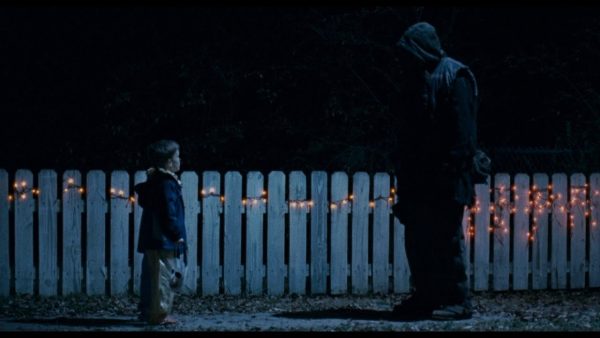
Rob Zombie’s 2007 Halloween reboot boasts a solid backstory of Michael Myers, but for the follow-up, he single-handedly runs the franchise into the ground. It’s not like Halloween II lacks ambition, as the movie opens promisingly with a thrilling hospital sequence that pays homage to Rick Rosenthal’s 1981 sequel. Even complete with a bold twist that subverts the audience’s expectations, resulting in a good 20 minutes looking as if Zombie’s vision is heading in the right direction.
Except that the rest of the movie falls apart with disappointingly unlikable characters, even reducing Scout-Taylor Compton’s Laurie Strode into a PTSD-inflicted protagonist who spends all the time lashing out and being hopelessly cynical. The 2009 sequel also strips off Michael Myers’ iconic Shape appearance into an unmasked, hobo-looking hulking figure with a bushy beard. Zombie equally mistakes mean-spirited violence and brutality for visceral terror since what we have here is rather hollow, while the added supernatural elements – the bizarre white-horse imagery and the ghost of Sheri Moon Zombie’s Deborah Myers – further derails the franchise.
Exorcist II: The Heretic (1977)
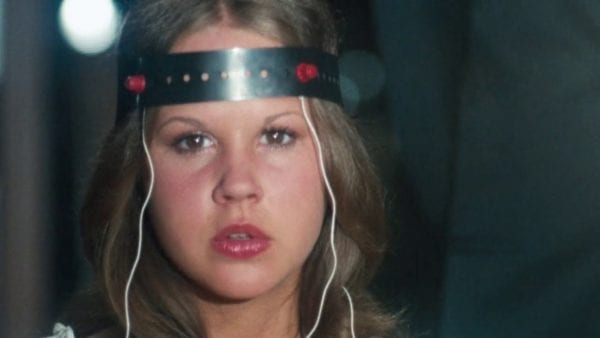
What do you get when you hire a director who despised the first film and set out to course-correct the franchise? So, the director in question is John Boorman, choosing to counter William Friedkin’s 1973 groundbreaking visceral original of The Exorcist by flipping the script altogether. Apparently, the aftermath of a once-possessed Regan MacNeil (Linda Blair, looking unnecessarily overly sexualized) is far from over, suggesting the initial exorcism casting out the demonic Pazuzu from her body still deeply suppresses her mind.
By using a mix of scientific and psychological approaches to justify the existence of the sequel, Boorman and screenwriter William Goodhart spend most of the time addressing Regan’s underlying trauma through the use of a hypnosis machine called the “synchronizer”. The result is a pretentious bore, with the mumbo-jumbo metaphysics and surrealism that veers off course from the first movie’s traditional possession horror. The sequel lacks the much-needed fright and dread, and even when Boorman tries to bring it full circle by returning to the Georgetown residence where the exorcism first took place at the end of the first movie, it’s all too late, and too little.
Aliens vs. Predator: Requiem (2007)
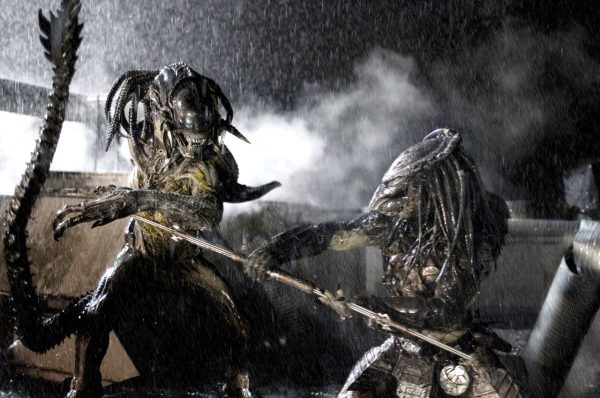
After the shockingly bloodless Alien vs. Predator that Fox reduced Paul W.S. Anderson’s 2004 sci-fi horror mashup into a toned-down PG-13 slop, it looks as if Alien vs. Predator: Requiem understood the assignment. And that is, an Alien vs. Predator movie that’s supposed to be dark and gory while bringing back the restrictive age rating. Too bad the reduced $40 million budget, compared to the previous movie’s $70 million, means a lot of corners must be cut.
And yet, there’s no excuse for the Brothers Strause – Greg and Colin — making the story lack genuine stakes and tension, while the characters come across as generic and disposable. But the biggest sin of all is that the movie is too dark – like literally! – to the point it’s hard to decipher what’s going on screen. All the so-called gore and the fascinating Alien-and-Predator hybrid called the Predalien barely matter, especially with the frustratingly dim lighting and overall muddy visuals, which feel like a waste of time watching it.
Hellraiser: Revelations (2011)

It’s no secret that the Hellraiser franchise suffers from more misses than hits. But if to pick the worst of the bunch, the ninth movie – Hellraiser: Revelations – proves to be a bottom-of-the-barrel creative fiasco. It was hastily put together in just 11 days with a measly $300,000 budget – an extremely rushed production to avoid losing the rights to the Hellraiser film series. Return to House on Haunted Hill director Victor Garcia sleepwalks through the movie’s seemingly shorter-than-usual 75-minute runtime, but it feels like an eternal damnation for watching the story unfold jarringly between the found-footage gimmick and traditional horror.
The absence of franchise mainstay Doug Bradley, who immortalized the sinister role of Pinhead, is sorely missed, with his replacement – Stephan Smith Collins (the physical appearance) and Fred Tatasciore (the voice) – looking more like an inexperienced cosplayer trying to take over the role. Not only does the Cenobite leader lack an intimidating presence, but he’s also spent time walking around the confined set with little to do, completely wasting the opportunity to make his role at least functional. Even by the time most of the sadistic gore does arrive in the third act, Hellraiser: Revelations already overstays its welcome with an amateurish effort that shouldn’t exist in the first place, no matter whether it’s about retaining the film rights.
Jaws: The Revenge (1987)
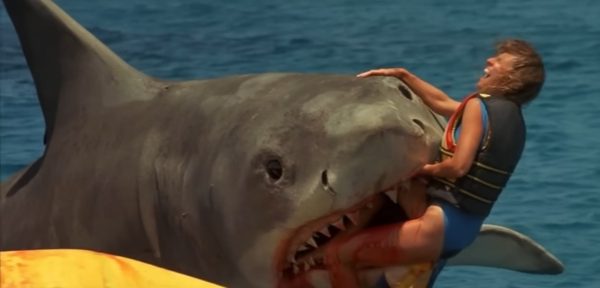
The Jaws franchise sinks to the bottom of the ocean with the ill-fated Jaws: The Revenge, the fourth and final film that turns the once-menacing great white shark into an… unbelievably telepathic apex predator on a vengeful mission. Apparently, the shark is all about getting personal against the Brody family. Now, if only the Jaws franchise originally started as gleefully over-the-top B-movie fun, it would have been forgivable.
But the absurd storyline about the shark and Lorraine Gary’s Ellen Brody somehow sharing a psychic connection is a baffling creative choice. It doesn’t help either when director Joseph Sargent plays it straight, flooding Jaws: The Revenge with a mix of overwrought family drama and a padded-out romantic subplot between Ellen and Michael Caine’s Hoagie.
The shark-horror moments are few and far between, lacking the palpable thrills and suspense that define Steven Spielberg’s 1975 groundbreaking original. The special effects look disappointingly inferior, while the climactic third-act showdown is laughably inept; notably, one of the characters miraculously survives for some hardly comprehensible reason.
Book of Shadows: Blair Witch 2 (2000)
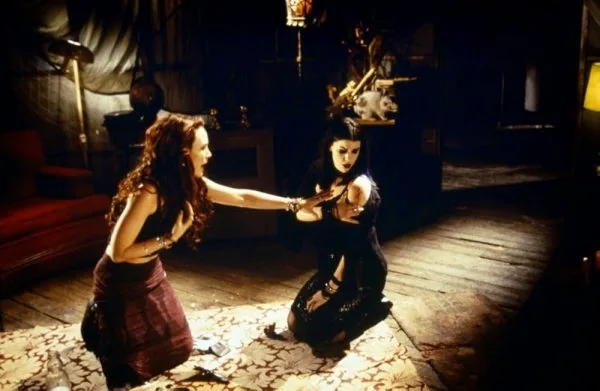
The ingenious marketing campaign and how the found-footage horror is used to its advantage have turned The Blair Witch Project into an overnight indie sensation in 1999. Anyone who attempts to top the creepy original with a follow-up would have had an uphill task. And yet, documentary filmmaker Joe Berlinger took up the challenge and co-wrote a screenplay about a group of young fans – among them played by Jeffrey Donovan, Erica Leerhsen and Kim Director – obsessed with the Blair Witch phenomenon, looking to study its mythology.
The is-it-real-or-is-it-a-hoax angle surrounding the original incident sounds like an intriguing idea. But the overall sequel’s execution looks as if it has been hijacked by a witch and butchered the story into a jumbled mess. The MTV-style editing, coupled with unlikable characters barely worth rooting for and a third-act twist about what really happens throughout the event of Book of Shadows: Blair Witch 2, feels like an ultimate cop-out.
Texas Chainsaw Massacre: The Next Generation (1995)
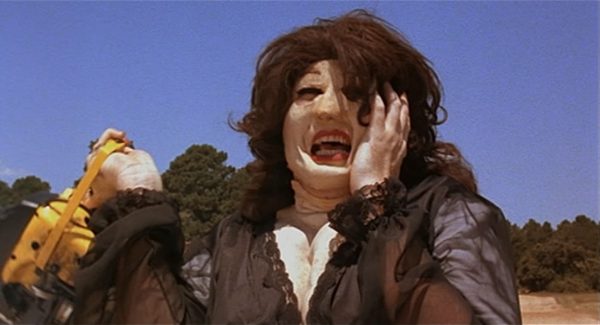
Having Kim Henkel on board to direct a Texas Chainsaw Massacre movie for the first time seems promising, especially given his involvement as a co-writer in Tobe Hooper’s 1974 genre-defining gritty horror original. The fourth movie – Texas Chainsaw Massacre: The Next Generation – also features pre-fame Renée Zellweger and Matthew McConaughey, supposedly making it interesting to watch how they first fare as then-unknown actors. Well, too bad the movie reeks of a stench that refuses to go away from start to end.
The story is simple: A group of teenagers finds themselves stuck in the rural Texas woods in the middle of the night, and what happens next is the usual running and screaming. And I mean, lots of screaming that gets unbearably annoying. Zellweger’s helpless young-woman protagonist is nothing more than your garden-variety archetype, while McConaughey’s unhinged turn as Vilmer, one of the notorious members of the cannibal family, is all obnoxiously loud acting style. The dimly lit cinematography makes the movie look visually incomprehensible, lacking the terrifying dread of the 1974 original. And as if the movie isn’t bad enough, Henkel ruins the franchise by incorporating a convoluted secret-society twist that would have fit better if it were a sci-fi conspiracy thriller.
What are your worst horror movie sequels? Let us know on our social channels @FlickeringMyth…
Casey Chong