Blue Heron, 2025.
Written and Directed by Sophy Romvari.
Starring Eylul Guven, Iringó Réti, Ádám Tompa, Edik Beddoes, Amy Zimmer, Liam Serg, Preston Drabble, Lucy Turnbull, and Jecca Beauchamp.
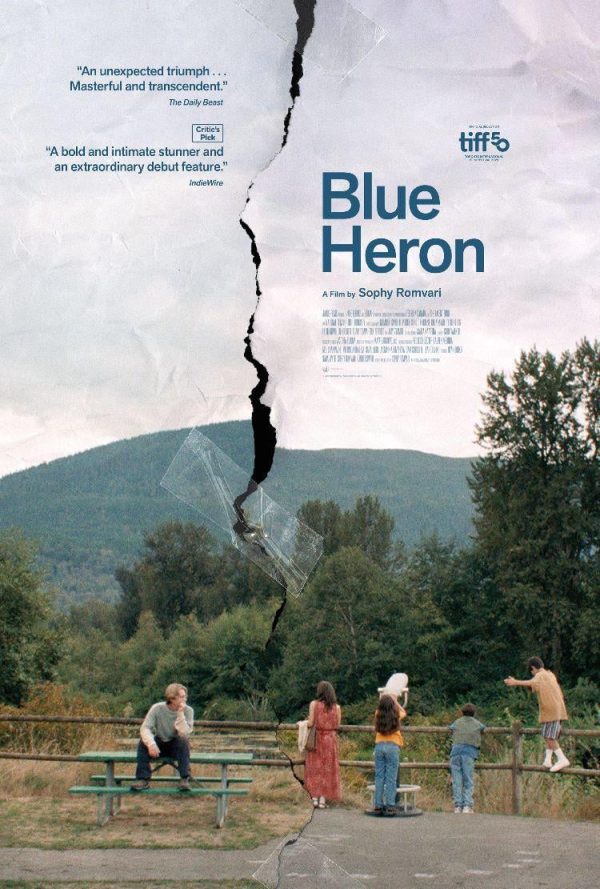
SYNOPSIS:
A family of six settles into their new home on Vancouver Island as internal dynamics are slowly revealed through the eyes of the youngest child.
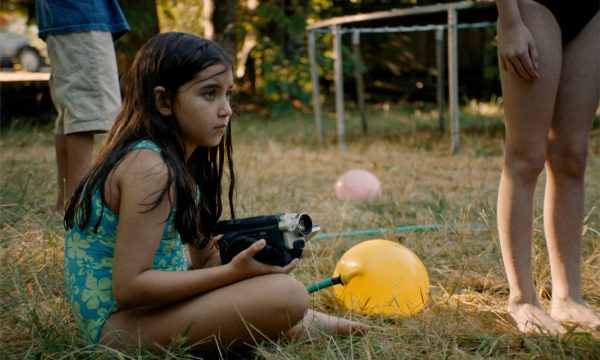
At one point in writer/director Sophy Romvari’s meta-reflective and profoundly personal 1990s-set Blue Heron, young Sasha (Eylul Guven) asks her mother (credited as such and played by Iringó Réti) if her friends can come over and play outside (the film primarily takes place during a warm, breezy summer filled with swimming and bursting water balloons), only to be told that it’s not a good idea. It could be” embarrassing”, even, given that her older brother Jeremy (the eldest child, played by a truly unknowable and unsettling Edik Beddoes) has a behavioral disorder that is gradually becoming more erratic, unstable, volatile, and dangerous to himself and those around him.
More than a film that convincingly portrays such a condition, and the lack of systemic resources and knowledge among psychologists and social services to properly help, Blue Heron approaches it from the narrative and cinematic perspective of a child eavesdropping on her parents (her father, played by Ádám Tompa mostly sticks to his computer-based work, avoiding what’s happening until that is no longer possible). Roughly halfway through, Sophy Romvari adds another layer, this time an experimental aspect in the present day that takes everything from the past and puts it under a new microscopic lens, juxtaposing those experiences and how Sasha feels as an adult (now played by Amy Zimmer), making films to reach a greater understanding of her brother and the rocky dynamic they had.
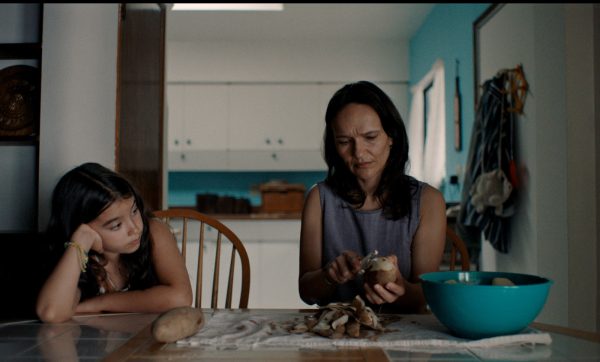
In some respects, it’s about a child’s first exposure to a disability or some type of condition destabilizing socially acceptable behavior, the frustrations that come with that from not only navigating it at such a young age, but during a time when adults also didn’t have much of an answer, later squared up against the fleeting happy memories, the reality of the situation, regret, and an adult perspective. At times, the film brilliantly and beautifully fuses the older perspective with the childhood memories and scenes, creating genuinely innovative emotional poignancy.
Much of this is elevated by striking cinematography (courtesy of Maya Bankovic) that is doing more than simply observing family interactions and dialogue through Sasha, but also sometimes utilizing tracking shots from an outdoor point of view following characters walking across the home, as if reappearing into something deeply personal on a narrative level and a similar sense regarding the filmmaker. The photography also makes use of reflections in numerous scenes, with the additional twist of characters sometimes reflecting back at one another, or of eerie ghosting that seemingly duplicates faces. Nearly everything about the filmmaking approach contributes to the reflexive nature of the story being told, a contemplation of whether something more or better could have been done to help Jeremy.
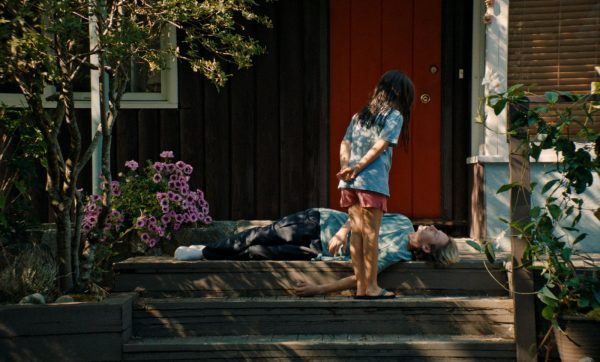
Then there is Jeremy (practically nonverbal, blonde-haired, sporting glasses, generally giving off quietly unhinged, emotionally distant vibes) who isn’t treated as a cheap caricature, but a real person who, at some point, changed (some family history is revealed providing fascinating context) and now teeters between serene moments of gentleness (most notably with Sasha at a beach) and outbursts that start off relatively harmless but blossom into full-blown threats of burning the house down (it’s also important to point out that the threat itself is kept offscreen, which is a smart decision so as not to exploit the behavior for misguided suspense; it’s not about whether or not he will follow through on any of this).
It should go without saying that these performances are nuanced, layered, and extraordinary across the board. However, it is that inventive second-half turn that elevates Blue Heron into a truly original work that takes the exploration of a condition and a child’s initial experiences around it, or how the entire situation alters and breaks apart the family dynamic into something far more profound regarding memory, sibling bonds, and systemic failings.
Flickering Myth Rating – Film: ★ ★ ★ ★ / Movie: ★ ★ ★ ★
Robert Kojder