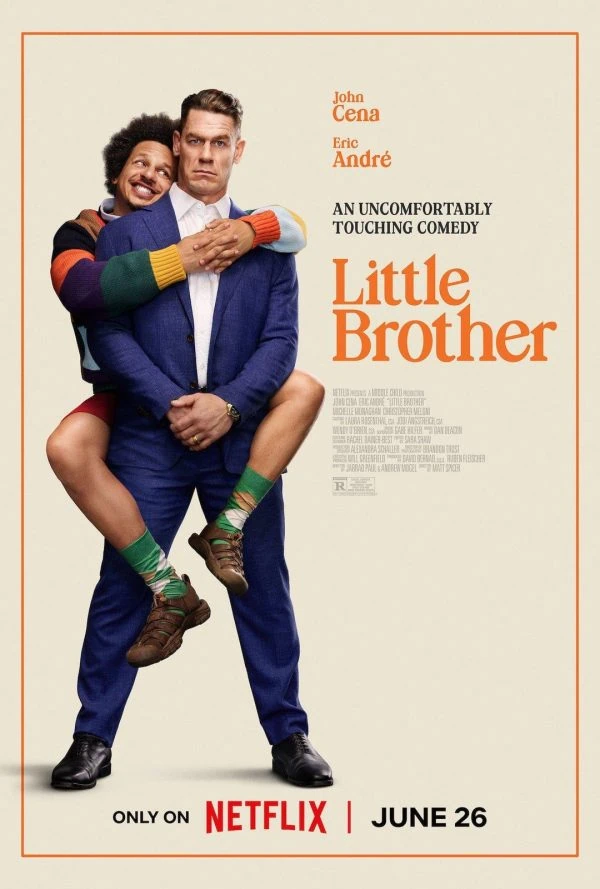
Little Brother, 2026.
Directed by Matt Spicer.
Starring John Cena, Eric André, Michelle Monaghan, Christopher Meloni, Sherry Cola, Ego Nwodim, Caleb Hearon, Dani Deetté, Ben Ahlers, Sophia Bunnell, Bryce Gheisar, Pilot Bunch, Sarah Ramos, Brett Azar, Stephen Singer, Christopher Woodley, and Holdyn Jaymes.
SYNOPSIS:
A famous real estate agent’s carefully curated world is upended when his eccentric “little brother” unexpectedly reappears.
Sometimes, the first joke sets the tone and, for better or worse, lets viewers know exactly what they are getting into. In director Matt Spicer’s Little Brother (he also helmed the great parasocial dramedy Ingrid Goes West, a shocking discovery considering the gulf in quality here), that bad sign comes in the opening moments as psych ward patient Marcus (Eric André) is reflecting on happy childhood memories alongside a roommate whose mental illness is repeatedly used for punchlines, showing him a 25-years-old photograph of his charity Big Brother Rudd (John Cena), currently a hot shot real estate businessman, who used to be heavyset. That’s the joke; John Cena’s character was once fat.
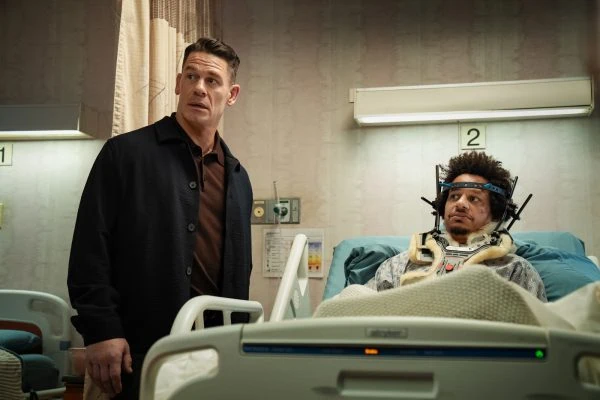
Marcus has lived a dour life moving from foster home to foster home, many of which were either borderline abusive or ended in some kind of tragedy, which the film also sees as something to cruelly mine humor from. He isn’t exactly in this psych ward because he is clinically insane, but rather because he is eccentric and lonely, with nowhere to go. Only happy during those couple weeks where he had a big brother (by the way, Marcus seems to believe that Rudd is his actual blood brother, which is enough for us to dispute the diagnosis of him not being a little bit crazy), he takes it upon himself to escape – a joke because he is there voluntarily – and set out on a journey to reconnect with Rudd. This quickly results in him getting hit by a car and injured, but not badly enough to inadvertently cause all kinds of lowbrow chaos for 90 minutes.
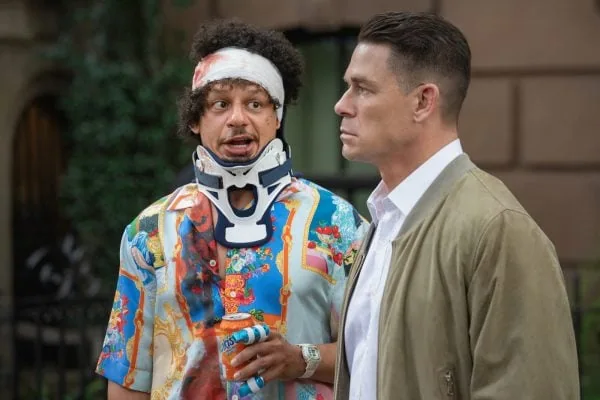
Rushing to the hospital under the impression that his older brother, Josh, is the one in critical condition, Rudd is flabbergasted to find someone he doesn’t even remember claiming to be of his bloodline. Unfortunately for him, his wife Deirdre (Michelle Monaghan) has a soft spot for underdogs and the broken (including adopting disabled dogs), insisting that Marcus come live with them and their teenage boys to reconnect with Rudd until finding some stability in life. Living in his billionaire older brother’s (Christopher Meloni) shadow and prepping for a real estate-based reality TV show that could help elevate him to a similar social and economic stature, Rudd has no time for any of this nonsense.
What follows is a deeply unfunny mashup of You, Me and Dupree and Step Brothers (the former is already terrible, so the recipe is at a disadvantage) that goes to some unbelievably crude lengths, failing to elicit laughter. It’s already awkward enough that the filmmakers (the screenplay comes courtesy of Andrew Mogel and Jarrad Paul) mostly see Marcus’s troubled life as something to poke fun at (they believe a throwaway line of him mentioning that one of his foster fathers died on 9/11, but not on one of the planes, is oh so hilarious), but there are sequences of gross-out humor here that, during the end credits outtakes, even Eric André appears as if he is about to say ” are you serious?” To his credit, he is game and certainly brings raucous energy to the character.

Beyond the relentless onslaught of juvenile and crass humor, Little Brother attempts to say something cyclical about what happens when someone becomes the kind of arrogant, distant, but cool brother they had, letting greed, success, and self-absorption get in the way of simply being a kind and decent person to others who admire them. We can gather that the young, chubby version of Rudd simultaneously looked up to and always perceived Josh as a rival, turning himself into John Cena and becoming a real estate mogul with excess wealth in his own right, who once wanted to do good for the less fortunate, hence signing up for that Big Brother program decades ago in the first place.
However, any worthwhile story to tell here or familial themes are buried beneath lazy humor that is often impressive for how dumb, lowbrow, and occasionally tasteless it gets. That’s not to say this style can’t be funny, but it seems driven by a desire to shock here rather than by characterization. The film ultimately means well, but simply isn’t funny. When Little Brother is over, you’ll want to send everyone to the same psych ward for making such a dreadful comedy, even if it does have a little bit of heart toward the finale. The manic energy of Eric André and John Cena (who usually always manages to be funny but barely registers here) deserve better.
Flickering Myth Rating – Film: ★ ★ / Movie: ★ ★
Robert Kojder