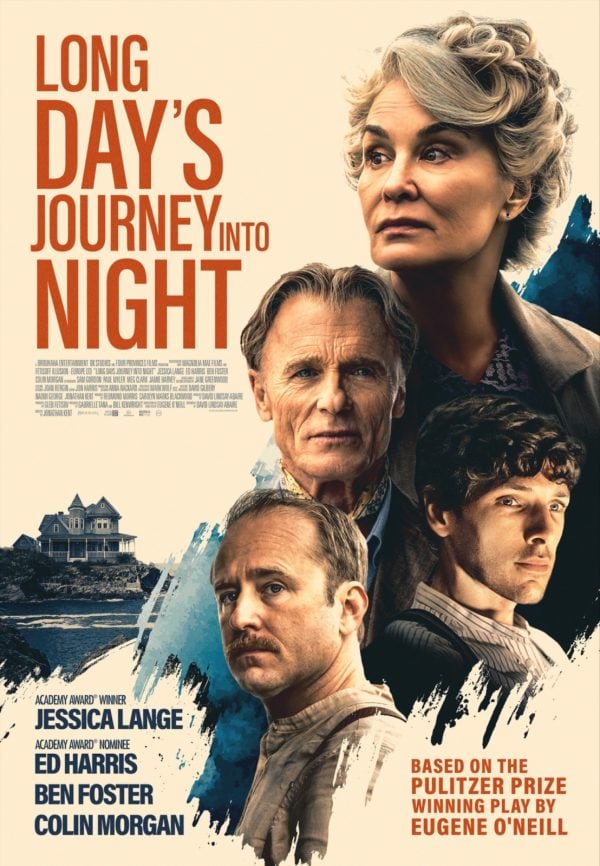
Long Day’s Journey Into Night, 2025.
Directed by Jonathan Kent.
Starring Jessica Lange, Ed Harris, Ben Foster, Colin Morgan.
SYNOPSIS:
Set on one single day in August 1912 at the family’s Connecticut seaside home, the story follows the Tyrone family as it faces the looming dual specters of Edmund’s potentially fatal consumption diagnosis alongside his mother Mary’s increasingly fragile and anxious state of mind.
Marking the feature directorial debut of celebrated British theatre and opera director Jonathan Kent, this screen adaptation of Eugene O’Neill’s masterwork brings the playwright’s deeply personal drama to the cinema. Kent steps behind the camera for the first time to helm an exploration of the Tyrone family, unfolding over the course of a single day in 1912 at their Connecticut seaside home. From the very first introductory voice-over delivered by Colin Morgan, the film establishes itself as a poetic piece exploring, more than anything else, what it means to be lost.
At the heart of the narrative are the dual threats of illness and relapse. The family is forced to confront younger son Edmund’s potentially fatal diagnosis of consumption alongside matriarch Mary’s increasingly unpredictable nervous energy. Everyone under the roof is acutely aware that the stress of Edmund’s illness threatens to drive Mary back into the severe morphine addiction she has only recently overcome. Dysfunctional family dynamics are the order of both day and night here, with substance abuse acting as the primary coping mechanism. Indeed, a drinking game based on this film would be perilous given how much whisky is knocked back throughout the runtime, and when combined with Mary’s reliance on morphine, the portrait of a family drowning in addiction becomes starkly clear.
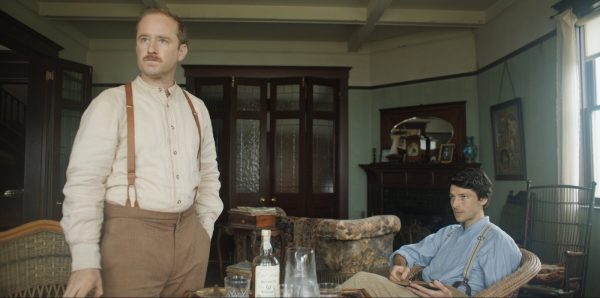
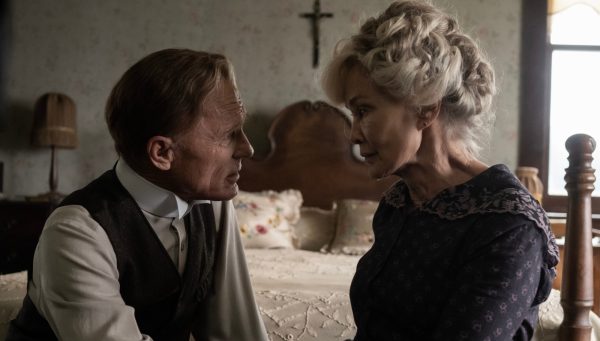
The ensemble cast delivers exceptional performances that bring these tormented characters to life. Jessica Lange is extraordinary as Mary, brilliantly capturing a deeply troubled soul. Kent uses intense close-ups of Lange’s haunted face, letting her show a woman slowly slipping away. Mary moves around the house like a ghost in her confusion, desperately trying to cling to the past. Her insistence on searching for, eventually finding, and clutching her old wedding gown serves as a powerful visual metaphor for where she is trapped in her own head.
Alongside Lange, Ed Harris co-stars as the patriarch James Tyrone, a self-made man, renowned actor, and failed property magnate. The family unit is completed by Ben Foster as the charming, wayward, and hard-drinking elder son, Jamie, and Colin Morgan as the poetic, bleakly optimistic Edmund—a direct portrait of O’Neill himself. Beyond addiction, the film is very much a story of cultural identity and roots. James, modelled on O’Neill’s own father, is an Irish immigrant to America whose connection to his homeland remains deeply ingrained in both him and his sons, standing in subtle contrast to Mary’s more affluent WASP background.
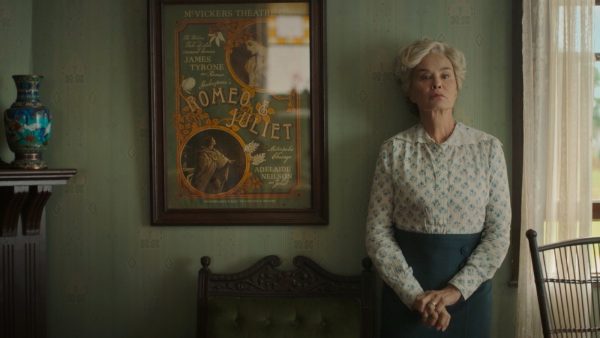
The coastal setting does heavy lifting throughout the film. Living literally on the edge of the land, the Tyrone family is metaphorically all at sea. The persistent sound of the ocean serves as a constant reminder that all things pass, grounding the domestic turmoil in a broader, philosophical stillness. While the early twentieth-century setting carries the weight of a difficult era with a world war looming just around the corner, the film balances its historical and personal heaviness with a lyrical grace.
Ultimately, while this story is undoubtedly a bleak piece, it is a profoundly poetic and moving one. Its theatrical roots remain evident throughout, with O’Neill’s dramatic dialogue hitting high emotional notes right from the off. To my mind, the project never quite fulfils its full cinematic potential, as those stage origins never entirely fade away. Even so, the film successfully weaves moments of quiet contemplation into its tempestuous arguments. Anchored by powerhouse performances and a haunting atmosphere, this gloomy yet deeply resonant film stands as a compelling meditation on memory, regret, and familial bonds.
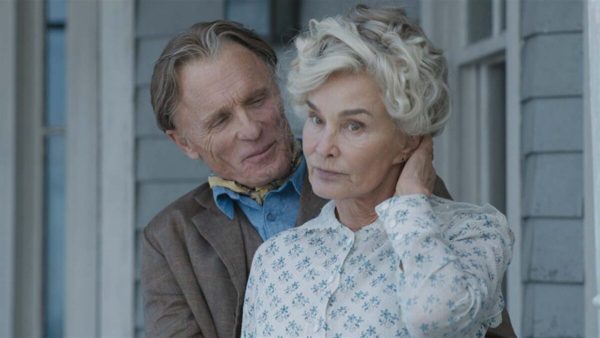
Interestingly enough, for a story so deeply concerned with relocation from Ireland to America, much of the filming actually took place in County Wicklow, Ireland. This detail adds an extra layer of thematic resonance to the production, subtly manifesting in the dreamy shots of the coastline. Visually, it feels almost as though the Irish landscape travelled across the ocean with James, patiently claiming his family as well.
Flickering Myth Rating – Film: ★ ★ ★ ★ / Movie: ★ ★ ★
Robert W Monk