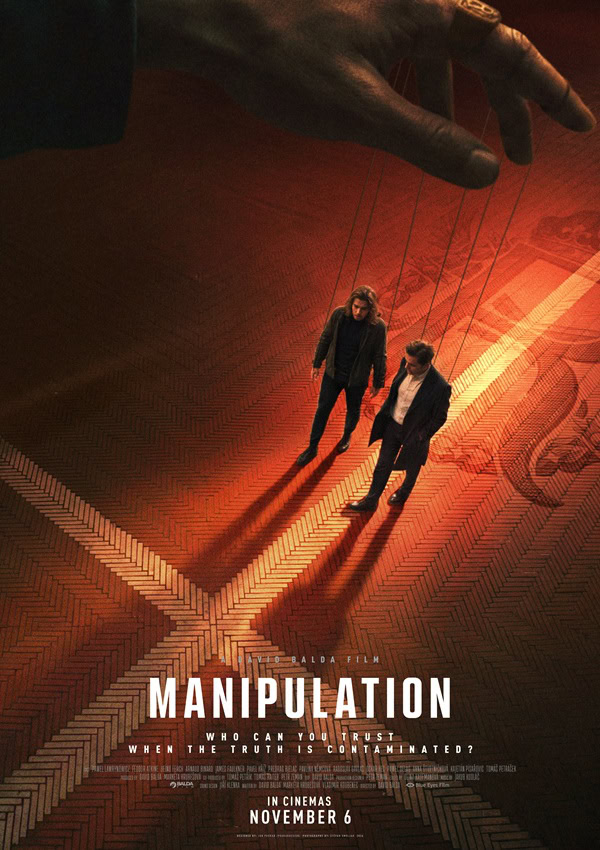
Manipulation, 2026.
Directed by David Balda.
Starring Radoslav Gavlas, Pawel Lawrynowicz, James Faulkner, Anna Ctvrtnícková, Heino Ferch, Paulina Nemcova.
SYNOPSIS:
An omnipresent threat of manipulation looms over the world. It can emerge anywhere, at any time, and by any means.

Manipulation is the latest offering from the young writer-director David Balda, who was just 18 when his first feature was released in his native Czechia, and is now in his mid-20s for this release. It is certainly an ambitious project, bolstered by international names and locations. The film delves into the shadowy world of conspiracy, aiming to explore who is really controlling society and pulling the strings of church and state. Beautifully shot in the European cities of Prague, Ferrara, and Bologna, the production has a wide scope and clearly attempts to capture the bigger picture.
The trouble is it all gets bogged down by far too much dialogue, without a clear reason as to what is being challenged or focused on. Essentially, it is a story of discovery, with a young initiate into a cult of elite movers and shakers (Radoslav Gavlas) gradually discovering that his father and his fellow acolytes may not be the most compassionate or fair-minded individuals. In fact, they can be downright fascist.

The youngster—after confiding in Anna (Anna Ctvrtníčková), who is also deeply intertwined with the family of someone involved in the conspiracy—leaves Prague to study in the ancient university city of Bologna. All the while, there is endless talk about control and power. A group of brave individuals aim to bring the truth about the conspiracy out into the open. Strangely, they choose to do this by means of a local Prague newspaper, which seems a slightly odd choice. Would a global conspiracy of this magnitude not have complete control over the press?
From an intriguing setup, Manipulation ultimately becomes a slog because of excessive, heavy-handed exposition. An over-reliance on stilted dialogue prevents the characters from developing any genuine chemistry, leaving the emotional stakes feeling remarkably flat and unearned. Furthermore, the action sequences are so poorly choreographed and randomly inserted that it is often unclear why they are even happening.

The subsequent culmination of the various convoluted plotlines is confused, and by the final frame, nothing of actual substance seems to have changed. It all becomes rather mystifying for the wrong reasons. That being said, the cinematography depicts the three beautiful cities skillfully, offering some atmospheric, Insta-ready visuals. However, pretty backdrop reels cannot salvage a structurally flawed narrative, and the film certainly could have benefited from a tighter runtime. A more focused narrative, concentrating on the screenplay’s strongest underlying aspect—how young, intelligent people can survive in a modern world governed by corrupt symbols—would have proven far more successful.
Flickering Myth Rating – Film: ★ ★ / Movie: ★
Robert W Monk