Nightborn, 2026.
Directed by Hanna Bergholm.
Starring Seidi Haarla, Rupert Grint, Pamela Tola, Pirkko Saisio, Rebecca Lacey, and John Thomson.

SYNOPSIS:
Saga (Seidi Haarla) and her British husband Jon (Rupert Grint) move to the isolated house where she spent much of her childhood, deep in the Finnish forest. But as soon as their baby is born, despite the reassurance of all around her, Saga knows there’s something terribly wrong with her son.

Torn from the same book as the Noomi Rapace-headlined Icelandic fable Lamb, this wicked little slice of Finnish folklore lays a foundation of fantasy upon which to build a twisted narrative that prays on parental fears, all thanks to its vicious little vauva (‘baby’ in Finnish).
Opening in a Shrek-like clearing in the forest, Saga (Seidi Haarla) and her British husband Jon (Rupert Grint) drive down a winding country lane towards her childhood home, and their new marital abode. He carries her across the threshold into a rundown house in which nature is encroaching, with foliage puncturing the walls, and where light hasn’t touched the wooden floorboards in years.
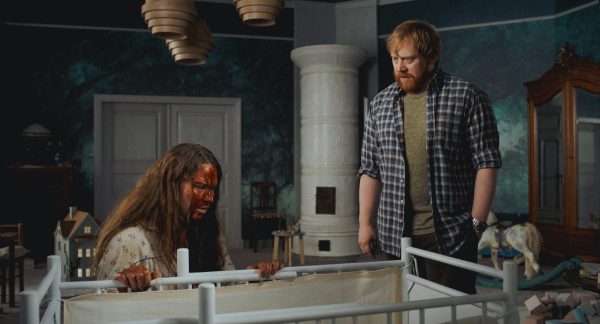
It’s while reconnecting with her natural environment, amongst trees adorned with Gigeresque anthropomorphic knubs and barely heard whispers, that Saga goes all Wicker Man, demanding that the woods make her a mother. She kneads the mossy forest floor, and embraces trees, while a pursuing Jon is scratched and caught on tendril finger-like branches, holding him back. They do the dirt-under-the-nails dirty and nine months later we’re transported to a blood-soaked birth, worried faces, and the inhuman cries of a new-born.
The screaming. Oh, the screaming! Nightborn‘s sound department are worthy of praise and admonishment, because the unholy cries of the newly-Christened Kuura are soul-piercing and requisitely intolerable for both the audience and the new parents. They go a long way to conveying how exhausting and relentless the demands of this particular child is for Saga.

While that element is presented all of its shrill, surround sound-testing brilliance, equally effective is the show-less approach of the filmmaking. Aside from the occasional look at ‘its’, sorry ‘his’ hirsute back, it’s not until the final sequence that we get a good look at the hell-spawn. For the most part Kuura is shrouded in darkness, glimpsed in silhouette like a junior Nikki from Obsession, or faced away from our lens, left to that most frightening of things, our imagination.
The script tackles that age-old question of evil being born or bred that has been a genre staple since the days of Damien’s scalp and Rosemary Woodhouse’s offspring, but Nightborn also raises issues of humanity’s relationship with the natural world, and a fear of things we don’t understand. It’s all very overt and unsubtle, but it just about works.

A lot of the horror rests on the shoulders of Seidi Haarla’s performance as the unsympathetic mother, who’s a taboo totem of despair as a woman losing her identity to her child. She’s put through the wringer as a physical manifestation of trauma, changing from this confident woman desiring a large family, to one alienated by her situation and unable to acknowledge her son as anything but a monster. Grint is on-hand to ground the heightened aspects of her behaviour with his comical everyman routine, which is hardly a stretch, but necessary for the film’s overall balancing act.
The concept is stretched a little thin, meaning that once the script moves from focusing on the horror of being a parent or more pertinently, a mother, it simply becomes a monster baby movie, none of which is as scary or unsettling as what came before. That said, Nightborn is a delightfully dark and stressful piece of postpartum horror that thrives on the unseen, raised above its monster-of-the-week concept thanks to a committed performance from a bloody good Seidi Haarla.
Flickering Myth Rating – Film ★ ★ ★ / Movie ★ ★ ★
Matt Rodgers – Follow me on Twitter