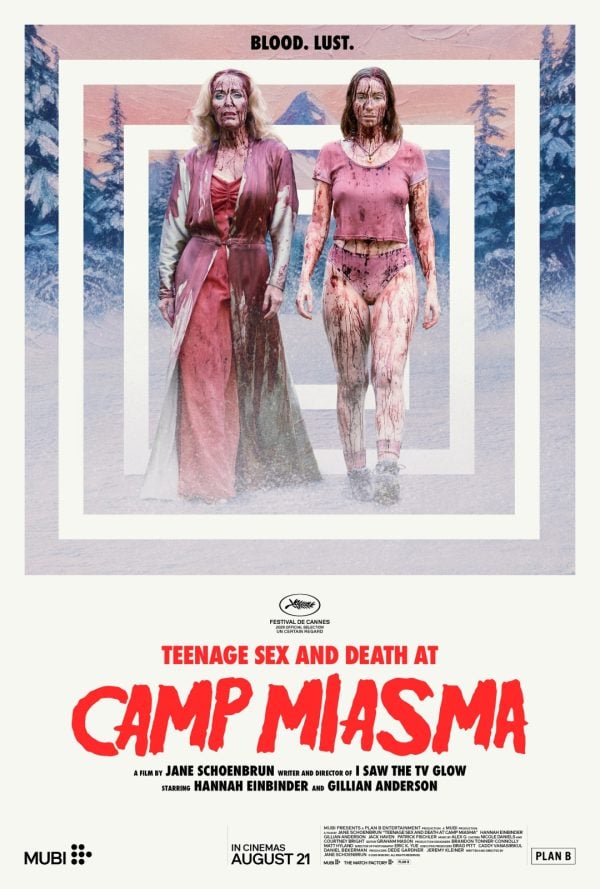
Teenage Sex and Death at Camp Miasma, 2026.
Written and Directed by Jane Schoenbrun.
Starring Hannah Einbinder, Gillian Anderson, Amanda Fix, Jess McLeod, Arthur Conti, Eva Victor, Zach Cherry, Sarah Sherman, Patrick Fischler, Dylan Baker, Jasmin Savoy Brown, Quintessa Swindell, Kevin McDonald, Jack Haven, Aren Buchholz, Florence Barrett, Hunter Dillon and Freya Edwards.
SYNOPSIS:
A director making a slasher sequel becomes obsessed with casting the original film’s ‘final girl,’ leading both women into psychological and sexual chaos.
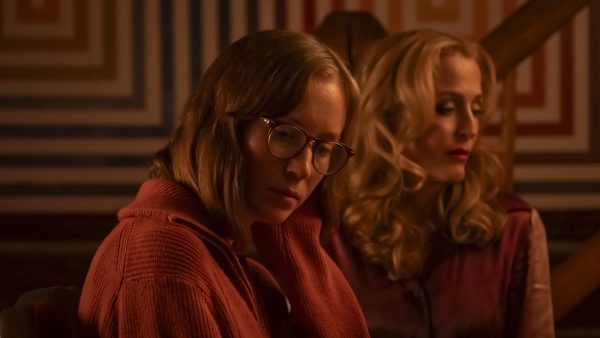
When queer filmmaker Kris (Hannah Einbinder) meets Billy (Gillian Anderson), the former star and final girl of the fictional 1980s Camp Miasma franchise, now a recluse living at the original film’s shooting location, she’s unsure what to expect and perhaps equally uncertain about the career choice she is considering. Sure, the initial conversation between the two in Teenage Sex and Death at Camp Miasma brings forth many generational divide topics ranging from the problematic material in slashers of the era to a sort of all-business, work-minded political correctness from the former – possibly in desperate need of loosening up that the latter might be able to instill in her – and whether she is relatively sane or has gone full blown Laurie Strode from the Halloween legacy sequels (she appears normal enough, at least until she starts asserting that the killer is still alive at the bottom of the lake, then letting out a cackle reversing course to shut down that notion as ridiculous).
However, what truly stands out about this portion, aside from the hysterical meta-humor takedown on studio executives, is Kris giving Billy a summary of her resume, having started out catching attention through a small indie film, causing the industry to take further notice with one or two follow-ups, which means that the logical next step is accepting the opportunity to work inside creative restrictions while rebooting some long forgotten IP, typically searching in vain for a fresh new angle.

The way Kris describes this comes across as a soulless nightmare. It’s enough to make one wonder how much of this character is a stand-in for writer/director Jane Schoenbrun; did someone watch We’re All Going to the World’s Fair or I Saw the TV Glow and try to box the filmmaker into bringing some franchise back from the dead? Is there an existential crisis that this is an unfortunate expectation or want from fans once popularity balloons (as soon as something takes Hollywood by storm like lightning in a bottle, those on the Internet can’t help themselves from misguidedly cherry-picking what franchise they would be best to star in or direct; hell, look at Obsession breakout Inde Navarette, already getting the Marvel fan-casting treatment)? It is safe to say, though, that Jane Schoenbrun is charting a densely rewarding filmography; no one is making movies like them and the cinematic landscape is a much richer place for it
Nevertheless, the specific subgenre for Kris’ filmmaking career intersection/possible crisis is slashers, which are richly important and personal to her, seeing something in the original Camp Miasma that goes beyond, well, sex and death, not to mention a highly controversial backstory for the killer involving transphobia. Particularly, that comes down to a look and an emotion for Billy during a pivotal scene that Kris wants to pick and pull at until she understands more, as something about it connects back to her personally.

Technically, Kris is supposed to be here asking the usual generic questions to figure out an audience friendly angle (and certainly a much more politically correct approach) to revive the series (which is given an extensive 40-year history of movies playfully poking fun at the directions these franchises typically go, including a “Takes Manhattan” reference, 3D installments and other tongue-in-cheek referential concepts, with VHS tapes, video game crossovers, action figures, pinball machines, and more making for a stunning undertaking of building lore and handcrafting that memorabilia). The studio wants something safe and bankable, although Billy doesn’t have the star power of Heather Langenkamp, let alone Jamie Lee Curtis (a scenario reference and name-drop that leads to a side-splitting acknowledgment of a juvenile rumor), so a legacy sequel is a no-go. Remakes are also out of the equation, as that has also been done to death with the property.
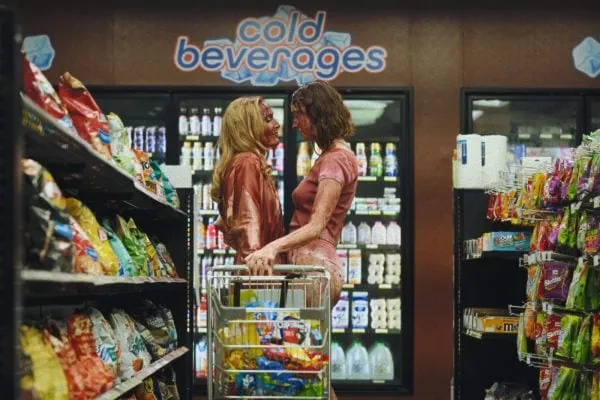
Instead, there is a growing psychological, psychosexual fixation toward Billy on Kris’s behalf (as I write this, it’s also not lost on me that both feminine-presenting characters are given gender-neutral names), with that interview gradually transforming into something more laid back and casual, getting high and ordering a delivery of KFC (the less said about this scene is for the better, as it deserves to be seen going in blind, although I will say it would be incredible to see a fast food chain partner up with a film as boldly and controversially titled as this one for a tie-in meal), getting into their sex lives or in the case of the filmmaker, her lack of one as even though she is in a polyamorous relationship, she is laser-focused on her art. As more is revealed, one could argue that there is sexual repression.
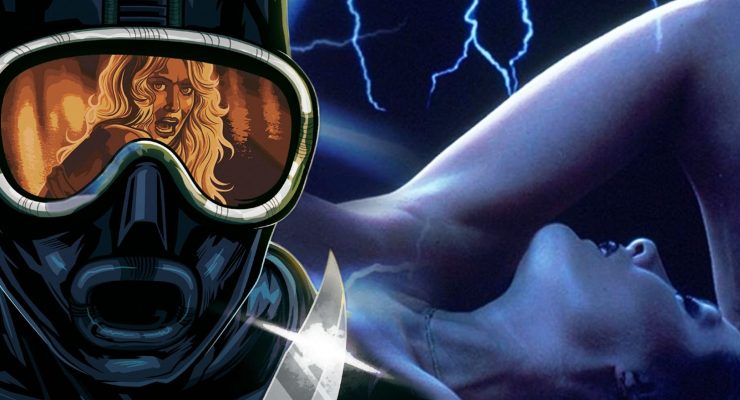
This journey of sexual discovery dovetails into a re-watch of the original Camp Miasma, in which Billy (played by Amanda Fix), forever and tragically altered by the making of it, was the final girl who also had an explicit sex scene (although not quite as graphic as what was regularly seen in the 1980s), where Jane Schoenbrun goes the extra step to take viewers back to the era by shooting on 35mm. A movie within a movie, Camp Miasma both lovingly points out the absurd campiness of the slasher genre while also serving as a gore-filled playground for killer Little Death (Jack Haven, previously seen in I Saw the TV Glow pre-transition) wielding a spear and slicing off heads, creating geysers of blood during a lengthy slaughter sequence. Such violence is intentionally exaggerated to come across as more of a reclamation of the problematic backstory grounded in transphobia rather than feeding into it, with Little Death donning a metallic square-box helmet, aesthetically reminiscent of Silent Hill‘s Pyramid Head.
Among the targets is Eva Victor, who shadowed Jane Schoenbrun on I Saw the TV Glow before directing their own emotional rollercoaster of a debut film, Sorry, Baby, here with a pleasantly ridiculous mohawk, serving as the counselor DJ; it’s a small role worth the price of admission alone.
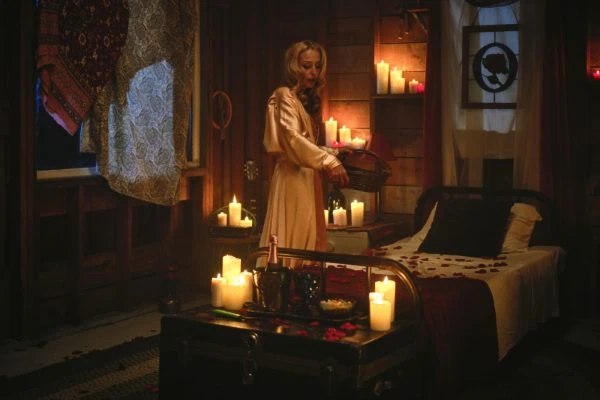
That visual resplendence is not limited to the recreation of Camp Miasma, as regular cinematography collaborator Eric Yue imbues reality with a beautiful, matte-painting-like backdrop that is downright exquisite. And while Teenage Sex and Death at Camp Miasma is Jane Schoenbrun’s most accessible film to date (and certainly the first with a sharp comedic edge throughout), the proceedings still get bizarre, with reality and fiction blending together to once again make a point on how our attachments and connections to art shape or stunt us.
It operates under similar narrative beats to I Saw the TV Glow, but on its own terms, with a new genre to deconstruct, pay tribute to, and reckon with. Like all of Jane Schoenbrun’s films, it’s not only revealing new character layers but also changing up how the story is told from act to act. Teenage Sex and Death at Camp Miasma is a unique blend of comedy, gore, horniness, tragedy, and romance, presented radically fresh, both meta and emotionally cutting, with Hannah Einbender and Gillian Anderson brilliantly inhabiting these characters and walking that tonal tightrope.
Flickering Myth Rating – Film: ★ ★ ★ ★ / Movie: ★ ★ ★ ★
Robert Kojder