Adam Page on why The Terminator is pure horror…
In a previous life, I worked in the Health Service. I’ve worked in hospitals, psych wards, I’ve worked the streets at night with people you pretend don’t exist. I know how to call something what it is: The Terminator is a horror movie.
It’s not an action movie with a few horror elements, or a sci-fi thriller with a darker than usual atmosphere. It’s a horror movie. Specifically, a slasher, and one of the great lean, mean, most efficiently constructed examples of the genre ever burned onto celluloid. And the fact we’ve spent four decades calling it something else says a thing or two about our cultural discomfort with admitting what we love and why we love it.
James Cameron filmed a slasher movie in 1984. He dressed it in chrome and machine oil, and sent it out into the world wearing Sci-Fi’s clothes. And the world at that time, desperate for a reason to feel okay about being frightened, called it an action movie and moved on. But pull away the conceit of time travel, all the mythology and franchise ambitions, and what you have left is Halloween, or Friday the 13th. We have a near-invincible killer stalking a young woman through the night and leaving a trail of bodies so steady and methodical it reads like a shopping list.
Oh, you don’t believe me? Pull up a chair, and let’s go through this scene by scene…
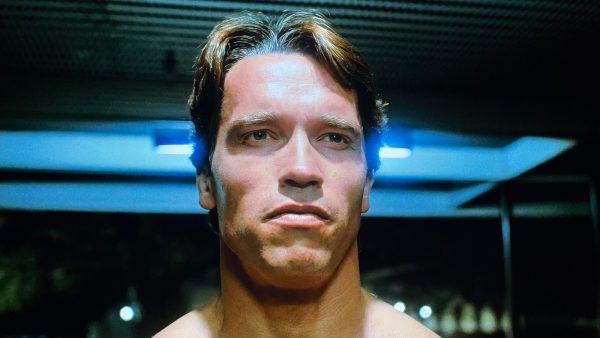
First, every great slasher needs its shape, its thing. Michael Myers had his Shatner mask. Freddy had his hat and glove. Jason had his hockey mask. Eventually, of course, after the franchise decided subtlety was for other people.
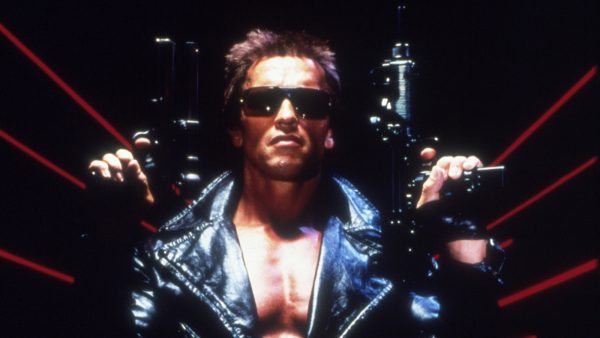
The Terminator has Arnold Schwarzenegger’s face, and nothing human at all underneath it.
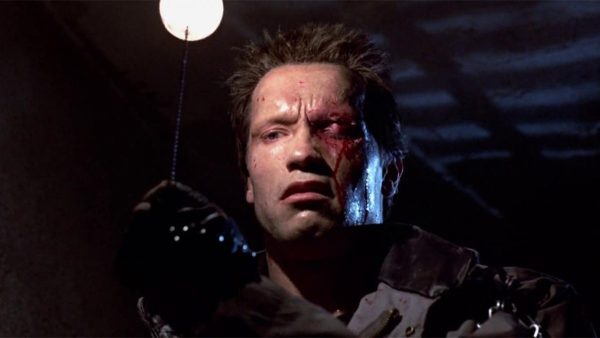
This is the first and most fundamental horror move of the film: it gives us a monster wearing a man’s skin. There is a scene where the T-800 is repairing its own eye in a filthy motel bathroom, socket cut open and silicone and wire where a pupil used to be, and it’s a body horror sequence just as effective as anything David Cronenberg put on screen in the same era. It doesn’t flinch or apologise, instead it lingers on the sheer wrongness of the thing and lets us sit with the visceral understanding that what we are looking at has never, in any real sense, been alive.
Horror lives in the uncanny valley, and Cameron plants his flag there from the first frame.
But the thing that really seals the deal is this: the Terminator just cannot be reasoned with. Kyle Reese delivers this news to Sarah Connor with all the gravity of a doctor delivering a terminal diagnosis, and he’s right. It has no mercy or fear. There’s no subtext or angle, no moment where you could appeal to something human because there is nothing human in there. It won’t stop and it won’t negotiate. It’s coming, and the only question is whether you can stay ahead of it long enough to matter.
Does that sound familiar? Because it should. John Carpenter made a movie about exactly this sort of monster six years before. In the script, he called it The Shape. We know him as Michael Myers. That philosophical DNA is identical; the entity of pure and motiveless, unstoppable violence moving with the calm certainty of something which has never once considered the possibility.
The monster in a slasher movie is defined by its inevitability, and there’s nothing on earth more inevitable-feeling that a machine that has worked out the optimal path to your death.
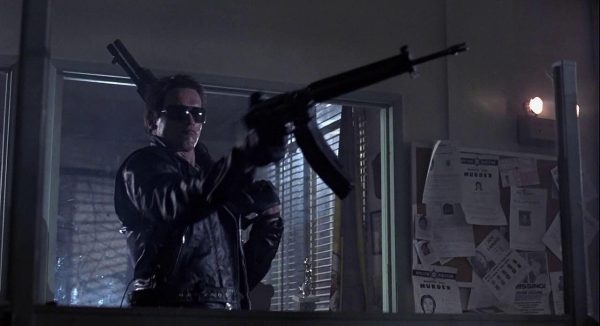
Let’s discuss the body count, as it’s a genre requirement.
The Terminator arrives in Los Angeles on a May night in 1984 and within 48 hours, the city looks like a particularly ambitious episode of Crimewatch. Three Sarah Connors are in the phone book, and two of them die. There is a police station, filled with armed officers, and most of them die. A nightclub full of people having a perfectly nice time, and several of them die.
This is the central bargain of the slasher, and it’s laid out here in its most mechanically honest form. The genre has always needed a body count as it serves a narrative function: it establishes the threat. It proves the monster isn’t playing around and its violence isn’t theoretical, and that the survival of the protagonist is not guaranteed. Each victim of the Terminator is a data point in an argument the movie is making about how serious the situation is.
Cameron’s genius, and it is genius no matter how nakedly functional, is that he justifies the body count with an internal logic. The Terminator kills the wrong Sarah Connors not out of sloppiness or malice, but out of systematic methodology. It’s working down a list. This makes the deaths a little less gratuitous than the average slasher flick, but structurally they are doing the exact same function, which is mounting evidence of escalating danger.
Also notably, the movie’s violence is relentless in a way that horror understands and action cinema just doesn’t. Action movies will give you beats, bursts of violence which are punctuated by recovery or regrouping. Witty remarks. The violence in this movie doesn’t breathe; the sequence in the police station isn’t a set piece with a beginning, middle, and heroic end. It’s a methodical and merciless atrocity, seen from Sarah’s perspective as a sustained nightmare from which there is no easy escape. There is no victory at the end, only flight, as you don’t win against the Terminator. You briefly survive while it recalculates.
That is horror, no matter what anybody says. It’s not action.

Now, then. Sarah Connor.
There is a template in the slasher genre so well-known by 1984 that Carol Clover would codify it academically seven years later in her book Men, Women and Chain Saws. It’s the Final Girl. She is typically, not always but typically, defined by a certain kind of ordinariness from the beginning. She isn’t the coolest person at the party, or the most reckless. In the opening act, she is someone things happen to instead of someone who makes things happen.
Sarah Connor in 1984 is a waitress who can’t keep a date, who has customers who dump ice cream on her, and whose biggest problems are regular, recognisable, and totally unrelated to anything apocalyptic. Deliberately, she is no one special. She is every woman; she is the audience.
The monster then comes for her specifically, and the movie becomes about her survival.
The Final Girl isn’t passive. This is the great misunderstood gift of the genre. She doesn’t survive because she’s lucky, but rather because she adapts. She learns and makes decisions, sometimes bad ones but always under pressure, and she fights back when fighting back becomes the only option left. Clover’s conclusion was that the Final Girl is the most active character in the movie, and the one whose agency and intelligence determine the outcome, even when that outcome is measured in feet of distance between herself and death.
By the final act of the movie, Sarah Connor isn’t the ice cream waitress. She’s someone who has had to process an incredible amount of information under conditions of sustained and mortal terror, coming out the other side capable of crushing a machine assassin in a hydraulic press. The transformation isn’t implausible; it’s the central dramatic arc of the genre, but rarely is it executed with this level of conviction.
Occasionally, James Cameron is credited with inventing the action heroine with Sarah Connor, but that framing misses the point. He didn’t invent an action heroine, instead he took the Final Girl, the specific genre-coded archetype, and followed her journey to its logical extreme. Sarah Connor works exactly because she is a Final Girl first and recognisably a warrior second, in that order.
The horror template may have created her, but this movie just let her finish what it started.
How about a technical detail that horror aficionados will appreciate and everyone else can feel in their bones without quite naming: the Terminator moves like a slasher villain.
In most action movies, the antagonist is usually a counterforce. They’re equipped with resources and a plan, a goal which brings them into conflict with the protagonist. There’s almost a chess quality to it, with move and countermove. With horror, the monster’s geography is different in that it converges. It doesn’t interact with the world so much as it eliminates obstacles between itself and the target. Everything in its path is that same thing: an obstacle.
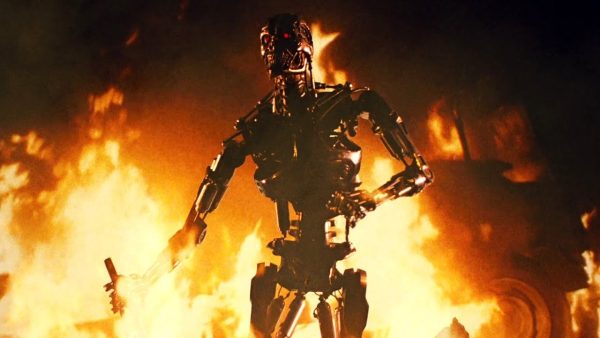
Watch just how the T-800 moves through the movie. It doesn’t strategize in a human sense. It acquires weapons and eliminates witnesses. It tracks, and appears in doorways, or at the end of corridors, outside windows. It’s always framed in the visual grammar of the reveal, which is horror cinema’s most reliable tool. The instant we see Arnold Schwarzenegger’s head turning slowly in the rear-view mirror of that police car, we’re watching a horror movie. When we see him walking through that burning truck wreckage, we’re watching a horror movie. Watching his metal endoskeleton drag itself across a factory floor grabbing at Sarah Connors ankles in the dark, we are absolutely watching a horror movie. No reasonable person could describe these images as action cinema.
Cameron knows just what he’s doing with his camera. The Terminator is very rarely shown in full, in the daylight, until the movie has to show you the monster without the mask. It lurks and peers, existing at the edges of frames. And this isn’t the visual language of action; it’s the visual language of Psycho and Alien and Halloween. Movies that haunt us.
So, it’s Los Angeles at night in 1984. Neon and rain-soaked streets, clubs where the music is loud enough to cover a scream. Seedy motels with burned out vacancy signs. Police precincts that look, in the dark, like every institutional nightmare you ever had. And a factory district that, at midnight, may as well be the underworld.
Horror definitely knows its real estate. The slasher movie needs places that are both familiar and threatening; places we recognise but the darkness has made wrong. Cameron’s Los Angeles is a masterclass in this. We’re not watching the sunlit Los Angeles of the Chamber of Commerce. It’s the nocturnal city, the one of bad decisions and uncertain exits. The city which has always known it’s sitting on a fault line and had made its peace with that knowledge in the most Angeleno way imaginable: ignoring it completely.
The movie is set almost completely at night, or in the grey no-man’s-land of overcast day, and this too is a horror decision, with the atmosphere as argument.
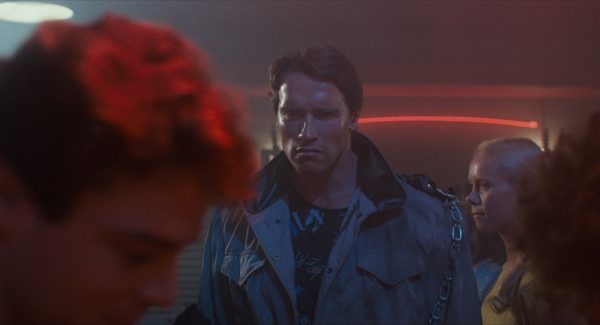
And in Tech Noir, where Sarah sits by a pay phone waiting for salvation, we get one of cinema’s great horror settings, all rendered in that specific neon palette of the 80s. We feel the danger before we see it, and the camera is paranoid on her behalf. We scan faces and watch the door. Without quite consenting to it, we are doing the work that horror cinema is there to make you do: imagine threat in every shadow, and rehearse your own vulnerability.
In popular culture and the critical establishment, there is a long tradition of apologising for horror. Of rescuing movies from their genre as though the genre was a gutter they’d fallen into by accident. We did it with Alien (“Well, actually, it’s science-fiction”) and we did it with Get Out. It took a while but we finally stopped pretending it was a “social thriller” and admitted it was a horror movie, and a damn good one. And we do it with The Terminatorevery time we class it as “action” and move along.
But horror isn’t the lesser genre, it’s one of the oldest and most honest genres we have. It goes straight to the things we can’t say in polite company: that we are terrified of death, of violation and loss of control. We are afraid of the night and what moves through it. The slasher specifically is a populist form; it’s raw and efficient, usually more formally rigorous than the detractors will ever acknowledge. It has rules and grammar, a moral architecture that, in its own way, is as codified as any Western.
The Terminator follows those rules and speaks with that grammar. In the most precise technical sense, it’s a slasher movie, and one of the best and well-made examples of the genre in the decade which defined it.
James Cameron went to the place horror knows best, which is the fundamental fear of being hunted. Of running and running and looking back to see that thing still coming. Of the night with no morning coming. And in that primal territory, he found a story about transformation and survival and what it costs you to outlast something which has decided, with robotic certainty, that you won’t.
He called it The Terminator.
Horror fans knew what it was all along.
Adam Page