As the film celebrates its 40th anniversary, we look at the story behind David Cronenberg’s The Fly…
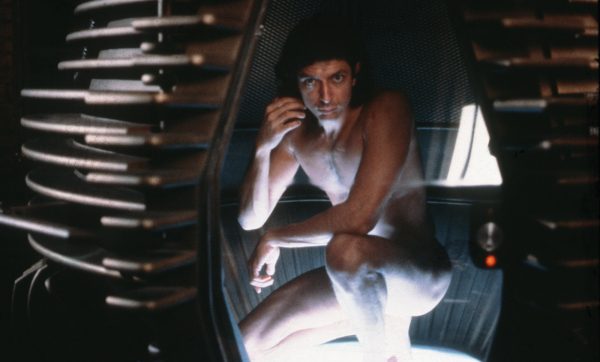
David Cronenberg is a man that requires no introduction. The Canadian filmmaker is almost a genre unto himself, being one of the principal originators of the body horror sub-genre. Despite being one of his early efforts, The Fly continues to be admired and appreciated as one of Cronenberg’s best films due to its thematic complexity, groundbreaking special effects and compelling performances. As The Fly celebrates its 40th anniversary we look back at what went on behind-the-scenes during the making of this beloved sci-fi horror classic.
Crafting the screenplay proved to be a time consuming affair
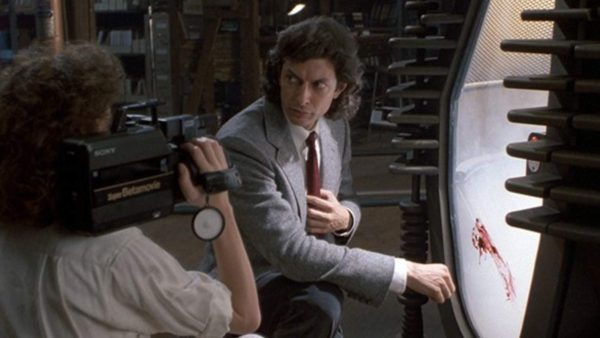
The Fly was a sci-fi horror short story penned by French-British author George Langelaan which was published in the Playboy magazine issue of June 1957 and later included in the author’s short story collection Out of Time in 1964. The property’s first feature film adaptation was by Kurt Neumann in 1958, and this eventually became the first installment of a trilogy of movies that centered around the grotesque human-fly hybrid character. Flashforward to nearly two decades later, producer Kip Ohman was keen on re-adapting the Langelaan’s property for a newer audience and approached screenwriter Charles Edward Pogue with the hope of accomplishing this task.
Pogue began his exercise by reading the short story and watching the original film to get a basic idea on the property. Enthused about adapting the source material, Pogue talked to producer Stuart Cornfield about setting up the project and together the duo pitched the idea to the executives over at 20th Century Fox where they received an enthusiastic response. Shortly after Pogue was given money to pen the first draft of the screenplay by the studio. Both he and Cornfield were of the opinion that the metamorphosis of the character should be gradual and not instantaneous and included that detail in the draft. The Fox execs, however, weren’t too thrilled with Pogue’s draft and withdrew from the project. Cornfield managed to salvage the situation by renegotiating the deal with Fox, who agreed to distribute the movie if the producer could sort out financing the effort with someone else.
Mel Brooks didn’t want people to know the film was produced by him
Once Fox pulled out financing the project it was none other than Mel Brooks that came in to save the day and bankroll the effort through his production company Brooksfilms. Although Brooks is no stranger to the film industry, his body of work mostly revolves around the comedy genre as evidence by movies like Blazing Saddles, Young Frankenstein, Silent Movie and High Anxiety. Cornfield handed Brooks the draft written by Pogue who liked what he read but felt a script polish by another writer was required. The Wild Bunch and Sorcerer scribe Walon Green was hired by Cornfield to do the needful but unfortunately Green’s draft wasn’t the direction they desired to go in. Thus, Green was let go and Pogue was once again rehired to do a script polish of the latest draft they had in their hands. Interestingly, Mel Brooks didn’t want people to know he was a producer of the movie because he was afraid that audiences wouldn’t take the effort seriously if they know about his involvement.
David Cronenberg completely overhauled the shooting script
Once the script was completed Brooks and Cornfield were looking for a suitable director to helm their project. David Cronenberg was shown the script but at the time the filmmaker was working on the pre-production of Total Recall. Due to his inability to commit, the producers moved on to young, up-and-coming British director Robert Bierman, whose short films had impressed Brooks and Cornfield. However, a personal tragedy forced Bierman to exit the project shortly after and by a queer quirk of fate Cronenberg too became available as he too had parted ways with the production of Total Recall. Cronenberg signed on as director, based on the condition that he could write the script as he was genuinely concerned about the quality of the screenplay. Cronenberg’s script rewrite was so extensive that only one line of dialogue remained from Pogue’s original draft. Nevertheless, Cronenberg insisted that he and Pogue share screenplay credit during the Writers Guild arbitrations.
John Malkovich, Pierce Brosnan, John Lithgow and Michael Keaton were considered for the lead role
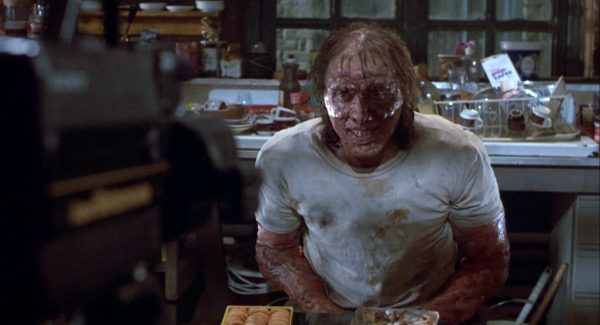
In a career that spans 50 years Jeff Goldblum has embodied a wide array of eccentric characters that make him one of the most instantly recognizable American actors in Hollywood. The actor achieved super stardom in the 1990s for playing the chaotician Dr. Ian Malcolm on Jurassic Park and satellite technician David Levinson in Independence Day, but his breakout role came with none other than, The Fly. Prior to Goldblum being cast as Seth Brundle, John Malkovich was the top choice for the part but the actor declined the opportunity. Mel Brooks’ favorite pick was the dashing Remington Steel star Pierce Brosnan, but he too rejected the role. John Lithgow was offered the part but he found it to be too “grotesque” and refused to join the project. Other actors who were considered to play the eccentric scientist included Michael Keaton and Richard Dreyfuss. Goldblum eventually got cast in the lead because the actor was willing to perform with the extensive prosthetic makeup that would be applied on him.
It took nearly five hours to do the prosthetic makeup application on Jeff Goldblum
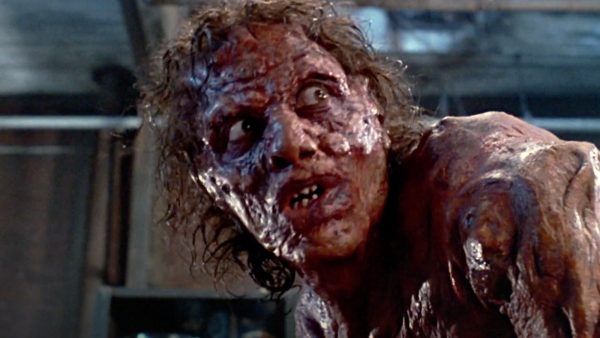
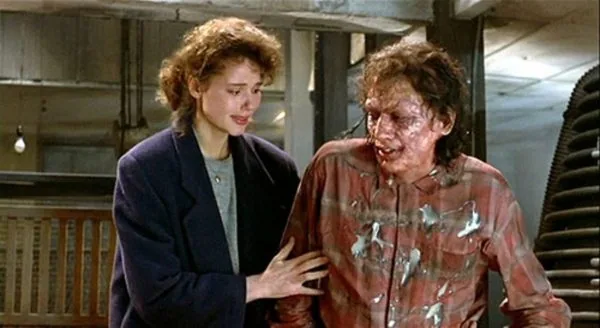
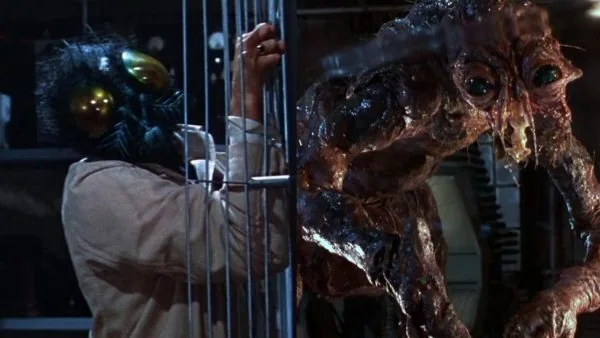
The utterly grotesque visage and the shocking transformation of Jeff Goldblum’s Seth Brundle into the human-fly hybrid was achieved through extensive prosthetic makeup application on the performer and this process was so tedious that it took nearly five hours to get it right. This complicated makeup was designed and executed by Chris Walas and makeup artist Stephan Dupuis, over a period of several weeks. The duo started with the final incarnation of the human-fly hybrid which they named the “Brundlefly” and worked backwards to figure out the different stages of the metamorphosis. This painful transformation was intended by Cronenberg and Walas to be a metaphor for the inevitable process of aging that all humans endure with the passage of time. The groundbreaking work Walas and his team did on The Fly earned them an Academy Award for Best Makeup at the following year’s Oscar awards ceremony.
The casting of Geena Davis had some opposition from the producers
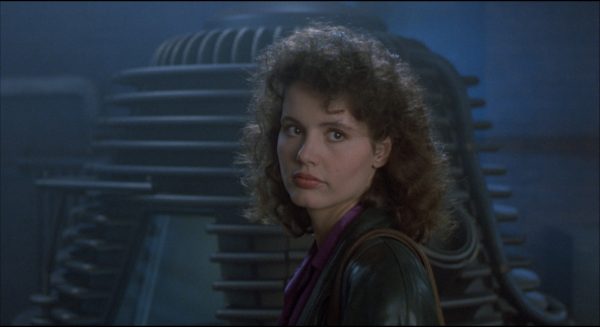
Making her feature film debut with satirical rom-com Tootsie, opposite Dustin Hoffman, Geena Davis has racked up an impressive career over the years with movies like Beetlejuice, Thelma & Louise and The Accidental Tourist for which she won the Academy Award for Best Supporting Actress in 1989. The Fly was one of her earliest acting gigs but the producers were skeptical that she was the right fit, as Davis was also Goldblum’s then real-life girlfriend. Cronenberg was confident that Davis would nail the role but Cornfield made the filmmaker look at other options but none of them were to his liking. Ultimately, Davis was cast as Seth Brundle’s love interest.
Keeping the untrained baboon in check proved to be a daunting task for everyone
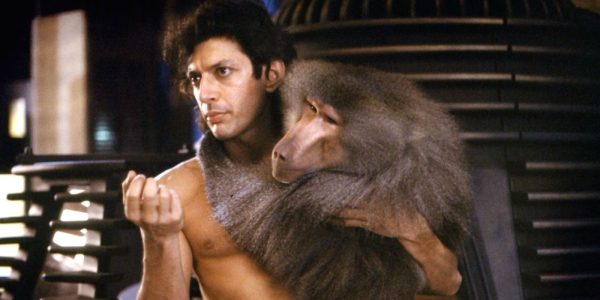
In the story, Seth Brundle uses live test subjects such as cats and baboons to test his teleportation device (telepod). During the shoot a real baboon named Typhoon was used instead of a trained tame animal or utilizing puppetry, and this caused some issues on set for the cast and crew. Many including Cronenberg recalled that the baboon was very much a wild animal due to its lack of training and this made its behavior volatile and difficult to predict. In a special features documentary Visual Effects supervisor Hoyt Yeatman revealed that Typhoon was once startled by the bright, flashing lights in the telepod and broke the door to get out. Only the wrangler and Jeff Goldblum, with his imposing 6’4” physicality were able to keep the primate in check.
Multiple scenes in the original cut were removed prior to the film’s theatrical release

Multiple scenes featured in the original cut of The Fly were cut for the theatrical release due to various reasons. Once filming concluded in early 1986, a rough cut was shown to executives who were thoroughly impressed by what they saw. A test screening of the rough cut was previewed at Toronto’s Uptown Theatre and one of the suggestions by audiences was to cut the sequence where Brundle beats to death the infamous “monkey-cat” hybrid, in order to retain sympathy for Brundle’s character. An alternative ending which featured Veronica dreaming of her unborn child – an infant with butterfly wings – was also cut.
Box-office success, Critical acclaim, awards wins and beyond
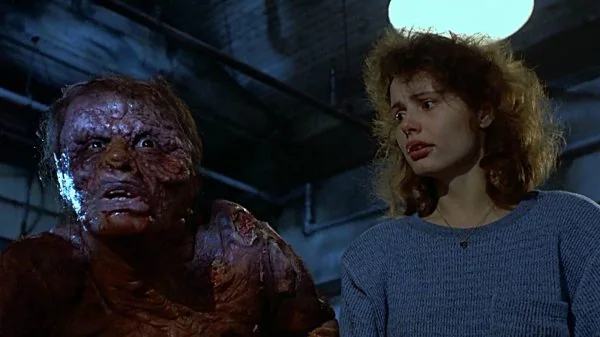
Produced on a budget between $9-15 million The Fly went on to make a more than respectable $60.6 million at the worldwide box-office. The film received critical acclaim at the time of its debut and as of writing holds a solid 93% on review aggregator site Rotten Tomatoes with its critical consensus reading, “David Cronenberg combines his trademark affinity for gore and horror with strongly developed characters, making The Fly a surprisingly affecting tragedy”. The effort also received praise for surpassing the original adaptation and expanding on Langelaan’s short story by making it more of a Shakespearian tragedy with body horror elements. During awards season The Fly nabbed the Academy Award for Best Makeup and Hair for Chris Walas and Stephan Dupuis whilst receiving a nomination in the same category at that year’s BAFTAs. Many film critics and genre fans hoped that Jeff Goldblum would earn a Best Actor Oscar nomination for his incredibly poignant and physically demanding performance in the movie, but alas the actor was robbed of the opportunity. The film’s marketing tagline “Be afraid. Be very afraid” also became so famous that it eventually became ingrained in pop culture and people forgot that the quote originated from this movie.
Due to its critical and commercial success Fox obviously wanted to make a sequel to The Fly, but they had to do so without the involvement of Cronenberg and the lead actors. So, Chris Walas stepped in to Cronenberg’s shoes and did the needful to make The Fly II, but the sequel film received mostly negative reviews and a modest box-office return. Efforts to develop more sequels proved to be an unsuccessful endeavor as financing issues, creative differences and story development hindered their progress. It’s almost as if destiny itself intervened to discourage the making of a threequel because in all honesty, even 40 years later The Fly remains one of David Cronenberg’s greatest efforts and one of the finest sci-fi body horrors in the history of cinema.
What are your thoughts on The Fly? Let us know on our socials @FlickeringMyth…
Hasitha Fernando is a part-time medical practitioner and full-time cinephile. Follow him on Twitter via @DoctorCinephile for regular updates on the world of entertainment.