Robert Kojder chats with Finding Emily director Alicia MacDonald…

Having been proficient across several TV advertisements and short films (including winning festival awards), it was only a matter of time before Alicia MacDonald would break into cinema with her first feature-length film. That movie is the perceptive and thought-provoking romantic comedy Finding Emily, which follows a young sound engineer and aspiring musician, Owen (Spike Fearn), on a quest to reconnect with a girl named Emily (duh) that he clicked with at a party, only to find out that she forgot a digit when putting her number in his phone.
Heading over to the Manchester University she attends, Owen certainly makes one questionable decision after another while trying to locate this Emily. He also meets and teams up with another Emily, a psychology student testing the thesis that romance is outdated and unnecessary, and that it only leads to self-destructive behavior. Essentially, she has the perfect guinea pig for that and also makes questionable choices, occasionally treating him more like an experiment than a person.
It’s an inherently ingenious premise that is played out with lightness and humor, making good on the romance and comedy with a healthy helping of smarts. As such, it was exciting to talk to Alicia MacDonald about the film, ranging from the casting to immersing those stars in their roles, an original version of the screenplay set in Los Angeles, comparisons to John Carney’s work, realizing she also wanted to direct while working on production design for Mike Leigh, and much more. She is chipper, friendly, highly engaging, and simply easy to talk with. There is also a strong sense of confidence in herself and her collaborators, which clearly paid off, as the movie is a terrific romantic comedy (it could end up the best of the year) and well worth seeking out. Enjoy the interview below:

This will probably be my favorite romantic comedy of the year.
Thank you so much! That’s amazing.
You’re welcome. I read that the original script was set in Los Angeles. Did you read that version of the script, or have any part in changing it to Manchester?
No. Do you know what? I didn’t. I really wish I had read the LA version. By the time it came to me, it had already been moved to Manchester. So maybe I’ll read that. Or will that stress me out? [laughs]
Yeah, I wonder what the differences would be, or if there’s any at all.
Probably not that many… well, actually, I’m gonna try and find out. You’ve inspired me!
Spike isn’t a singer. Tell me about the music training you put him through and why you thought he would come out the other side convincing for that aspect of the role.
It’s funny. I just had absolute faith that he would. Now that you mentioned it, I didn’t even have a doubt. He had this amazing guitar teacher and a singing teacher, and he was so dedicated. I would get sent these little videos while he was in rehearsals, and he was so determined that he was gonna be able to do this. And he did. He did it in three weeks or something. We put him through this bootcamp. He nailed it.
Sticking with the music, you have also challenged yourself here with lots of music. There’s singing, sometimes live performances. There’s even a music-video sequence over the end credits. Can you talk about preparing for all of that and what gave you the confidence to pull it off?
Good question! I don’t know. Music has always been a really big part of every job I do. I always have extensive playlists, and I really like the rhythm of editing to specific music that makes you feel sonically held as a viewer. Subconsciously, it does something really interesting to your brain to have a lot of the editing cut in time to the music. We did a lot of that. It’s always been something I’ve enjoyed doing, and I loved the challenge and breadth it offered for this particular film. The live music stuff was really fun. The music video was such a mad challenge that we shot it in half a day, on the last day as a last-ditch attempt to do it. It started raining; everything was falling apart, but it was fun. Music is such a big part of my life. It’s a big part of everyone’s lives, I think. So, I felt a real responsibility to get it right. Strangely, I didn’t feel unconfident in that bit. It’s a bit that I really love.
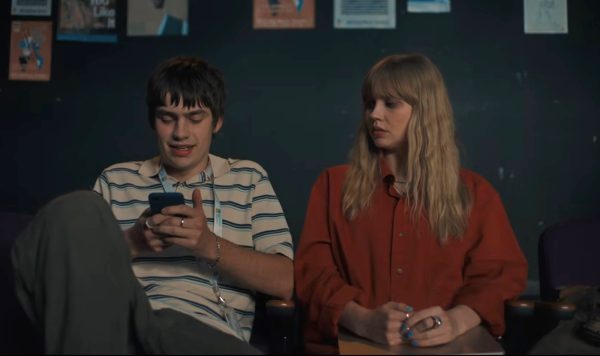
The movie and that aspect also remind me of John Carney films. Have you ever been inspired by him at all?
John Carney, of course. Yeah! Although I actually hadn’t seen Sing Street until after the film.
Oh, that’s my favorite one.
I know! I watched it recently, and I’d never seen it before. A lot of people had said, “Oh, it reminds me of Sing Street. It’s got that kind of tone.” And I watched it and was like, “Yeah, I see that.” It’s just such a gorgeous film. I think his career is so interesting because his music is always such a big part of his films, and I think having done this, music will always be a really big part of my films too. So he’s a real inspiration.
You already have me excited for the next one now.
Thanks!
I also noticed that you worked on production design for Mr. Turner. Did he ever teach you anything that made you feel ready to direct your own movie?
He did, actually! It was when I was working for Mike, because yeah, I did production assistant stuff for him, but I was also his assistant for a brief period, and it was actually working for Mike that I realized I wanted to be a director, because I’d always been writing up until then. I worked in production; I was writing screenplays on the side, but it was working for Mike and watching his process that was really inspiring. I actually had a full-circle moment because, when we were releasing this film in the UK, the publicity team asked me if there were any directors who might be up for doing an interview with me about it. I asked Mike, and we sent in the film, and he did an interview with me, and it was the coolest thing in the whole world because it felt like a full-circle moment. But yeah, he was a huge inspiration. I think particularly the way he works with actors; he’s unafraid of them, and I think that really taught me to be unafraid of them too and to use them. They’re wonderful.
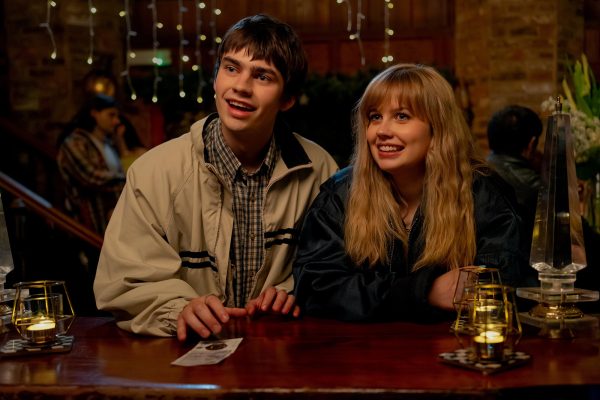
You also work great with actors here. Can you talk about immersing Angourie Rice in both romantic psychology and the psychology of her character?
She’s a voracious reader, and we shared quite a few kinds of psychology books. A lot of Angela Barton and Bell Hooks, and we went to a couple of psychology lectures together in Manchester. It was on Jungian Theory, which I quite liked because I felt like, as opposed to if it was Jung or Freud, if, if who sponsors this movie, I’d say it was Carl Jung, because Jungian Theory is that you could be the doctor who could be impacted by their patient. Freud doesn’t believe that. That was a conversation that we had because she’s the doctor and he’s the patient. She’s definitely impacted by him. Psychology, I’m super interested in, and sometimes I like to think if I hadn’t been a film director, I would’ve been a psychologist. So Angourie and I had lots of chats about it.
Would you say that psychological aspect is what drew you to the script?
I think so. We changed the thesis a couple of times. We sort of couldn’t quite work out exactly what that was. I did a lot of research and tried to work out what that argument would be and how to move through that. It was definitely a pull of a psychology student, for sure.
Can you talk about finding the chemistry between her and Spike Fearn? How did you know they would work well together?
I chemistry-tested them, and I hadn’t done many chemistry tests before, and they always feel like a sort of dark art, because you don’t quite know what you’re looking for. But those two in the same frame, they’re such different people and different actors, and they have a completely different physicality. Seeing that in a two-shot for the first time in the chemistry test told me everything that I needed to know. Then, in terms of the rest of the film, that was the guiding light; if you just put them in a two-shot and you let them play, you sort of get your chemistry. We had a lot of camera movement as well. We sort of always wanted to move with them, and I didn’t do too many close-ups. We do obviously have close-ups, but my favorite thing is just holding the two of them together and watching them interact.
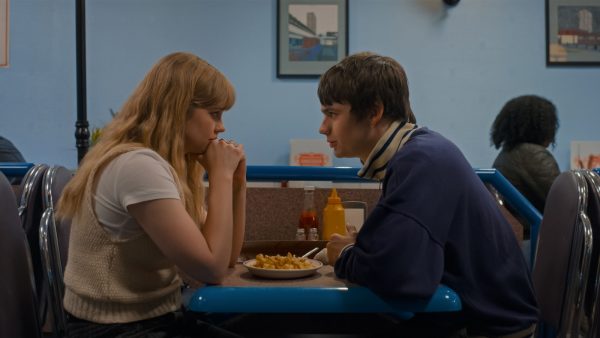
This movie is very funny and romantic, but it’s also a thoughtful movie in how it approaches conversations and criticisms of modern dating. And that’s a tricky needle to thread. Your movie also reminds people that it’s cool to be a hopeless romantic and a yearner, and to make these wild swings and gestures. Can you talk about that aspect as well?
Yeah. That is definitely the film’s message: to be bold and say what you want to say. I’m very existential and really believe in putting yourself out there and whatnot. We’re all so generally worried about what other people think, but time is really precious, and life is really short. So the film definitely, I hope, inspires people to tell the people they love just that. Friends, family, teachers- whoever it is- and also maybe not tell them that you love them, but just call your people. I’ve taken to calling people out of the blue recently, which I know makes me a psychopath, but just have a chat with your friends because I think we get really distracted. This movie is also a sort of love letter to friendship and to the people who support you, whether it’s family, friends, or whoever they are. People are everything. I hope people are inspired to go out into the world and hold their people close.
You also pull off the trick of having characters do some morally questionable things, like Emily giving Owen the emails, for example, yet they remain charming to us. Talk about making that work with your actors.
I’m gonna come in with justice for Emily here, because she does give him the emails, but it’s still his choice to…
That’s true.
Yeah. He has agency here, and it’s his choice to appear on the podcast. She tells him actively, “Don’t do that,” but he does. And he has a lot to learn about, yes, going forward and being open… she does encourage, but he’s a human being in the world, and he has to learn as well.
That’s all true, and keeps them endearing. Thank you so much. I thought the movie was great.
Thank you so much. I’m so thrilled!
Robert Kojder