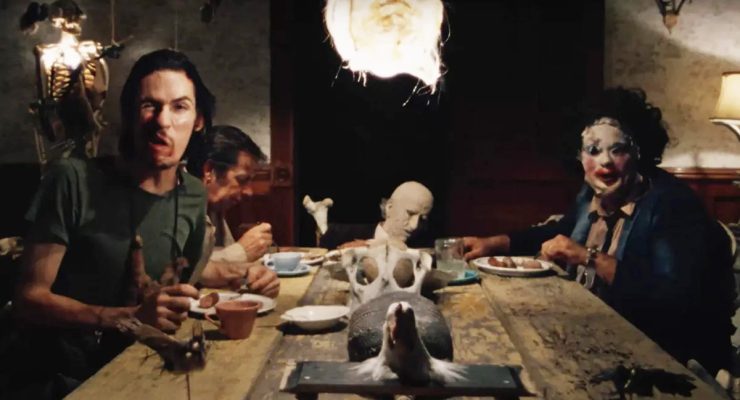
King Lear, 1987.
Directed by Jean-Luc Godard.
Starring Peter Sellars, Burgess Meredith, Molly Ringwald, Norman Mailer and Woody Allen.
SYNOPSIS:
A collaged interpretation of Shakespeare’s King Lear.
Jean-Luc Godard’s King Lear is a memorable experience. If you’re looking for Shakespeare, this is definitely a unique interpretation of the Bards tragedy. Starring Molly Ringwald, Burgess Meredith and an uncredited Woody Allen in the final act, this is an unexpected combination of talents. My imagination runs wild as a fan of The Breakfast Club impulsively catches the latest brat-pack actor, to be met with Ringwald repeating lines and leading a white horse to the water. “Nothing. No thing.” King Lear: A Study. A picture shot in the back. It is possible that this picture was shot in the back by Godard himself, and left writhing around the floor of the studio gasping for a single breath of air. Alternatively, there is considerable praise for his one-of-a-kind interpretation.
Rather than a period-set recreation, Jean-Luc Godard sets his version in the future – after Chernobyl. All of culture has been lost and a descendant of Shakespeare is tasked with recreating each word of the King Lear play. After introducing Norman and Kate Mailer, discussing scripts and roles, an edit turns back the scene and they re-act the sequence. This is the last we see of the father and daughter. We’re next in a café as William Shakespeare Jr. the Fifth (Peter Sellars) observes a different father and daughter, Burgess Meredith and Molly Ringwald playing Don Learo and Cordelia. He pieces the play together as we try to make sense of the multi-layered, collaged movie ourselves.
One of the legends behind the film is in its inception at Cannes Film Festival 1985. Cannon Films’ Menahem Golan and Yoram Globus made a contract on a table-cloth with Jean-Luc Godard, to direct an adaptation of King Lear. Starring Norman Mailer and his daughter with Woody Allen playing The Fool, it was bound to be a success. As Albertine Fox explained in her introduction at the BFI – and what we were to witness on-screen – this was not to happen. The consequence was a $2million film earning barely $16,000 at the box-office. Jean-Luc Godard, a French filmmaker directing a famously English production with American actors, set on the Swiss shore of Lake Geneva. This is a strange film that dances with the language of Shakespeare with editing that only distorts his ideas further.
Cannon Films, the production house who had Chuck Norris leading its major movies, at this particular point was branching out to more art house fare. Foreign films including The Assault and Otello picked up Oscars and Golden Globes. Godard’s King Lear was less celebrated. Though Richard Brody, of The New Yorker, explains how Robert Koehler (Los Angeles Times) and Vincent Canby (New York Times) dismissed the film, he does place it amongst his ‘Greatest Films of All-Time’. He even revives a positive review from Jonathan Rosenbaum (Chicago Reader) who, according to Brody, “recognized its greatness”. Is this a masterpiece or a shocking, two-fingers to the Hollywood system?
With piercing, crowing seagulls and repeated dialogue littering the soundtrack; King Lear plays almost as an installation for an art gallery. As characters walk through forests, men carry nets and guns while Ringwald’s Cordelia leads a horse. Title-cards are replayed and the dreamlike experience of dipping in and out, as Godard toys with the text in such a surreal fashion, could be an alternative viewing experience. Apparently, Mailer’s script was “too linear” for Godard, and his changes (and the implication that the King and Cordelia had a sexual connection) prompted their departure from the project. Rather than plot and characterization, Wheeler Winston Dixon writes how it’s “a series of ruminations on the nature of life, cinema, fame, and canonization”. Casting new starlet Molly Ringwald as the “daughter of cinema”, against Meredith’s “veteran of the Golden Age”, makes this a reflective and self-aware study. Godard even casts himself too, as a crazed man, in ‘Pluggy’.
It is not for the fainthearted. King Lear could never be the starting point for those keen to learn of Godard’s work, but it’s innovative. This integrity can only be complemented and championed – however mixed the outcome may be.
Flickering Myth Rating – Film: ★ ★ ★ / Movie: ★ ★
Simon Columb
The Jean-Luc Godard season continues at the BFI Southbank until mid-March 2016 and, amongst many films they are screening, it includes Goodbye to Language (3D), Film Socialisme and Nouvelle Vague. Click here to buy tickets.
Originally published February 28, 2016. Updated November 29, 2022.