Christian Jimenez reviews Bram Stoker’s Dracula…
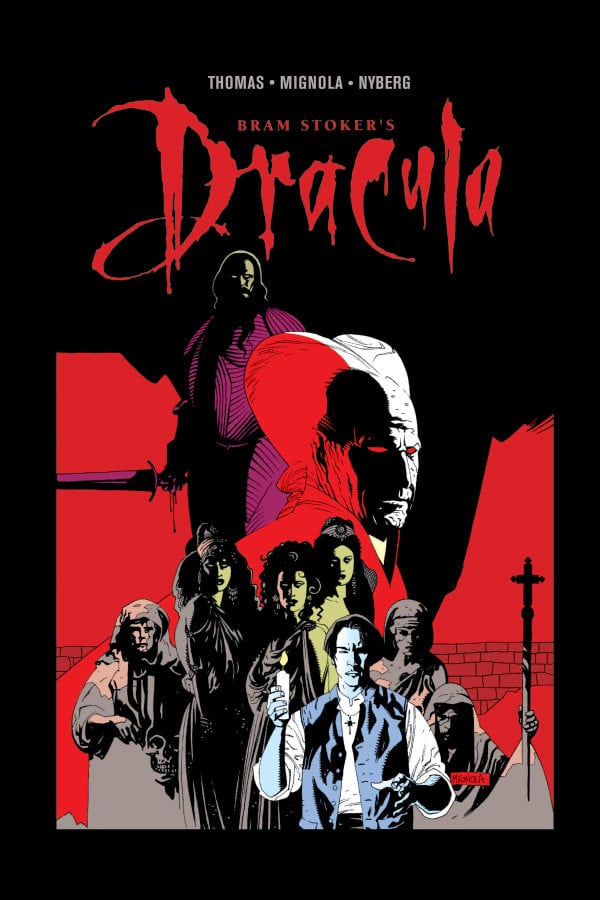
This graphic novel follows the 1992 film adaptation of Francis Ford Coppola of Bram Stoker’s Dracula. Dracula decides to come to London and discovers a woman, Mina, who resembles a lover of his from centuries past. A doctor, Van Helsing, who hunts vampires discovers Dracula’s plant to kidnap Mina and he gathers several men to fight for her life and soul.
IDW has reissued Bram Stoker’s Dracula, originally a four-issue comic book mini-series based on the 1992 Coppola film. Written by Roy Thomas and drawn by Mike Mignola, the graphic novel is apparently a must-have for Mignola fans searching back issues for his interpretation of Dracula. While I was vaguely aware of the comic, I was unaware of how popular it is among Mignola fans and Mignola has endorsed the reprint. The novel collects the four issues and includes sketches of how Mignola laid out several pagesas well as some material not included in the original comics.
Unfortunately, I am not sure why this is such a favored item. All together, the story is fine and the art, generally, excellent. The problem is that the comic is essentially attempting to condense and transpose the film into a comic rather literally. Certain pages try to match how the film was framed. Passages of dialogue go on endlessly and needlessly to match how dialogue was said in the film. The majority of the plot is lifted from the film. Yet as viewers know of the Coppola film, dramatic tension in the film is through stylization and visual effects. While most of the art by Mignola is powerful only a few representations of Dracula can match the film’s power.
For instance, when Dracula transforms into a wolf or werewolf we can see the power of the vampire and its threat. But when Mignola draws other versions – Dracula as a bat or a bunch of rats – the power is drained from the imagery. Another problem is the overreliance on shadows for storytelling. Part of this is simply an issue of labor. Mignola can not detail every object in a room or scene. On the other hand, the entire novel has a distinct gothic feel. While the film has some gothic elements it is not indebted to the gothic entirely but the comic book is.
Indeed it is hard to escape how much Mignola having only to use black and white is constrained greatly. Even on its terms, the use of black and white limits what Mignola can do greatly with a rather generic plot: Dracula having found his (allegedly) long-dead Mina goes to any length to retrieve her and his nemesis Helsing opposes him.
The real attraction is the art and the first few issues are in many ways superior to the film. But much – if not the majority of the comic – when the plot kicks in is essentially life-less. Mignola’s Keanu Reeves is striking close to the film as is his version of Winona Ryder – at least, initially. But the other characters suffer from becoming merely stock versions of characters in other comics from heroes to helpers to villains.
Since this is not Hellboy, Mignola is pretty constrained in what he can do. In his Hellboy books, Mignola is able to plunder endless mythic images but this novel is focused only on late nineteenth century England. In fact, the early scenes of Dracula’s origins are probably the weakest as the art can only barely approximate the play of colors Coppola uses to establish the transformation of Vlad to Impaler into Dracula. Mignola gives his version of Vlad but he can not possibly match the performative energy of Gary Oldman as he flails his arms and passionately damns his soul to become a vampire.
If one is entirely new to the vampire myth, the novel will be dense and dull. A more experienced reader will find the pace rewarding but much of the pausing and delaying is unnecessary. Thomas himself may not be responsible as it could be the novel has to follow the film rather closely. Since the novel is so big there will be many pages to enjoy. Unfortunately, the story is not commensurate to the images Mignola has constructed making for an uneven reading experience.
The adaptation is a powerful and solid horror graphic novel but one hobbled by having to slavishly ape Coppola. Not that Mignola’s art is perfect either. The distinctive style, for the most part, matches the intent to horrify and exciting but sometimes Mignola’s interpretation is inferior to Coppola’s filming. For instance, in an early scene, the three wives of Dracula look, initially, erotic and dangerous. But a more wide-shot of them drawn in a strongly Mignola style makes them look fat, ugly, and static. Their lips are overly exaggerated and their staring at the reader is off-putting. In the film, the wives move at lightning speed and we only catch glimpses of their naked bodies as Dracula fends them off.
Using some of the Hellboy technique pays dividends with regard to the animals and insect – the spiders and wolves look especially well drawn. But the human characters look flatter and more static than they should. When, near the end, Helsing chases after Dracula, the chase lacks any real kinetic punch to match the film. It is also extremely difficult to notice (or care) about the power of the sun when so many scenes are drenched in the dark both literally and metaphorically. While Mignola does try to depict the passage of time, again, there is such a sharp contrast to Coppola able to simply shoot some simple shots of sun-drenched London to provide a visual contrast between the daylight and the night when Dracula become a wolf.
To be sure, ultimately, these are minor quibbles. The novel is eminently readable and Mignola’s art is as sharp as ever. But a stern warning is needed that this is Mignola in mid-career moving away from his superhero work and just before he got into Hellboy. Someone expecting Hellboy or proto-Hellboy will be disappointed. Still, as an adaptation this is a solid if tedious piece and will probably rank as less visceral and enjoyable to the film. An overall good comic but one too constrained by being a literal translation.
Rating: 7/10
Christian Jimenez